Jia Lissa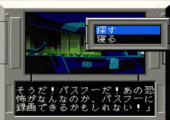
Historical Context and Development Background
The early 1990s represented a transitional period for the video game industry, as hardware manufacturers moved away from the storage limitations of silicon cartridges toward the expansive capacity of compact discs. The Sega Mega CD, an add-on for the Mega Drive console, was marketed on its ability to provide "Full Motion Video" (FMV) and high-fidelity CD audio. During this time, the "Media Mix" strategy—where a single intellectual property was simultaneously developed across manga, anime, and video games—became the standard for Japanese production committees.
Detonator Orgun was a prime candidate for this treatment. The OVA was produced by AIC and Artmic, studios known for high-quality sci-fi productions like Bubblegum Crisis. The game’s publisher, Hot-B, was a mid-tier veteran of the industry, having established a reputation with titles such as Steel Empire and the Inindo series. By securing the rights to Detonator Orgun, Hot-B aimed to capitalize on the cult following of Masami Ōbari’s work, positioning the game as a premier "interactive anime" experience.
Narrative Structure and Adaptation
The plot of the game closely mirrors the events of the first two episodes of the OVA, focusing on the protagonist, Tomoru Shindo, a university student living in the futuristic metropolis of City No. 5 in the year 2292. Tomoru’s mundane life is disrupted by recurring dreams of a mechanized warrior and a distant conflict. These visions manifest into reality when he is telepathically contacted by Orgun, a "Detonator" or elite scout from the hostile alien race known as the Evoluders.
The Evoluders are a race of cyborgs who have discarded their biological forms to become living weapons, traveling across the galaxy to assimilate or destroy other civilizations. Orgun, having rediscovered his humanity, deserts his kind and flees to Earth, eventually merging his consciousness and combat data with Tomoru. This union allows Tomoru to pilot the Orgun armor to defend Earth against the impending Evoluder invasion, led by the ruthless commander MH.
The game functions as a visual novel, utilizing the Mega CD’s storage to house extensive dialogue branches and animated sequences. While the anime was noted for its "slow burn" pacing, the game leans even further into this narrative style, prioritizing world-building and character interaction over the visceral combat scenes that defined the source material.
Gameplay Mechanics and Interface
Unlike many contemporary mecha-themed games that opted for side-scrolling action or tactical simulation, Detonator Orgun is a traditional graphic adventure. The interface is entirely menu-driven, requiring players to navigate through various scenes using a set of standard commands: "Look" (Miru), "Think" (Kangaeru), "Talk" (Hanasu), and "Move" (Ido).
This mechanical choice aligns the game with other seminal Mega CD titles like Hideo Kojima’s Snatcher or The Space Adventure. The gameplay loop involves:
- Observation: Examining the environment to trigger specific flags or clues.
- Dialogue Management: Conversing with NPCs, such as the scientist Michi Kanzaki or members of the Earth Defense Force (EDF), to advance the plot.
- Decision Making: Selecting specific actions during critical story beats, though many of these choices lead to the same narrative outcome, reflecting the game’s linear nature.
The lack of traditional action sequences was a point of contention upon release. Players expecting the high-octane "Super Robot" battles seen in the OVA were instead met with a methodical investigation game. This design philosophy emphasizes the "Adventure" (ADV) genre’s dominance in the Japanese PC and console markets of the early 90s, where storytelling often took precedence over mechanical complexity.
Technical Execution: Visuals and Audio
The technical performance of Detonator Orgun is a study in the limitations of early 1990s CD-ROM hardware. The game features numerous FMV cutscenes ripped directly from the OVA. While the inclusion of these scenes was a major selling point, the Mega CD’s hardware constraints resulted in heavy compression. The video playback is characterized by a limited color palette (often appearing grainy or "dithered") and a reduced frame rate, which was a common compromise for the Cinepak and TruVideo codecs of the time.
The audio presentation is similarly inconsistent. The game’s soundtrack was composed by Kouji Hayama, a celebrated figure in the industry known for his energetic work on the Cho Aniki series. The opening cinematic utilizes Red Book CD audio, providing a high-fidelity experience that includes professional voice acting from the original anime cast. However, as the game progresses, the reliance on CD audio diminishes. Much of the in-game background music reverts to the Mega Drive’s internal YM2612 FM synthesis chip. While the chiptune compositions are technically competent, the shift from orchestral-quality CD tracks to 16-bit synth was often viewed as a regression by contemporary critics.
Furthermore, while the game is "fully voiced" in certain key sequences, many of the standard dialogue scenes rely on text alone or low-sample-rate audio that lacks the clarity of the intro. This inconsistency suggests a rushed production cycle or a failure to optimize the disc’s 600MB storage capacity effectively.
Chronology of Release and Regional Availability
The release of Detonator Orgun occurred during a pivotal year for Sega:
- December 1991: The Mega CD launches in Japan.
- July 1992: Detonator Orgun is released in Japan (Price: ¥7,800).
- October 1992: The Sega CD launches in North America.
- 1993: The Mega CD launches in Europe.
Despite the global rollout of the hardware, Detonator Orgun never received an official localization. The heavy reliance on Japanese text and the niche status of the OVA in Western markets made a North American or European release financially risky. At the time, the Western market for "interactive movies" was focused on titles like Night Trap and Sewer Shark, which utilized live-action footage rather than anime-style illustrations. Consequently, the game remained a "grey market" import for dedicated collectors in the West, often requiring a Mega Key or hardware modification to bypass regional lockout.
Critical Analysis and Industry Impact
From a journalistic perspective, Detonator Orgun serves as a case study for the "quick-turnaround" licensed games of the 16-bit era. While it succeeded in providing a faithful interactive window into the world of Tomoru Shindo, it struggled to justify its existence as a standalone game.
The primary criticism leveled against the title involves its "production value-to-format" ratio. CD-ROM games were expected to offer experiences impossible on cartridges. By reverting to internal sound chips and offering highly compressed video, Detonator Orgun failed to utilize the Mega CD’s potential as effectively as titles like Lunar: The Silver Star or Silpheed.
However, the game’s contribution to the cyberpunk aesthetic on consoles cannot be ignored. The environmental art effectively captures the neon-lit, rain-slicked streets and sterile laboratory settings of the OVA. For fans of Masami Ōbari’s "Obari-ism"—characterized by dynamic posing and muscular mechanical forms—the game offered a way to linger in that visual world longer than the 90-minute runtime of the anime allowed.
Broader Implications and Legacy
Today, Detonator Orgun is viewed through the lens of retrogaming nostalgia and preservation. It represents a specific moment in time when the industry was experimenting with how to merge cinema and gaming. The "Digital Comic" format seen here would eventually evolve into the modern Visual Novel genre, which remains a staple of the Japanese gaming industry on platforms like the Nintendo Switch and PlayStation 5.
The game also highlights the difficulties of early software localization. The barrier for non-Japanese speakers remains high, as no official or fan-made English translation patch has been widely adopted for the Mega CD version. For modern enthusiasts, the game is often experienced through "long-play" videos on platforms like YouTube, which allow viewers to appreciate the art and music without the frustration of navigating complex Japanese menus.
Ultimately, Detonator Orgun stands as a testament to the ambitious, if flawed, spirit of the Mega CD era. It was a product of its time—a period defined by the excitement of new technology and the growing pains of figuring out how to use it. While it may not be remembered as a masterpiece of gameplay, its existence reflects the deep synergy between the anime and gaming industries that continues to define Japanese pop culture today.