Farhan hamdan
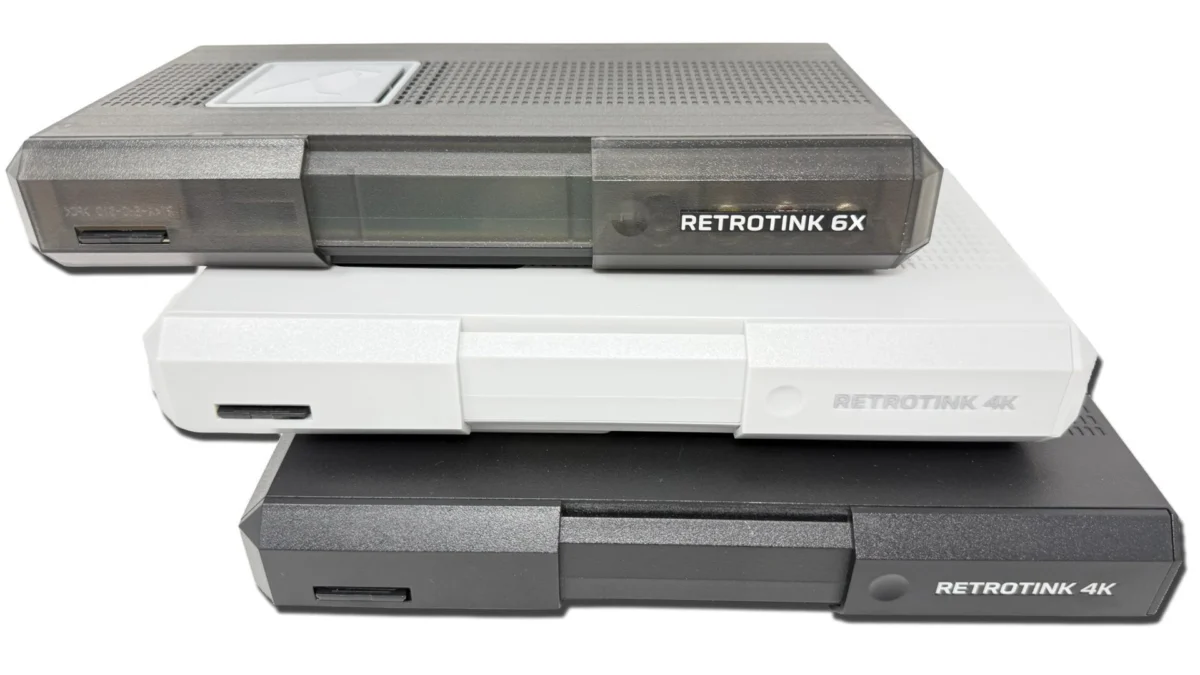
Hardware developer Mike Chi has released a comprehensive suite of firmware updates spanning several flagship devices in the RetroTINK lineup, most notably introducing stable Lumacode support, optimization patches, and crucial bug fixes for the 6x CE, 4K CE, and 4K Pro models. Alongside general system stability enhancements, the latest experimental firmware package rolls out advanced, hardware-specific features tailored exclusively for the high-end RetroTINK-4K Pro. These additions include a second-generation Inverse Telecine (IVTC) engine and a heavily revamped Black Frame Insertion (BFI) CRT Beam Emulation suite designed to bring unprecedented motion clarity and visual authenticity to legacy video game hardware and archival video formats.
The latest experimental builds are currently available for public deployment via the official RetroTINK firmware repository, continuing a rigorous cycle of post-launch software support that has defined the brand’s premium upscaling hardware ecosystem.
Streamlined Lumacode Integration and Setup Procedures
A primary focus of the recent firmware iteration is the complete overhaul and simplification of the Lumacode user experience. Lumacode is an advanced modification standard utilized by retro gaming enthusiasts to extract pure, uncompressed RGB digital video signals from older consoles—such as the Nintendo Entertainment System and the Sega Master System—via custom multi-pin cabling solutions.
Under the previous system architecture, integrating Lumacode sources into a RetroTINK setup required cumbersome profile management and manual configuration adjustments. With the new firmware, users are directed to clear legacy Lumacode directories from their SD storage cards and replace them with a simplified, updated folder structure packaged with the version 1.87.3 release.
Once the directory structure is updated and the system is flashed with the latest experimental firmware, the configuration workflow is drastically streamlined. Users simply connect their modified legacy console to any designated Green input channel on the RetroTINK hardware, select the corresponding source through the on-screen display menu, and navigate to the Advanced Settings followed by Sample Rate Detection. From this submenu, operators can enable the native Lumacode parameter and execute a preset loading function tailored directly to their specific hardware platform.
Furthermore, the firmware automates adjustments that previously required manual calibration. For instance, legacy platforms like the Sega Master System historically demanded manual Automatic Gain Control (AGC) configuration and pre-gain adjustments within the Analog-to-Digital Converter (ADC) menu to achieve proper color depth and sync lock. The new firmware automates these handshake protocols, ensuring that incoming signals are mapped accurately without requiring users to build specialized profiles from scratch.
Next-Generation Inverse Telecine Engine for Enhanced 24p and 30fps Playback
For users leveraging the RetroTINK-4K Pro for mixed media consumption, the implementation of a second-generation Inverse Telecine (IVTC) engine represents a major technological leap. Telecine is the process of converting film—typically shot at 24 frames per second—into interlaced video formats such as 480i for broadcast or home video distribution through a cadence of alternating frames. Inverse telecine reverses this process, reconstructing the original progressive frames to eliminate combing artifacts and motion judder.
The updated second-generation engine is engineered to lock onto interlaced sources with significantly higher precision. This development benefits not only cinephiles consuming standard-definition 24p video content through the upscaler, but also retro gaming enthusiasts playing specific 480i titles locked internally at 30 frames per second.
According to development demonstrations utilizing demanding software cutscenes—such as those found in Square Enix’s Final Fantasy X—the new IVTC algorithms dramatically reduce visual artifacts and demonstrate vastly superior adaptability when handling dynamic, fluctuating framerates. Additionally, mixed-content broadcasts that combine 480i video footage with 30p graphical overlays, special effects, or credit sequences will now render with cleaner cadence locks, closely mimicking professional broadcast standards.
Revamped CRT Beam Emulation and Black Frame Insertion Options
Perhaps the most visually striking addition in the latest firmware update is the completely redesigned CRT Beam Emulation Black Frame Insertion (BFI) feature set available exclusively on the 4K Pro hardware tier. Cathode-Ray Tube (CRT) displays render images through a continuous, sweeping electron beam that illuminates phosphors momentarily before they decay. This inherent sample-and-hold characteristic of vintage displays creates natural motion blur that the human eye perceives as smooth fluid movement, whereas modern sample-and-hold flat-panel displays often suffer from perceived motion blur and pixel persistence issues.

To bridge this gap, RetroTINK’s revamped BFI suite introduces three primary, highly granular customization parameters: Motion Clarity, Beam Steepness, and Multi-Firmware Glow.
Motion Clarity allows users to scale an index ranging from 0 to 12. This parameter dictates the precise ratio of black insertion intervals injected between active frames. By increasing the Motion Clarity value, users can systematically eliminate sample-and-hold motion smear, resulting in crystal-clear moving images that rival vintage glass displays. However, this clarity comes at a direct cost to overall peak luminance, requiring users to balance the setting against their display’s maximum HDR brightness capabilities.
Beam Steepness addresses the temporal blending behavior between sequential frames. The default setting, designated as "smooth," maintains a high degree of frame-to-frame blending designed to eliminate unwanted screen tearing and maintain luminance continuity. As operators increase the steepness parameter, temporal blending is progressively reduced, culminating in a "hard" setting that completely severs any visual overlap between consecutive frames.
Finally, the Multi-Frame Glow feature attempts to replicate the lingering luminescence characteristic of vintage cathode phosphors by blending sequential frames with a controlled digital afterglow. Development notes emphasize that the subjective visual performance of these CRT emulation tools is entirely dependent on the host display’s native refresh rate, peak HDR performance, and individual user physiology. Consequently, these settings are optimized for deployment within HDR-enabled display pipelines to preserve dynamic range despite the introduction of black insertion intervals.
Chronology of the RetroTINK-4K Ecosystem and Firmware Development Cycle
The release of these experimental features continues a rapid, community-driven development cadence that has characterized the RetroTINK product line since the commercial rollout of the RetroTINK-4K in late 2023. Designed by Mike Chi under the RetroTINK LLC banner, the hardware series has established itself as the gold standard for high-end video processing, digital upscaling, and scanline simulation in the retro gaming community.
Initial hardware iterations focused on establishing baseline 4K scaling, robust motion-adaptive deinterlacing, and HDMI output compatibility for analog video standards including Composite, S-Video, Component, and RGB/SCART. As the hardware manufacturing matured, subsequent firmware updates shifted toward advanced architectural features, including proprietary HDR tone-mapping pipelines, custom CRT mask overlays, and specialized protocol decryption such as Lumacode.
The transition from version 1.94.0 through the intermediate incremental patches leading up to the current 1.99.1 experimental builds demonstrates an ongoing commitment to maximizing the computational potential of the hardware’s internal FPGA architecture. By decoupling experimental features from stable releases, the development team allows early adopters to stress-test complex rendering algorithms—such as advanced BFI and dynamic IVTC—before they are permanently integrated into the core stable firmware branches.
Technical Analysis and Broader Industry Implications
The continuous refinement of high-end video processors like the RetroTINK-4K Pro highlights a broader paradigm shift in archival gaming technology and digital preservation. As original CRT displays age, suffer from component degradation, and become increasingly scarce, the burden of authentic visual presentation has shifted entirely to software-driven emulation and external hardware scaling solutions.
Traditional frame upscalers historically focused strictly on spatial resolution scaling—multiplying standard-definition pixels to fit modern 4K panels via nearest-neighbor or basic bilinear filtering. While effective for sharpening geometry, these methods fail to replicate the temporal dynamics of legacy display technology, often resulting in unnatural motion judder, exaggerated pixel grid harshness, and missing phosphor interaction.
By implementing sophisticated temporal processing features such as second-generation IVTC and customizable beam emulation BFI, firmware suites like version 1.99.1 address the temporal domain of video reproduction. The ability to manipulate frame cadence, black insertion intervals, and phosphor persistence at a hardware level bridges the experiential gap between modern display panels and vintage analog display hardware.
For high-end home theaters, retro gaming broadcast setups, and digital preservation archives, these tools offer an unprecedented degree of calibration control. While the complexity of configuring advanced parameters like Lumacode presets and ADC pre-gain thresholds demands a technical baseline from the end user, the resultant visual fidelity reaffirms the position of hardware upscaling at the bleeding edge of interactive media preservation.
Users wishing to test the latest experimental features can access the installation packages directly via the official RetroTINK experimental firmware portal, with community support channels actively tracking user feedback across various display manufacturers and hardware configurations.