Farhan hamdan
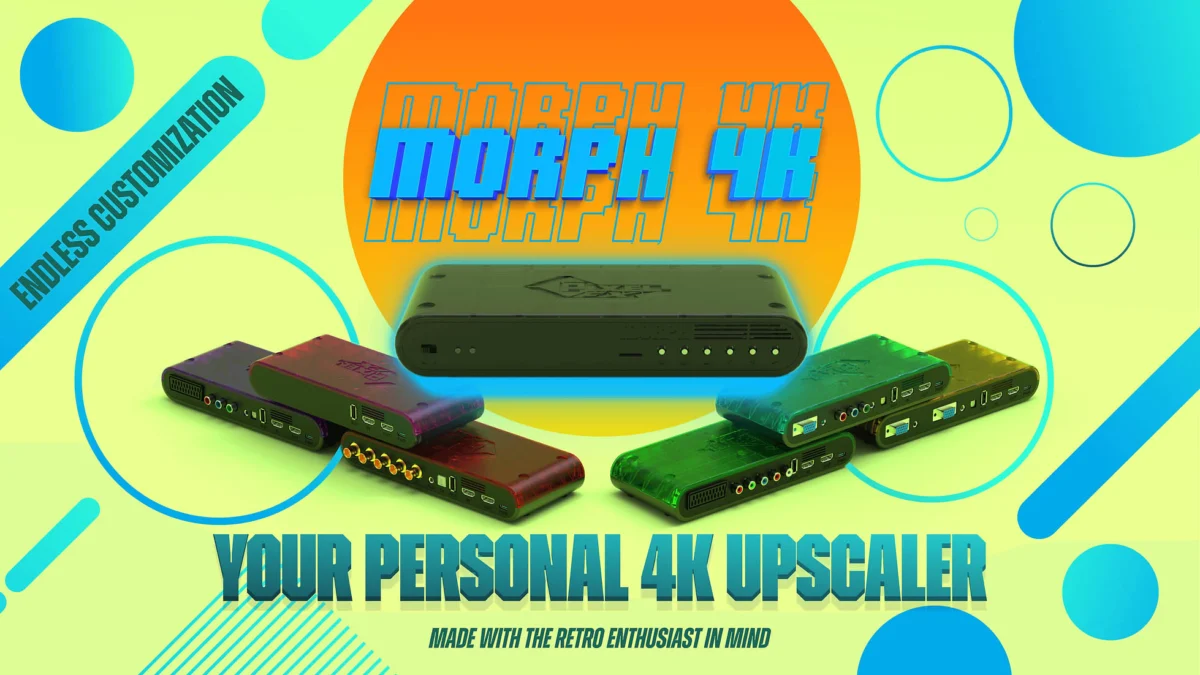
The landscape of retro video game preservation and display technology has taken another significant leap forward as hardware developer PixelFX has officially released a public beta of its comprehensive v4 firmware for the Morph 4K upscaler. Representing a fundamental rewrite of the device’s core processing software, the v4 update moves beyond traditional scaling algorithms to simulate the physical behavior and signal processing characteristics of cathode-ray tube (CRT) displays. This ambitious approach aims to bridge the visual gap between vintage hardware and modern high-resolution digital panels, offering enthusiasts an unprecedented degree of authentic visual reproduction.
Background Context and Evolution of Retro Scalers
For decades, retro gaming enthusiasts relied on standard definition CRT televisions to experience classic consoles as their developers originally intended. CRTs possess unique optical and electronic traits—such as phosphor persistence, scanlines, mask grids, and analog signal degradation—that inherently blend pixels, soften high-contrast edges, and mask imperfections in early digital art.
As vintage televisions age, become scarcer, and occupy significant physical space, the retro gaming community has increasingly turned to digital line doublers and upscalers like the OSSC, Framemeister, RetroTINK series, and PixelFX’s own product ecosystem. While these devices successfully adapt analog signals for HDMI-compatible flat-panel displays, early iterations focused primarily on pixel-perfect sharpness rather than replicating the organic warmth and physics of CRT glass. PixelFX’s v4 firmware represents a philosophical shift in the industry, treating upscaling not merely as a resolution conversion, but as a comprehensive simulation of vintage display physics.

Core Architectural Overhaul in Firmware v4
The v4 update is a ground-up reconstruction of the Morph 4K’s software stack. Rather than applying superficial overlays or static filters, the new firmware processes incoming video signals with a deep algorithmic focus on how actual CRT hardware interacts with electron beams, color bleeding, and shadow masks.
Among the standout features introduced in the beta is the capability to simulate Composite video and RF (Radio Frequency) signals regardless of whether the incoming source is pristine RGB or digital HDMI. By mathematically modeling the signal degradation, artifacting, and chroma-subsampling inherent to lower-quality vintage connections, users can accurately recreate the specific visual aesthetic of 1980s and 1990s home television sets.
Furthermore, the update introduces a heavily revamped deinterlacing engine equipped with a specialized smoothing algorithm designed to eliminate jitter without introducing excessive blur. A new Super-xBR scaling mode has also been integrated, holding significant potential for cleaning up and enhancing early 3D polygon graphics found on fifth-generation consoles like the PlayStation and Sega Saturn. For enthusiasts of vertical arcade cabinets and console shoot-’em-ups, the firmware adds native signal rotation capabilities for TATE mode. Additionally, an Inverse Telecine (IVTC) "film mode" has been implemented to handle 3:2 pulldown content efficiently, optimizing performance for 24p DVD playback as well as 480i video game software locked natively to 30 frames per second.
Installation Procedure and Availability
PixelFX has streamlined the deployment process for beta participants utilizing the Morph 4K hardware ecosystem. Users can access the v4 beta directly through the device’s user interface by establishing an internet connection via Wi-Fi, navigating to the System, Firmware, and Update Channel settings, and changing the update channel from the stable release track to the "preview" channel. The system then downloads and executes the installation package automatically, with built-in provisions allowing users to revert to the main stable branch at any time.

Alongside the software rollout, PixelFX has announced that pre-orders for the next manufacturing batch of the Morph 4K are currently open, with shipments anticipated for early next year. Meanwhile, the smaller-footprint Morph 2K remains fully in stock and ready for immediate dispatch. The company has confirmed that the sophisticated architectural advancements engineered for the Morph 4K v4 firmware will eventually be ported to the Morph 2K, as well as PixelFX’s internal RetroGEM console modification products.
Industry Implications and Market Impact
The release of the Morph 4K v4 firmware beta underscores a growing maturity within the high-end retro gaming accessories market. As consumers increasingly demand plug-and-play fidelity that honors the artistic intent of classic software developers, hardware manufacturers are investing heavily in advanced digital signal processing (DSP) and field-programmable gate array (FPGA) capabilities.
By shifting the focus from mere pixel scaling to the emulation of display physics, PixelFX is positioning its hardware line at the intersection of preservation technology and modern display engineering. While purists continue to debate the merits of emulation versus native analog hardware, advancements of this magnitude demonstrate that digital signal processing can achieve a remarkably faithful approximation of the classic CRT experience on modern 4K OLED and LED displays. As the beta period progresses and user feedback is integrated into subsequent builds, the broader retro gaming community will closely monitor how these physics-based simulation techniques influence the future design standards of video scalers industry-wide.