 Indra Gunadi
The Technical Context of the Sega 32X
To understand the significance of Asphalt Vendetta, one must contextualize the hardware for which it was built. The Sega 32X, released in November 1994, was an ambitious yet polarizing peripheral designed to extend the lifespan of the Sega Genesis (Mega Drive) by providing a 32-bit processing bridge toward the Sega Saturn. Featuring two Hitachi SH-2 processors, the unit was marketed as a "next-generation" upgrade, yet it struggled with a fragmented library, internal competition from the Saturn, and a reputation for being a "stop-gap" solution.
Throughout its brief market life, the 32X was often criticized for a lack of software that fully utilized its dual-processor architecture. Most titles were ports of existing games that failed to leverage the hardware’s 32,768-color palette or its ability to handle more complex sprite manipulation and polygon rendering. In the decades since its commercial failure, the homebrew scene has attempted to rectify this historical deficit. Asphalt Vendetta serves as a prime example of this post-market evolution, demonstrating that with modern cross-compilers and enhanced development tools, the 32X is capable of supporting fast-paced, multi-asset gameplay that its original developers often struggled to implement.
Gameplay Mechanics and Design Specifications
Asphalt Vendetta is fundamentally categorized as a vehicular-combat title, a genre that saw its peak popularity in the late 1990s with franchises such as Twisted Metal and Vigilante 8. The game design centers on a high-octane feedback loop of movement, tactical positioning, and offensive engagement. According to the release documentation provided by the developer, the game features a robust core set of assets:
- Vehicle Roster: Players can select from 12 distinct vehicles, each featuring unique handling characteristics and durability stats.
- Armament System: The game includes 9 customizable weapons, ranging from rapid-fire ballistic projectiles to high-damage explosives.
- Arena Selection: Combat takes place across 3 specialized arenas designed to encourage verticality and strategic maneuvering.
- Controller Integration: Recognizing the complexity of modern inputs, Dmar3000 has implemented native support for the Sega six-button control pad, ensuring that players can map weapon switching and defensive maneuvers effectively.
The decision to include six-button support is particularly noteworthy. While the standard three-button controller was the baseline for the Genesis, the six-button controller—originally released for games like Street Fighter II: Special Champion Edition—has become the de facto standard for modern homebrew developers seeking to provide more fluid gameplay experiences on 16-bit and 32-bit platforms.
The Role of AI in Modern Homebrew Development
One of the most notable aspects of Asphalt Vendetta is the explicit disclosure that artificial intelligence was employed during its development. This reflects a growing trend in the software engineering world, where AI-assisted tools are increasingly used to accelerate the writing of boilerplate code, optimize algorithms, and debug complex subroutines.
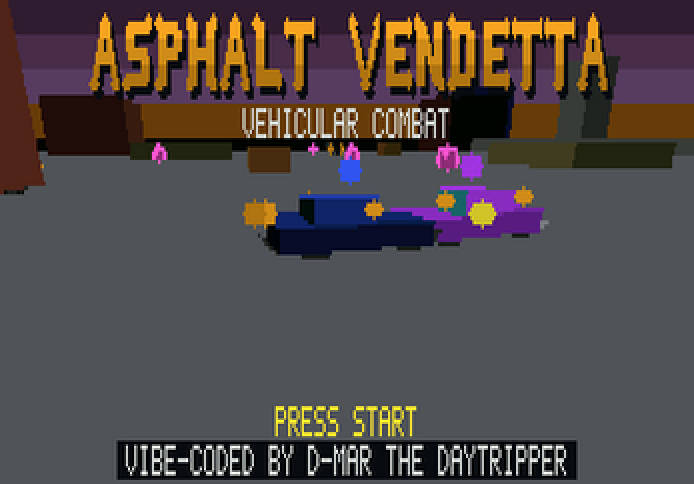
In the context of the Sega 32X, where documentation for the proprietary Hitachi processors is often obscure and technical support is non-existent, AI agents can serve as a vital resource for developers. By parsing legacy hardware manuals and providing optimized C or assembly-language snippets, these tools allow independent developers to overcome the "entry barrier" that previously prevented all but the most seasoned assembly coders from releasing 32X content. This integration of AI does not necessarily diminish the human creative contribution; rather, it allows the creator to focus on game balance, art style, and level design, while the machine handles the intricacies of memory management and hardware-specific instruction sets.
Chronology of the Project
The development cycle for Asphalt Vendetta followed a trajectory common among long-term homebrew projects. While the release date is marked as October 2026, the project is the culmination of months of iterative testing.
- Early 2026: Initial conceptualization of a vehicular combat engine for the 32X, focusing on the limitation of the hardware’s frame buffer.
- Mid-2026: Integration of AI-assisted coding modules to handle the game’s physics engine and collision detection.
- August 2026: Beta testing phase, involving community members from the PDROMS and Sega 32X enthusiast forums.
- October 10, 2026: Official public release, accompanied by technical documentation and video demonstrations showcasing the game’s performance.
This timeline reflects the maturation of the retro-gaming community, which has moved from simple sprite-swaps and ROM hacks to complex, original software development.
Broader Implications for the Retro Gaming Market
The release of Asphalt Vendetta raises important questions regarding the future of legacy gaming. As the primary user base for original hardware continues to age, the demand for "new" content for "old" machines has transitioned from a niche hobby into a sustained market. There is now a clear ecosystem of developers, physical cartridge manufacturers, and digital archival projects that sustain interest in the Sega 32X.
Furthermore, the successful deployment of this game suggests that the limitations of 32-bit hardware are as much a product of past software development constraints as they are physical hardware limitations. With modern PC-based development environments and AI assistance, the "ceiling" of what the 32X can achieve has been raised. Future releases may see even higher fidelity, as developers find ways to squeeze performance out of the dual-SH2 architecture that would have been considered impossible in 1995.
Industry and Community Reception
While official statements from legacy hardware developers are rare, the broader gaming community has responded with enthusiasm. Forums dedicated to the preservation of Sega’s legacy have praised Dmar3000 for creating a cohesive experience that feels native to the 32X while avoiding the "stutter" common in early 3D efforts.

The inclusion of AI-assisted code has also sparked a debate within the community regarding the ethics and future of "assisted" retro development. Proponents argue that the use of these tools is the only way to keep the homebrew scene alive, as it allows solo developers to complete projects that would otherwise require large, funded teams. Conversely, purists express concerns about the loss of manual assembly-language craftsmanship. However, the prevailing view is one of pragmatism: the primary goal is the expansion of the game library, and the methods used to achieve that goal are secondary to the final user experience.
Technical Analysis of Performance
Asphalt Vendetta’s performance on the 32X hardware is a significant point of interest for technical analysts. The 32X’s architecture required careful synchronization between the Genesis’s Motorola 68000 processor and the 32X’s dual Hitachi SH-2s. Mismanagement of this handshaking often led to the "tearing" or frame-rate drops that plagued official releases.
Dmar3000’s implementation appears to prioritize consistent frame timing over maximum visual fidelity, a choice that is essential for a fast-paced combat game. By limiting the arena complexity while maximizing the efficiency of the sprite-rendering engine, the game avoids the common pitfalls of 32X software. The use of AI to optimize the game loop likely contributed to this stability, as the code can identify and eliminate redundant calculations that would otherwise consume precious cycles on the 32-bit CPUs.
Conclusion: A New Chapter for the Sega 32X
The arrival of Asphalt Vendetta serves as a reminder that the lifespan of a console is not dictated solely by its manufacturer’s support cycle, but by the ongoing passion of its user base. By bridging the gap between 1990s hardware and 2020s development methodologies, Dmar3000 has contributed to a growing library of software that redefines the 32X’s legacy.
As we look toward the future, it is highly probable that we will see an increase in AI-assisted homebrew projects. This will not only continue to enrich the libraries of defunct systems like the 32X but will also serve as a vital case study in how human-AI collaboration can preserve the technical spirit of vintage computing. Asphalt Vendetta stands as a definitive example of this transition—a modern game for a classic machine, ensuring that the Sega 32X remains a relevant platform for enthusiasts and developers alike. Whether or not the game becomes a staple of the homebrew scene remains to be seen, but its technical achievements and its place in the timeline of independent development are already well-established.