 Jia Lissa
For over three decades, Capcom’s 1987 arcade masterpiece Black Tiger remained an elusive title for console enthusiasts. Despite its critical success and popularity in coin-operated parlors, the game never received an official home port on 8-bit or 16-bit systems during its prime commercial window. That void is finally being filled by indie developer rester159, who has spearheaded a comprehensive recreation of the title for the Sega Genesis, utilizing the Sega Genesis Development Kit (SGDK). This project represents more than a simple emulation; it is a ground-up reconstruction that adapts the game’s core mechanics to the specific architectural nuances of the Motorola 68000-based hardware.
The Historical Context of Arcade Conversions
During the late 1980s and early 1990s, the "arcade-to-home" conversion market was a cornerstone of the video game industry. Capcom, in particular, saw significant success with titles such as Forgotten Worlds and Ghouls ‘N Ghosts when they were adapted for the Sega Genesis. These ports were highly anticipated because they brought the fidelity of expensive arcade hardware into the domestic living room.
However, Black Tiger—a challenging action-adventure title characterized by its dark fantasy aesthetic and platforming complexity—was notably absent from these lineups. While it saw releases on various home computer formats of the era, the lack of a console port left a permanent gap in the library of the Sega Genesis, which was widely considered the most capable platform for hosting such arcade-perfect experiences. The arrival of this new version serves as a technical correction to a historical oversight, bringing a lost classic to the platform where it arguably would have thrived during its peak popularity.
Technical Architecture and Hardware Adaptation
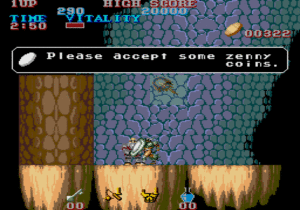
Developing for the Sega Genesis requires navigating a specific set of hardware constraints, most notably the 256×224 pixel display area and the limited number of simultaneous color registers. Unlike a direct software emulation, which would run the original game code inside a virtual environment, rester159 has authored native 68000 assembly and C code to translate the game’s logic.
This adaptation required a fundamental restructuring of art assets. Every tile pattern and sprite from the 1987 original had to be re-indexed and converted to fit the Genesis’s palette limitations. While the arcade version utilized a vastly larger color palette to generate high-fidelity gradients, the Genesis port utilizes optimized color registers, resulting in subtle aesthetic differences that maintain the visual spirit of the original while adhering to console hardware parameters.
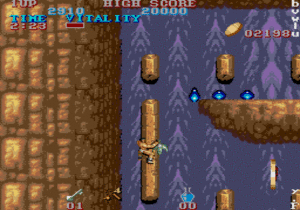
Furthermore, the developer has integrated features that were not present in the 1987 coin-op, such as visual parallax scrolling. By layering background elements to move at different speeds, the port introduces a sense of depth that significantly elevates the visual presentation. Additionally, the inclusion of SRAM (Static Random Access Memory) support allows for the persistent storage of high scores—a feature that was functionally impossible on the original arcade cabinet’s volatile memory.
Dual Gameplay Modes and User Accessibility
One of the most notable aspects of this development is the implementation of two distinct gameplay modes, designed to accommodate both the purist and the casual console player.
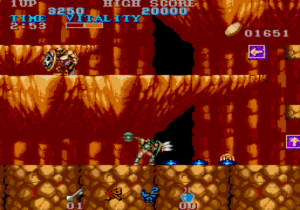
- Arcade Mode: This mode provides a faithful recreation of the 1987 experience. It includes the original coin-op mechanics, such as credit insertion, simulated attract sequences, and DIP switch configuration menus. It serves as a historical archive of the original game’s difficulty curve and progression.
- Home Mode: Recognizing that modern console players engage with titles differently than arcade patrons, this mode removes coin-based limitations. It includes a dedicated "gauntlet" mode that focuses on boss encounters, as well as a suite of developer tools, such as level selection and invincibility codes. Perhaps most significantly, it introduces an optional jump-assist mechanic for the notoriously difficult seventh stage, lowering the barrier to entry for players who previously found the original title’s platforming requirements insurmountable.
Audio Reconstruction and Performance Metrics
The audio landscape of the project presents a unique challenge. The original arcade audio was generated by dedicated hardware, which differs significantly from the Genesis’s Yamaha YM2612 FM synthesis and SN76489 PSG chips. Rester159 has spent considerable time re-mapping the game’s soundtrack and sound effects to work within the specific noise-channel and volume-scaling constraints of the Genesis hardware.
While the result is a high-fidelity recreation of the original score, the project acknowledges the limitations of 16-bit processing. During complex sequences—specifically when multiple enemies and projectiles occupy the screen simultaneously—the game engine occasionally experiences minor frame-rate dips. This is a common hurdle in homebrew development, as maintaining a constant 60 frames per second requires precise optimization of CPU cycles. The current public beta serves as a living document of these efforts, with the developer actively soliciting feedback from the community to refine performance through upcoming patches.
Broader Implications for the Homebrew Scene
The Black Tiger project highlights the increasing sophistication of the modern homebrew scene. What once started as simple ROM hacks has evolved into professional-grade development projects that leverage modern tools like the SGDK to push the limits of aging hardware.
The implications for the retro-gaming market are twofold. First, it demonstrates the viability of "native" porting as a method for software preservation. By recreating the game’s logic from the ground up, developers are effectively archiving the "feel" of these titles for future generations who may not have access to original, aging arcade cabinets. Second, it shifts the expectation of the gaming community. Players no longer demand 1:1 copies; they are increasingly supportive of "optimized" ports that take advantage of the host console’s specific features, such as parallax scrolling or save-state functionality.
Future Outlook and Availability
While there is currently no finalized release date for a physical cartridge or a gold master, the project is currently in a fully playable public beta state. The software is compatible with modern flash carts, standard emulators, and high-end hardware solutions like the MiSTer FPGA, ensuring that a wide range of enthusiasts can participate in the testing process.
By allowing the community to chime in on bugs and gameplay balance, rester159 has effectively turned the development process into a collaborative effort. As the project nears its final iteration, it stands as a testament to the longevity of 1980s game design and the enduring dedication of the Sega Genesis community. For those who grew up in the shadow of the arcade, waiting for a home port that never came, this development offers a rare opportunity to finally experience a foundational chapter of Capcom’s history on their own terms.