 Jia Lissa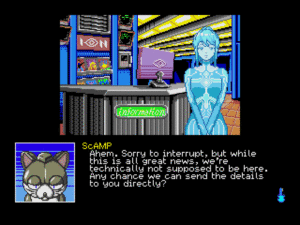
The Sega Genesis, known predominantly for its high-octane action titles, platformers, and arcade ports, is currently witnessing a paradigm shift in homebrew development. While the Sega CD add-on historically cornered the market on complex, cinematic graphic adventures—hosting legendary titles like Hideo Kojima’s Snatcher and the gritty Rise of the Dragon—the base console often lacked the storage capacity to support such narrative-heavy experiences. However, independent studio Pixel Pusher Games is challenging this hardware limitation with their upcoming title, Chords. By utilizing advanced programming techniques, the developers aim to deliver a sophisticated, multi-act graphic adventure that functions natively on the standard Genesis cartridge format.
The Evolution of the 16-bit Graphic Adventure
For decades, the graphic adventure genre on 16-bit consoles was largely defined by the CD-ROM medium. The 1990s saw the release of games that relied heavily on pre-rendered backgrounds, voice acting, and large data files that simply could not fit on a standard 4-megabit or 8-megabit Genesis cartridge. Games like The Secret of Monkey Island and The Adventures of Willy Beamish exemplified the potential of the CD format.
Pixel Pusher Games, led by developer Matt, has spent several years reverse-engineering the pacing and structural DNA of these classics. Chords is explicitly designed to bridge the gap between the atmospheric storytelling of the Sega CD era and the limitations of the Genesis hardware. By optimizing asset compression and focusing on high-quality 16-bit pixel art, the studio is crafting an experience that mirrors the depth of Snatcher without requiring additional hardware peripherals.
Narrative Framework and Game Mechanics
The story of Chords follows Akio, a musician navigating a high-stakes, global battle-of-the-bands competition. What begins as a creative journey quickly devolves into a thriller, as Akio uncovers a clandestine group manipulating the contest for ulterior motives. The narrative is partitioned into three distinct acts, designed to provide a substantial playtime that rivals contemporary indie adventures.
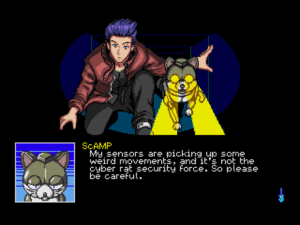
According to internal development metrics, a speed-run of the first chapter alone takes approximately 45 minutes, suggesting a full playthrough will offer several hours of interactive gameplay. Unlike traditional point-and-click games that allow players to exhaust menu options through trial and error, Chords demands a higher level of cognitive engagement. Players must synthesize information from environmental clues, dialogue branches, and visual motifs found in the background art. This design choice forces the player to adopt the role of an investigator, where small, easily overlooked details often provide the key to progressing through a scene.
Artistic Collaboration and Technical Specs
The aesthetic success of Chords relies on a veteran production team. The pixel art is headed by Daniel “108 Stars” H., an industry-recognized artist whose previous credits include the critically acclaimed RPG Pier Solar. His contribution ensures that the game maintains a high level of visual fidelity, utilizing the Genesis color palette to create moody, cinematic environments that evoke a noir-cyberpunk atmosphere.
Complementing the visuals is an original chiptune score composed by SuperJet Spade. The music is intended to drive the emotional pacing of the narrative, moving beyond simple background loops to underscore the tension of the story. To ensure the game has a global reach, Pixel Pusher Games has committed to multi-language support, with localization planned for English, French, German, Spanish, and Portuguese. This inclusion marks a significant effort to cater to the modern international retro-gaming community, which remains highly active in Europe and South America.
Industry Context and Independent Development
The current wave of Genesis homebrew development represents a broader trend within the video game industry: the preservation and expansion of "legacy" platforms. Developers are increasingly using modern development tools—such as cross-compilers and enhanced sprite editors—to push hardware to performance levels that were rarely achieved during the original 1990s retail cycle.
In the case of Chords, the project is part of a larger portfolio at Pixel Pusher Games, which also includes the dungeon crawler Crypt of Dracula. The studio’s approach is rooted in the philosophy that games are fundamentally a medium for interactive storytelling. By prioritizing narrative, atmosphere, and character development over twitch-reflex action, the studio is positioning its software as a "prestige" title for the Genesis. This shift is notable because it provides a necessary diversification for a console library that is otherwise saturated with shooters and platformers.
The Influence of Snatcher and Genre Identity
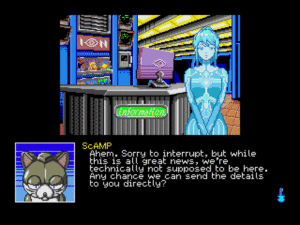
While the developers acknowledge that Snatcher served as the primary architectural inspiration for Chords, they have been clear about their intent to carve out a unique identity. The game is not intended to be a derivative work; rather, it seeks to modernize the graphic adventure template. By focusing on a musical setting and an original mystery, Chords differentiates itself from the sci-fi tropes that dominated the Sega CD era.
The implications for the homebrew market are significant. If Chords succeeds in delivering a seamless, long-form narrative on a cartridge, it could lower the barrier to entry for other narrative-focused developers. The ability to produce high-quality, story-driven content on physical cartridges without the need for disc-based media would allow for a new wave of physical releases that are both collectible and functionally robust.
Timeline and Future Outlook
Development on Chords is ongoing, with the team currently refining the second and third acts of the game. While a definitive release date for the physical and digital versions has yet to be finalized, the progress demonstrated in the current demo has generated significant interest within the retro-gaming press and the Sega-16 community.
Pixel Pusher Games has committed to a policy of transparency, sharing development logs and technical insights via their official website and the social media platform BlueSky. These updates provide a window into the complexities of programming for the Motorola 68000 processor—the heart of the Genesis—and the challenges of fitting a multi-hour adventure into a limited ROM space.
As the industry looks toward the eventual launch of the full game, the expectation is that Chords will be reviewed alongside other notable 2020s-era homebrew titles. The success of such projects is largely dependent on the support of the community, which has shown an increasing willingness to back physical releases. For the Sega Genesis, the arrival of Chords serves as a reminder that even after three decades, the console remains a viable canvas for innovative, genre-defining creative work.
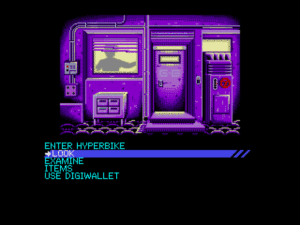
Analysis of Market Impact
The decision to develop Chords for both the Sega Genesis and PC suggests a dual-market strategy. By releasing on modern hardware alongside the original console, Pixel Pusher Games is ensuring that their narrative is accessible to a wider audience, including those who may not own original 16-bit hardware but appreciate the aesthetic and design sensibilities of the era.
Furthermore, the emphasis on a "story-driven experience" addresses a specific segment of the retro-gaming demographic that values intellectual challenge and environmental storytelling. As the market for retro-gaming continues to mature, the demand for "complete" experiences—games that tell a coherent story from start to finish—is likely to grow. If Chords can execute its narrative arc with the polish shown in the demo, it will likely serve as a benchmark for future cartridge-based adventure games.
Pixel Pusher Games continues to monitor community feedback as they iterate on the final build. The studio’s commitment to both Chords and their concurrent project, Crypt of Dracula, indicates a long-term investment in the Genesis ecosystem. Whether Chords will truly stand beside the giants of the Sega CD library remains to be seen, but the initial reception suggests that the studio has the technical and creative capacity to provide a compelling addition to the console’s storied history.