Vera Clarissa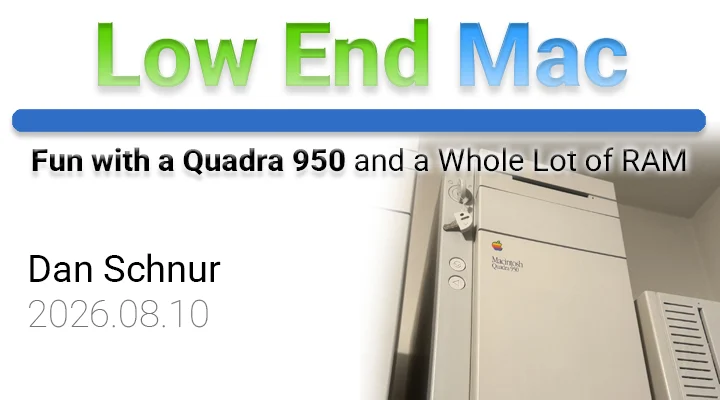
The Macintosh Quadra 950, released by Apple Computer in May 1992, represented the pinnacle of the company’s Motorola 68040-based architecture. Serving as the successor to the Quadra 900, the 950 was marketed as a high-end workstation designed to compete with Unix-based desktop systems of the era. While modern computing environments measure RAM in gigabytes and terabytes, the Quadra 950 was engineered with a theoretical maximum of 256 MB of RAM, a staggering figure for the early 1990s. Recently, a restoration project successfully reached this maximum capacity, providing a rare look at the limitations of vintage operating systems and the architectural constraints of early 1990s hardware.
Architectural Context and Historical Significance
In the early 1990s, the Quadra 950 was more than a mere personal computer; it was the engine behind significant infrastructure experiments. During its prime, the machine was frequently repurposed as the Workgroup Server 95, a specialized version of the hardware running A/UX, Apple’s implementation of the Unix operating system.

Historical records indicate that the Quadra 950 was instrumental in early Internet development. During the mid-1990s, when the NSFNET served as the primary backbone of the burgeoning World Wide Web, high-performance Macintosh servers were often utilized as nodes for FTP and early web traffic. Reports from the era suggest that individual Quadra 950 units were capable of handling significant portions of regional network traffic, though performance was consistently throttled by the high cost and technical limitations of contemporary RAM modules.
The Engineering Challenge: Sourcing and Construction
The recent effort to populate all 16 SIMM (Single In-line Memory Module) sockets with 16 MB modules—the maximum density supported by the system—presented a complex supply chain and hardware engineering hurdle. Because 16 MB FPM (Fast Page Mode) SIMMs are no longer manufactured, the project required an unconventional approach: the use of open-source hardware designs.
The project utilized custom-designed PCBs sourced from manufacturing services, which allowed for the configuration of memory chips to match the Quadra’s specific electrical requirements. The primary components were salvaged from high-capacity 256 MB parity EDO (Extended Data Out) DIMMs, which were common in server environments from the late 1990s. By using hot-air rework stations, the individual memory chips were desoldered from their original high-density modules and re-applied to the custom SIMM boards. This process, while labor-intensive, effectively bridged the gap between legacy hardware interfaces and high-density memory components.

Chronology of the Testing Phase
Upon installing the 256 MB of RAM, the system encountered an immediate operational bottleneck: the Power-On Self-Test (POST). Designed in an era when 8 MB was considered a substantial memory footprint, the Quadra 950’s ROM-based memory diagnostic routine was not optimized to scan 256 MB of RAM. The boot sequence required an extensive amount of time to verify the address space, effectively paralyzing the machine during startup.
To circumvent this, the project integrated a custom ROM SIMM. By modifying the system’s boot firmware to bypass the exhaustive memory check, the machine was able to initialize the operating system almost instantaneously. This modification highlights a common theme in vintage computing restoration: the necessity of altering low-level firmware to accommodate hardware configurations that exceed the original design specifications of the machine.
Operating System Compatibility and Software Limits
The success of the hardware installation varied significantly depending on the operating system employed. When running System 7, the machine recognized the full 256 MB of RAM, allowing for a desktop experience that was exceptionally fluid by 1992 standards. However, the result was starkly different when attempting to run A/UX.

A/UX, Apple’s Unix variant, was engineered with specific kernel memory constraints. Empirical testing revealed that the operating system could not initialize the memory management unit (MMU) when presented with 256 MB or even 128 MB of RAM. The system only stabilized once the memory was reduced to 64 MB. This discrepancy demonstrates that software from that period was often tightly coupled to the hardware memory ceilings of its release year. Despite having the physical capacity to address more, the Unix kernel of the time lacked the necessary abstraction to utilize such a large pool of memory, effectively rendering the additional hardware useless in a server environment.
Data Analysis: The Diminishing Returns of Retro-Hardware
The following table outlines the memory thresholds and system behaviors observed during the testing:
| Configuration | OS Environment | System Behavior |
|---|---|---|
| 256 MB RAM | System 7 | Full recognition; stable operation |
| 256 MB RAM | A/UX | Kernel failure/Initialization error |
| 128 MB RAM | A/UX | Kernel failure/Initialization error |
| 64 MB RAM | A/UX | Stable operation |
From a technical standpoint, the experiment illustrates the "law of diminishing returns" in computer architecture. While the Quadra 950 was designed to be modular and upgradeable, the software ecosystem was rarely future-proofed for the maximum theoretical hardware configurations. The vast majority of software released between 1992 and 1995 was optimized for 8 to 32 MB of RAM; consequently, having 256 MB provided no measurable performance increase for standard tasks such as word processing or desktop publishing.

Implications for Modern Restoration
The restoration of this Quadra 950 serves as a microcosm for the broader retro-computing community. It highlights three critical factors:
- Firmware Modification: As hardware components age and supply chains for original parts disappear, the use of flashable ROM modules has become essential for maintaining operational parity.
- Open-Source Hardware: The ability to design and print custom PCB adapters has allowed enthusiasts to keep legacy systems running, often exceeding the capabilities of the original components.
- Software Limitations: Modern users must acknowledge that simply upgrading physical hardware does not guarantee software performance. Operating systems, particularly those from the early 1990s, often have hard-coded memory management limits that cannot be bypassed via hardware upgrades alone.
Conclusion: Historical Value vs. Practical Utility
While the installation of 256 MB of RAM in a Macintosh Quadra 950 serves no practical purpose for contemporary professional workflows, it provides invaluable data for computing historians. It confirms that while the hardware was physically capable of supporting advanced configurations, the software of the era acted as a primary constraint on growth. The project serves as a testament to the robust engineering of the early 90s, proving that even three decades later, these machines can be pushed beyond their intended operational parameters through the application of modern technical ingenuity. The Quadra 950 remains a significant, if beige, monument to a time when Apple was aggressively competing for the desktop workstation market.