Farhan hamdan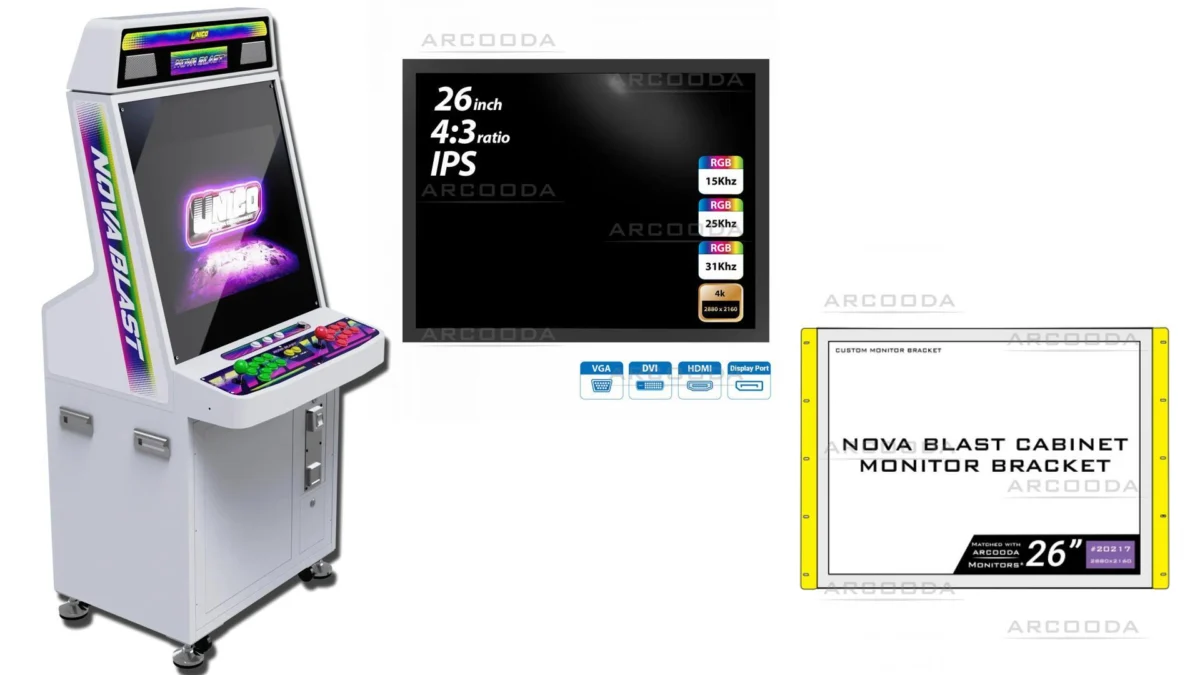
The market for home arcade enthusiasts has expanded rapidly in recent years, driven by consumer demand for authentic retro gaming experiences without the logistical hurdles of sourcing, importing, and maintaining aging cathode-ray tube (CRT) hardware. However, building or purchasing a modern arcade cabinet often involves compromises, particularly regarding visual display quality. A prominent development in this niche sector addresses a persistent hardware flaw in a popular consumer arcade cabinet. Arcooda, a manufacturer specializing in industrial-grade arcade displays, has officially released a custom mounting bracket designed to integrate its high-end 26-inch 4K LCD monitor into the Unico Nova Blast cabinet, directly resolving widespread user complaints concerning the machine’s stock visual output.
The release of this mounting solution follows months of inquiries from the retro gaming community regarding display compatibility. The Unico Nova Blast, priced around $1300, features a sturdy metal chassis and responsive control layout that have earned positive reviews from hobbyists. Despite these structural merits, the cabinet has faced continuous criticism for the performance and limitations of its factory-installed LCD panel. For users looking to upgrade their hardware, Arcooda’s newly engineered bracket bridges the gap between premium display technology and mass-market consumer cabinets, though the financial investment required to execute the upgrade is substantial.
Background Context of the Unico Nova Blast and Display Challenges
The evolution of home arcade cabinets has mirrored advancements in flat-panel display technology. For decades, traditional arcade machines relied on heavy, bulky CRT monitors to deliver native 15kHz, 24kHz, and 31kHz signals, ensuring zero motion blur and authentic scaling for classic arcade boards and retro consoles. As genuine CRT tubes grew increasingly scarce, manufacturers pivoted toward Liquid Crystal Displays (LCDs). However, adapting modern LCD technology to legacy gaming signals is notoriously difficult. Standard commercial computer or television panels often struggle with proper scanline simulation, low-latency scaling, and the specific resolutions generated by older hardware.
Unico, a notable manufacturer in the consumer arcade space, released the Nova Blast to capture the burgeoning market for modular and pre-built cabinets. While the physical construction—specifically the metal enclosure and control deck—met consumer expectations, the accompanying ULM-26 display panel became a point of contention within the enthusiast community. Reviewers and end-users frequently cited issues related to viewing angles, color reproduction, black levels, and signal processing. These deficiencies sparked a demand for viable third-party replacement panels.
Throughout multiple hardware iterations, display performance has remained a critical vulnerability for manufacturers attempting to balance production costs with enthusiast-grade demands. When companies attempt to source low-cost LCD panels to keep retail price points competitive, the resulting visual quality often fails to satisfy purists accustomed to traditional arcade monitors. This performance gap created an opening for specialized component manufacturers like Arcooda to offer targeted, premium hardware alternatives.
Chronology of the Compatibility Solution
The path toward a formalized compatibility solution between Arcooda and the Unico Nova Blast unfolded through grassroots testing and direct consumer demand.
Initial customer inquiries regarding display swaps began shortly after the widespread adoption of the Nova Blast cabinet. Because Arcooda’s monitors are engineered with specialized industrial circuitry capable of handling diverse arcade frequencies natively, owners of the Nova Blast sought to determine whether an Arcooda panel could be retrofitted into the Unico chassis.
Subsequent testing conducted by Arcooda and independent end-users confirmed technical viability, establishing that the manufacturer’s high-end 26-inch 4K display could physically fit within the Nova Blast housing, provided the correct mounting architecture was utilized. It is worth noting a critical technical constraint identified during this testing phase: while Arcooda’s 26-inch 4K model is compatible via the new bracket, the company’s separate 26-inch 1080p display variant utilizes different physical dimensions and cannot be installed in the Nova Blast chassis.
To formalize the retrofit process, Arcooda introduced a dedicated hardware SKU designated as the "26inch 2880×2160 Nova Blast Monitor Bracket." The company integrated this component directly into its retail pipeline. Customers purchasing a new 26-inch 4K Arcooda display can select the Nova Blast bracket as a complimentary inclusion at the point of sale. Concurrently, consumers who already own the display can purchase the mounting bracket separately for $13, minimizing additional expenditure for early adopters of the monitor technology.

Technical Specifications and Financial Implications
Evaluating the integration of Arcooda hardware into a Unico cabinet requires an examination of the cost-to-performance ratio. Arcooda’s 26-inch 4K arcade monitor retails for approximately $700. When combined with a $1300 Unico Nova Blast cabinet, the total financial outlay for a fully upgraded system reaches roughly $2000.
For many consumers, investing a sum equal to more than half the cost of the cabinet solely to replace the display introduces the economic phenomenon known as "sunk cost fallacy." However, industry analysts and experienced hobbyists argue that the expenditure must be viewed through the lens of total cost of ownership and operational convenience. Traditional alternatives—such as importing a vintage Japanese "candy cab" housing a functioning CRT—frequently involve exorbitant freight shipping fees, complex voltage step-down configurations, and the persistent threat of high-voltage component failure with limited access to replacement parts.
In contrast, the combination of the Unico metal chassis and an industrial-grade Arcooda panel yields a lightweight, modern arcade machine that eliminates traditional CRT maintenance while retaining high-fidelity signal compatibility. Arcooda’s industrial panels are specifically designed to accept a wide array of legacy video inputs—including 15kHz, 24kHz, and 31kHz signals—without requiring complex external scan converters, superguns, or extensive cabinet re-wiring. Users require only a basic RGB adapter to achieve native-level visual presentation.
Industry Analysis and Broader Market Impact
The necessity for aftermarket display brackets highlights a broader challenge within the arcade hardware manufacturing sector: the disparity between structural assembly quality and display engineering. Constructing a durable, aesthetically pleasing metal cabinet is an industrial feat achievable by numerous manufacturers; however, designing or sourcing an appropriate display panel capable of satisfying the stringent demands of retro gaming purists remains an elite specialization.
Incidents involving sub-par display integration, such as those documented across various Unico hardware releases, demonstrate that cutting corners on visual components significantly degrades the perceived value of an otherwise well-constructed product. When consumers encounter foundational flaws in core components like monitors, third-party ecosystems inevitably emerge to fill the performance void.
Arcooda’s pricing strategy—positioning its products as premium industrial solutions rather than budget consumer electronics—often generates initial sticker shock among buyers accustomed to mass-market computer monitors. Yet, the engineering required to process authentic arcade refresh rates, native resolutions up to 2880×2160, and low-latency scaling commands higher production overhead. Market reception suggests that for dedicated enthusiasts, the investment is justifiable given the absence of viable factory alternatives.
Future Outlook for Modular Arcade Modifications
As the home arcade market matures, the trend toward modularity and cross-brand component compatibility is expected to accelerate. Manufacturers that design open architectures or accommodate third-party hardware integrations may find favor among discerning hobbyists who prioritize customization and longevity over closed, proprietary ecosystems.
The introduction of the Arcooda Nova Blast mounting bracket serves as a case study in responsive manufacturing within a specialized niche. By addressing a specific engineering deficiency through targeted accessory development, component suppliers can extend the operational lifespan and enhance the user satisfaction of popular consumer hardware platforms. Whether this development prompts original equipment manufacturers to elevate the baseline quality of their factory-installed panels in future product cycles remains to be seen, but for current Nova Blast owners dissatisfied with their visual output, a viable, albeit costly, path forward is now established.