Cecilia Chamidah Nur
Technical Specifications and Modular Design
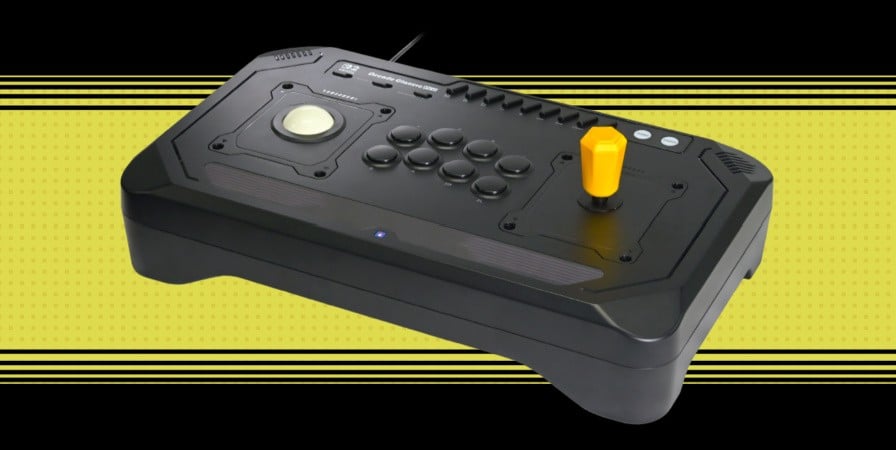
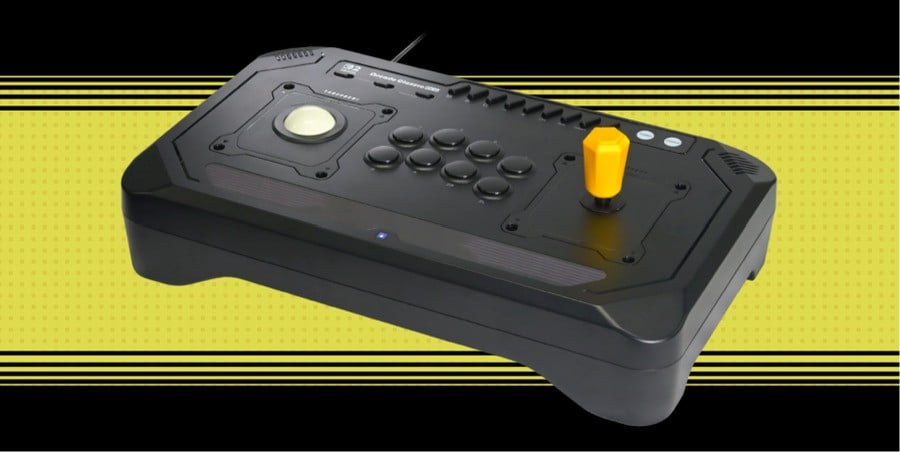
The HORI Arcade Classic Pro is a substantial piece of hardware, measuring 19.5 inches in width and 4.3 inches in height, with a weight of approximately 4 lbs. This physical footprint is intended to provide the stability required for intense arcade sessions. The standout feature of the unit is its modularity; the left and right sides of the control deck feature swappable panels. Users can configure the device to suit specific game genres by inserting different input modules.
Available modules include a traditional 8-way ball-top arcade lever, a rotating loop lever for specific rotary-controlled titles, a Pong-style dial paddle, and a dedicated trackball for games like Missile Command. Because each slot is universal, the controller is fully ambidextrous, allowing players to place the primary stick or specialty controller on either side of the chassis. The central console features eight standard arcade-sized buttons, all of which are fully programmable and offer adjustable turbo and auto-fire settings. Connectivity is handled via a three-metre USB-A cable, ensuring minimal input latency—a critical requirement for competitive retro gaming.
Strategic Alignment with Hamster Arcade Archives
The development of the HORI Arcade Classic Pro is deeply intertwined with the ongoing success of Hamster’s Arcade Archives series. For years, Hamster has been the primary vehicle for porting classic arcade titles to modern consoles. However, the variety of control schemes found in the 1980s and 90s—such as trackballs, paddles, and rotary joysticks—has historically rendered many of these ports difficult to enjoy on modern controllers.
By securing official Nintendo licensing and the endorsement of Hamster, HORI is positioning the Arcade Classic Pro not merely as a generic joystick, but as an essential companion piece for the Arcade Archives ecosystem on the Nintendo Switch 2. This symbiotic relationship suggests that future software updates or specific compatibility patches within the Arcade Archives library may be optimized for the unique inputs provided by this new hardware.
Historical Context and the Evolution of Arcade Hardware
The demand for high-fidelity arcade controllers has seen a resurgence alongside the growing popularity of retro emulation. In the late 1970s and 1980s, coin-op cabinets were often defined by their unique, dedicated control interfaces. Games like Tempest required a spinner, while Missile Command relied exclusively on the precision of a trackball. As home consoles moved toward standardized d-pads and analog sticks, these specialized mechanics were largely lost, forcing players to rely on imprecise software-based emulation of analog movements.
The HORI Arcade Classic Pro addresses a nearly 40-year technological gap. By reintroducing physical spinners and trackballs to the home market, HORI is facilitating an authentic experience that software-based mapping cannot replicate. This follows a long tradition of "arcade-perfect" peripherals, dating back to the early days of the NES Advantage and the high-end custom sticks produced by Japanese manufacturers throughout the 1990s.
Market Implications and Pricing Strategy
The retail price for the HORI Arcade Classic Pro is set at ¥39,980, which translates to approximately $260 USD, excluding shipping and potential customs duties. While this positions the device at the premium end of the controller market, it is consistent with HORI’s history of producing high-durability, tournament-grade hardware.

The investment of $260 suggests that the target demographic is the "prosumer" or the dedicated retro enthusiast. Industry analysts note that this price point reflects the complexity of the modular components, which are significantly more expensive to manufacture than standard digital buttons or hall-effect joysticks. The inclusion of PC compatibility further widens the value proposition, as it allows the device to function as a universal controller for various open-source emulation platforms, such as MAME (Multiple Arcade Machine Emulator), which have long sought a high-quality, all-in-one input solution.
Pre-order Timeline and Distribution
The pre-order window for the HORI Arcade Classic Pro is currently open, with a firm cutoff date of October 2. Prospective buyers are encouraged to secure their units during this period, as the modular nature of the production may limit the volume of units available for general retail upon the expected Spring 2027 release date.
The announcement has already generated significant interest among industry figures, with notable developers such as PlatinumGames co-founder Hideki Kamiya publicly acknowledging the controller’s potential. Such industry visibility is expected to bolster initial demand, as collectors and professional players seek to secure the hardware early.
Future-Proofing and Longevity
One of the core design philosophies behind the Arcade Classic Pro is durability. HORI has historically utilized high-grade microswitches and reinforced internal cabling to ensure that their arcade sticks can withstand millions of inputs. In an era of "disposable" consumer electronics, the ACP is designed for longevity, with replaceable modules that allow the user to swap out worn-out parts without needing to replace the entire unit.
Furthermore, the integration with the Nintendo Switch 2 suggests that Nintendo’s next-generation platform will continue to emphasize backward compatibility and retro-gaming accessibility. If the Switch 2 maintains the momentum of its predecessor, the Arcade Classic Pro could become the gold standard for how publishers port legacy content to new hardware.
Impact on the Emulation Community
For the broader emulation community, the arrival of a high-quality, manufacturer-supported trackball and spinner controller is a significant milestone. Many emulation enthusiasts spend hundreds of hours constructing custom "arcade boxes" using third-party components from companies like Sanwa or Seimitsu. The HORI Arcade Classic Pro provides a "plug-and-play" alternative that offers a professional-grade experience without the need for extensive DIY knowledge or soldering.
The potential for this device to standardize control schemes across different emulators is also worth noting. If the ACP gains widespread adoption, developers of emulation software may prioritize native support for its specific input protocols, further streamlining the experience for end users.
Conclusion: A New Standard for Retro Preservation
The HORI Arcade Classic Pro represents more than just a new peripheral; it is a commitment to the preservation of arcade history. By acknowledging that certain games cannot be played correctly on standard controllers, HORI and its partners are taking a definitive step toward maintaining the integrity of classic gaming experiences.

As the release date in Spring 2027 approaches, the success of the device will likely hinge on the quality of its modular components and the extent to which the Nintendo Switch 2 library supports its unique features. If the hardware performs to the standard set by HORI’s previous releases, it may well become the definitive input device for the next generation of arcade enthusiasts, finally allowing players to experience titles like Missile Command or Marble Madness exactly as they were intended to be played in the arcades of the past.