Chalid Lutfie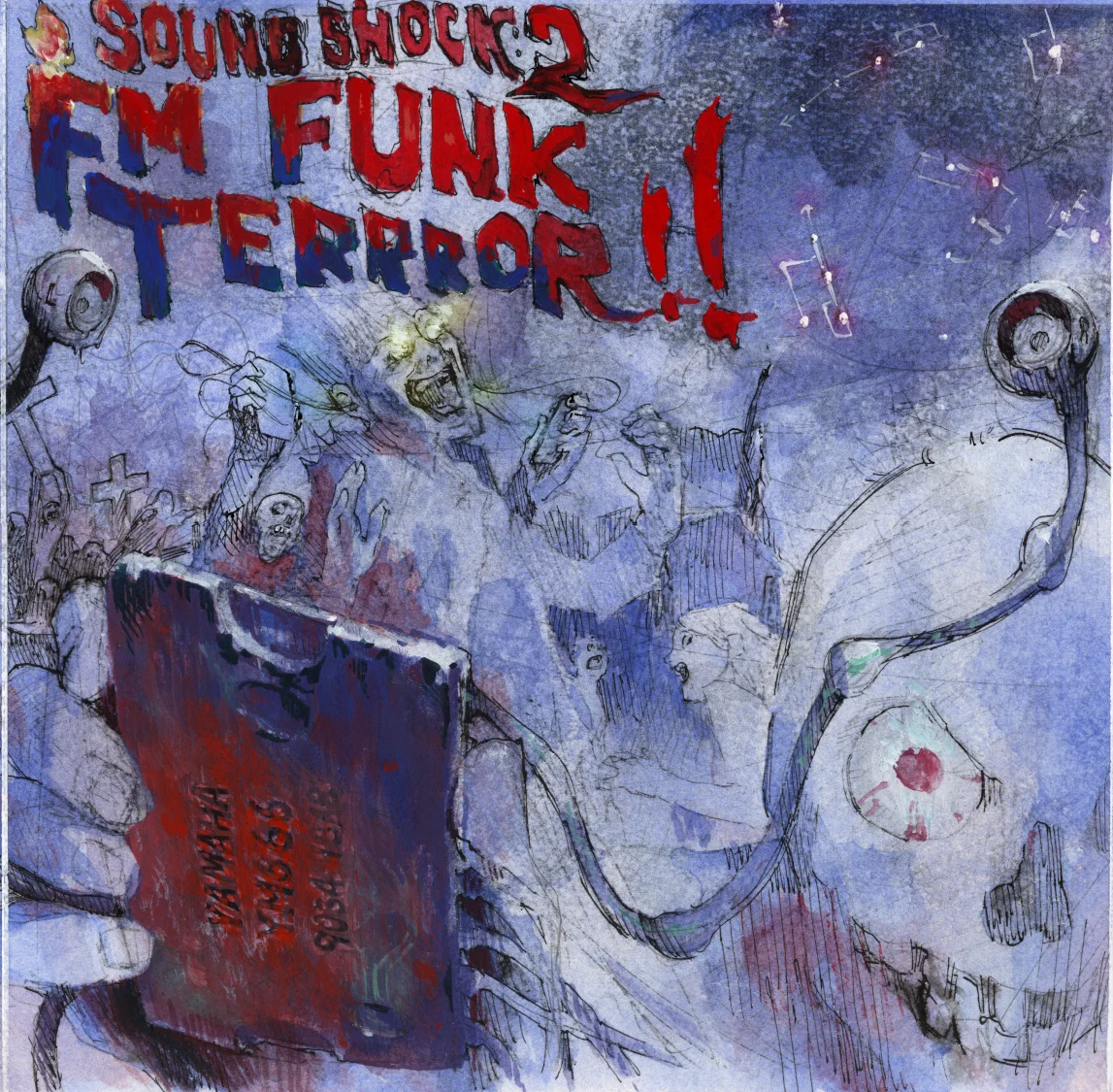
The completion of the SOUNDSHOCK music series marks a significant milestone in the contemporary appreciation of Frequency Modulation (FM) synthesis, a sound technology that defined the auditory landscape of the 1980s and early 1990s. Central to the identity of this trilogy is the visual contributions of Tsuyoshi Shimokura, a professional artist and manga creator whose hand-painted cover art bridged the gap between technical audio engineering and high-concept science fiction. Through a collaborative effort led by the series curator, known in the industry as zinger, the SOUNDSHOCK project evolved from a niche musical tribute into a comprehensive multimedia exploration of retro-futurism. The series, which concluded in April 2017, serves as a testament to the enduring legacy of the Yamaha FM sound chips and the cultural impact of Japanese arcade aesthetics.
Origins and the Collaborative Framework
The partnership between zinger and Tsuyoshi Shimokura began through a recommendation by the artist hex125. Initially, Shimokura was invited to contribute a musical composition for the series’ debut, SOUNDSHOCK: FM FUNK MADDNESS!!. However, his background as a professional manga artist and his profound passion for early computing history led to a broader role within the project. Zinger discovered a portfolio of Shimokura’s visual work that displayed a deep alignment with the series’ goals: to celebrate the "power" and "crunch" of FM synthesis.
This collaboration was founded on a shared technical appreciation for the hardware that powered the Sega Genesis (Mega Drive) and various Sharp X68000 systems. Shimokura’s ability to translate the abstract concepts of FM algorithms—the mathematical structures used to create sound—into tangible, monstrous, or divine visual entities became the hallmark of the series. The project followed a structured trajectory, with each installment pushing the boundaries of the "FM funk" theme through distinct artistic lenses: mechanical warfare, horror-inspired chaos, and ultimately, cosmic transcendence.
Chronological Development of the SOUNDSHOCK Aesthetics
The visual narrative of the SOUNDSHOCK series followed a deliberate escalation in intensity and thematic complexity. Each volume was designed to surpass its predecessor, both in musical technicality and visual scale.
Phase I: FM FUNK MADDNESS!! and the Mechanical Heroic
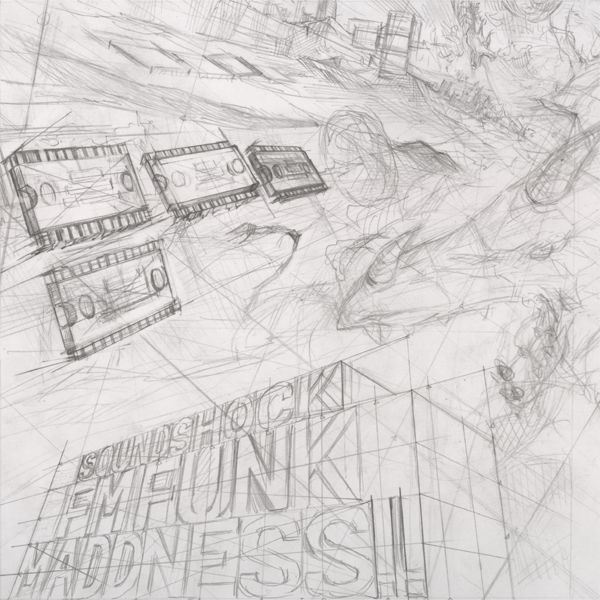
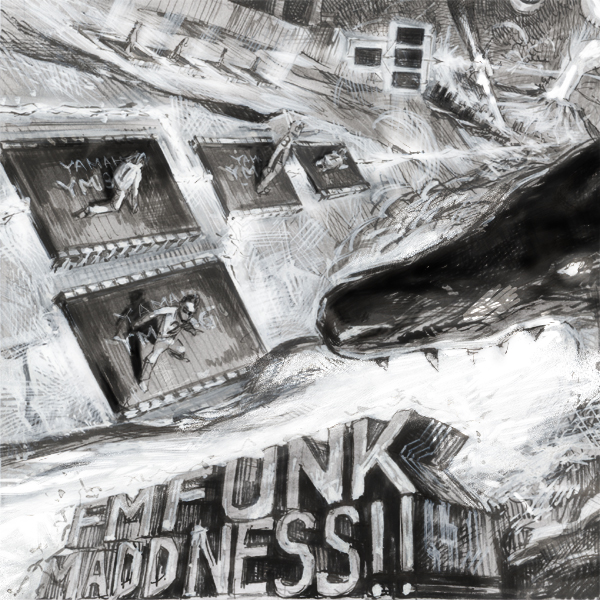
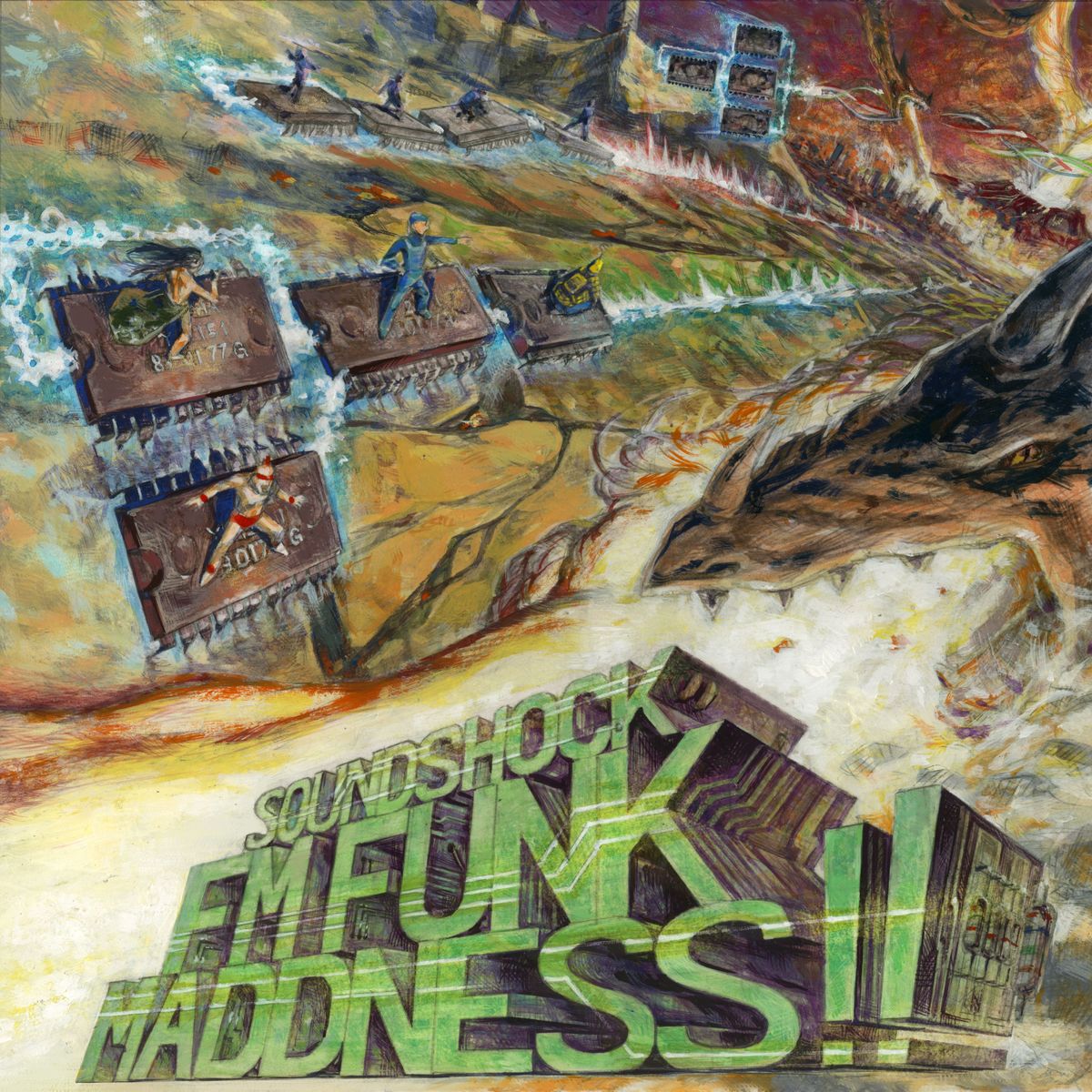
The first installment focused on the raw energy of FM synthesis. The creative process involved heavy referencing of classic arcade flyers, specifically Taito’s Metal Black and Darius II. These titles were known for their detailed, mechanical, and often surreal artwork. Shimokura’s concept for the first cover depicted a world where musicians and listeners utilized the "power of FM" to combat existential threats.
A notable detail in this phase was the personification of the hardware itself. Shimokura designed the FM chips—integrated circuits such as the Yamaha YM2151—to move on caterpillar-like treads. He also incorporated algorithm charts, the literal blueprints of FM sound design, into the physical structure of the world. This established a recurring motif where the technical limitations and specifications of the hardware were celebrated as aesthetic assets.
Phase II: FM FUNK TERRROR!! and the Horror Aesthetic
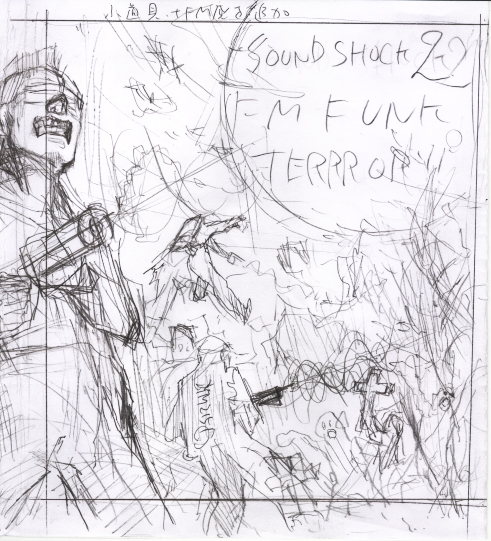
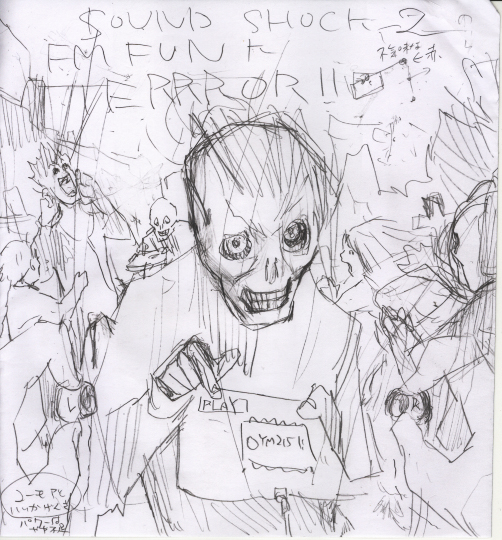
For the second volume, released as SOUNDSHOCK 2: FM FUNK TERRROR!!, the team shifted toward the "over-the-top" marketing styles of the 1980s. Zinger provided Shimokura with a variety of reference materials, including posters from the A Nightmare on Elm Street and Evil Dead film franchises, as well as the Splatterhouse video game series.
The resulting artwork was a dense, detail-rich homage to the "horror" of distorted FM sound. Key elements included a ghoul holding a gravestone-styled music player labeled "YM666"—a play on the Yamaha chip prefixes and the "Number of the Beast." Furthermore, the constellations in the sky were arranged to form FM algorithm patterns. This phase introduced a narrative element where FM sound was depicted as a supernatural force capable of "turning" listeners into devotees, paralleling the cult-like following of retro hardware in the modern era.
Phase III: FM FUNK NIRVANA!! and the Final Transcendence
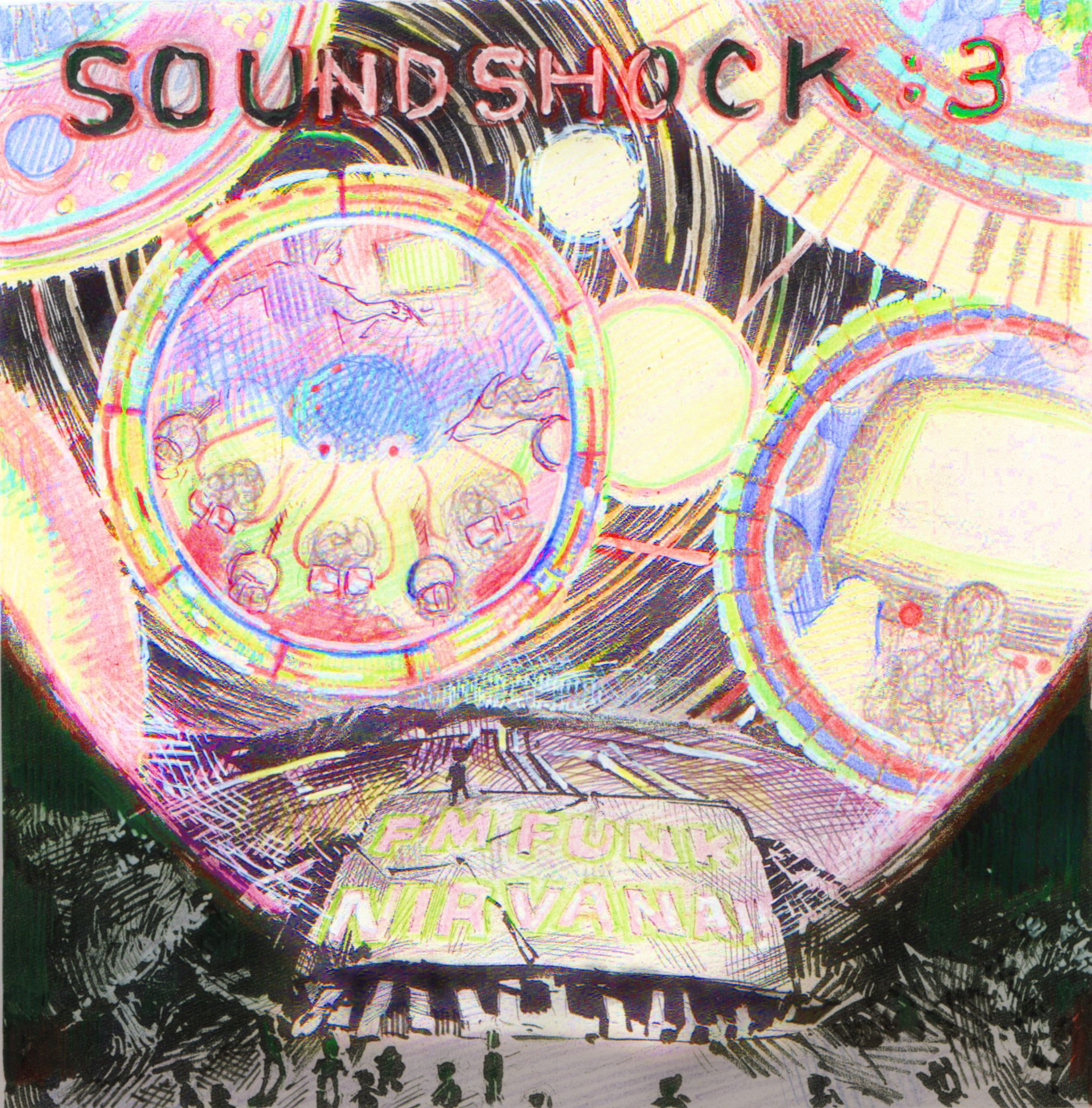
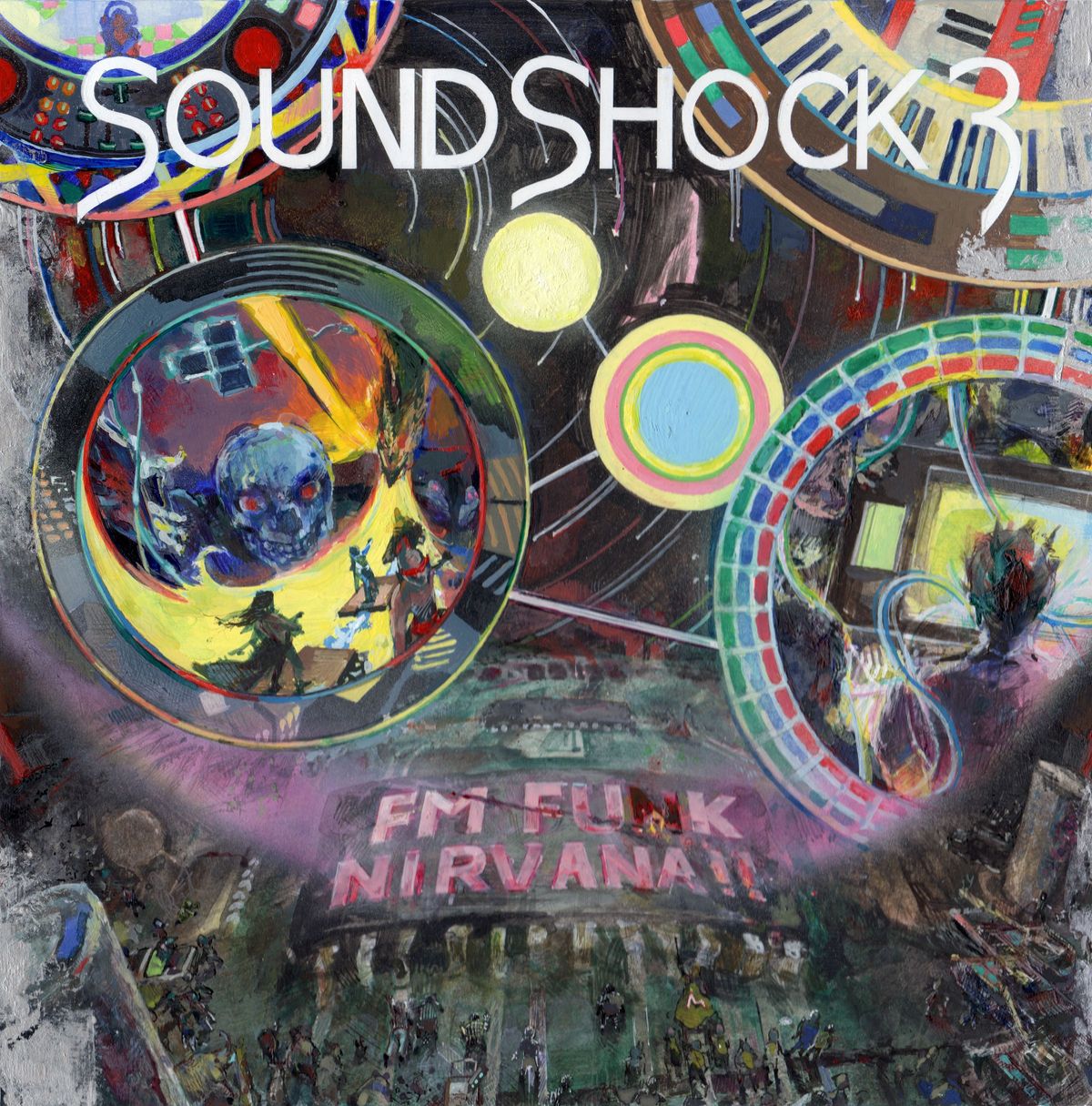
The trilogy concluded with SOUNDSHOCK 3: FM FUNK NIRVANA!!. The title was inspired by a fan comment that predicted a move toward a "perfect" or "ultimate" state. Zinger noted that while the previous titles used intentional misspellings (MADDNESS, TERRROR) to imply extra power, "NIRVANA" was a term that already represented a maximum state of being.
The visual direction for the finale moved away from horror and toward Buddhist-inspired cosmology. Shimokura looked to the soundtrack art of Darius Gaiden for inspiration, creating a "mandala" of FM elements. The final cover depicts a massive FM chip mounted on a circuit board, being worshipped by a vast congregation of disciples. This imagery suggests that the technology has moved beyond being a mere tool or a monster, becoming an object of spiritual significance.
Technical Context: The Legacy of FM Synthesis
To understand the significance of the SOUNDSHOCK series, one must consider the technical history of Frequency Modulation synthesis. Developed by John Chowning at Stanford University and later licensed by Yamaha, FM synthesis allowed for the creation of complex, harmonically rich sounds using relatively simple hardware.
In the 1980s, Yamaha’s FM chips became the backbone of the music industry (via the DX7 synthesizer) and the gaming industry. Chips like the YM2151 (found in countless arcade machines) and the YM2612 (the heart of the Sega Genesis) produced a distinct, metallic, and "funky" sound that differed sharply from the "warm" analog synthesizers of the previous decade. The SOUNDSHOCK series was a deliberate attempt to reclaim this sound in an era dominated by high-fidelity digital sampling. By focusing on the "funk" inherent in these chips, the project highlighted the artistic potential of working within the constraints of 4-operator and 6-operator synthesis.
Official Responses and Philosophical Implications
Upon the conclusion of the series, Tsuyoshi Shimokura released a statement reflecting on the project’s legacy. He characterized the end of SOUNDSHOCK not as a termination, but as a dispersal of creative energy. "Our work could be thought of as a seed for future stars that have yet to be born," Shimokura stated. He described the creators and fans as "progeny of our forerunners," suggesting a lineage of FM sound believers that transcends individual projects.
Zinger, acting as the primary curator, echoed these sentiments, emphasizing the collaborative joy found in the project. He noted that the intricate details Shimokura added to the art—such as the "Algorithm constellations"—were not merely decorative but were part of a larger mythos that the two had developed over years of discussion. The project was also a personal journey for the creators, involving research trips to small-scale game centers in Osaka to reconnect with the original environments where FM sound flourished.
Broader Impact and the Independent Music Scene
The SOUNDSHOCK series occupies a unique space in the "doujin" (independent) music scene. While many independent projects focus on modern genres, SOUNDSHOCK was a curated, international effort to revitalize a specific era of Japanese technological history. Its impact can be analyzed through three primary lenses:
- Aesthetic Revival: The series contributed to the "retrowave" and "synthwave" movements but with a specific focus on the Japanese "FM sound" rather than Western analog tropes. It validated the use of "obsolete" hardware as a legitimate medium for contemporary composition.
- Narrative Illustration: By treating album covers as part of a continuous story, the project elevated the standard for independent music packaging. Shimokura’s work demonstrated that cover art could be more than a marketing tool; it could be a world-building device.
- Community Building: The series brought together artists from different backgrounds—manga, game development, and electronic music. It fostered a global community of "FM believers" who shared a technical vocabulary and a nostalgic connection to 16-bit audio.
Conclusion: The Finality of Nirvana
The release of the final artwork for FM FUNK NIRVANA!! serves as the definitive closing of a chapter for the SOUNDSHOCK team. The imagery of the FM chip as a deity, surrounded by a universe of algorithms, encapsulates the project’s journey from "maddness" to "nirvana." While the series has officially ended, the "seeds" mentioned by Shimokura continue to influence a new generation of sound designers and visual artists who find inspiration in the limitations of the past.
The project stands as a rare example of a music compilation where the visual and auditory components are inextricably linked. Through the hand-painted efforts of Tsuyoshi Shimokura and the curation of zinger, the SOUNDSHOCK trilogy has secured its place as a comprehensive cultural archive of the FM synthesis era, proving that even in a digital age, there is a profound, spiritual resonance to be found in the silicon and circuits of yesteryear. The series remains a benchmark for how independent creators can honor history while forging a unique, visionary path forward.