Vera Clarissa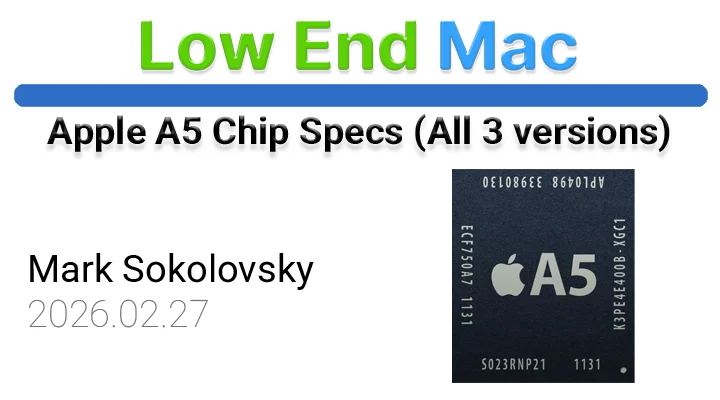
The Apple A5 chip, a pivotal component in the evolution of Apple’s mobile ecosystem, represents a significant leap in mobile processing power. This article provides an in-depth hardware profile of the A5 series, detailing its various configurations, architectural features, and the impact it had on the devices it powered. First introduced on March 11th, 2011, the A5 chip was manufactured by Samsung and laid the groundwork for subsequent generations of Apple Silicon, driving performance and capabilities in the burgeoning smartphone and tablet markets.
Architectural Foundation of the A5
At its core, the Apple A5 chip is built upon the ARMv7 instruction set architecture, a 32-bit standard that was prevalent in high-performance mobile devices of its era. This architecture facilitated efficient execution of complex tasks, essential for the increasingly sophisticated applications and user interfaces being developed for iOS. The chip’s design focused on balancing processing power with energy efficiency, a critical consideration for battery-dependent mobile devices.
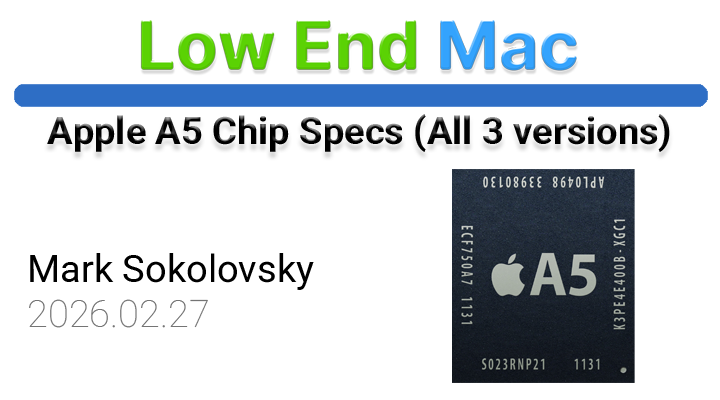
The A5 chip was initially fabricated using a 45-nanometer process, later evolving to a more advanced 32nm High-K dielectric metal gate process. This refinement in manufacturing technology allowed for increased transistor density, improved power efficiency, and potentially higher clock speeds. While the exact transistor count for the A5 remains undisclosed by Apple, the advancements in fabrication processes suggest a substantial increase in complexity compared to its predecessors.
CPU Configuration and Performance
The A5 chip is characterized by its dual-core CPU design, a significant upgrade from the single-core processors found in earlier Apple devices. These cores, based on ARM’s Cortex-A9 architecture, were designed for high performance. The A5 typically operated with P-Core (Performance Core) clock speeds ranging from 800 MHz to 1 GHz, providing ample processing power for multitasking and demanding applications.
A key aspect of the A5’s architecture, particularly in later iterations, was the inclusion of different core configurations. While the standard A5 featured two performance cores, a variant found in the third-generation Apple TV, codenamed APL0498 and part number S5L8940, notably featured a single performance core. This strategic reduction in core count for the Apple TV likely aimed to optimize power consumption and cost for a device with different performance requirements.
The cache hierarchy within the A5 was also crucial for its performance. Each performance core was equipped with 32 KB of L1 instruction cache (P-L1i) and 32 KB of L1 data cache (P-L1d), totaling 64 KB per core. These caches provided rapid access to frequently used data and instructions, minimizing the need to access slower main memory. A unified 1 MB L2 cache served both performance cores, further enhancing data retrieval speeds and reducing latency. For the Apple TV variant, the L1 caches were halved to 32 KB per core, reflecting the reduced core count. The absence of efficiency cores (E-cores) in the A5 design meant that the chip relied solely on its performance cores for all computational tasks, a design choice that prioritized raw power over granular power management capabilities seen in later Apple Silicon generations.
Memory Subsystem
The memory subsystem of the A5 chip was designed to support its dual-core CPU and integrated graphics. It featured a 64-bit memory bus, capable of handling two 32-bit channels. This dual-channel configuration, utilizing LPDDR2-800 memory operating at 400 MHz, provided a theoretical memory bandwidth of approximately 6.4 GB/s. This bandwidth was essential for feeding data to the CPU and GPU at a sufficient rate, preventing bottlenecks and ensuring smooth operation. The A5 chip was typically paired with 512 MB of RAM, a substantial amount for its time, enabling the multitasking capabilities and rich graphical experiences expected by users.
Graphics Processing Unit (GPU)
The graphics capabilities of the A5 chip were handled by an integrated PowerVR SGX543MP2 GPU. This GPU featured two cores, each equipped with 4 SIMD (Single Instruction, Multiple Data) execution units and 32 FP32 (Single-Precision Floating-Point) arithmetic logic units. Operating at a clock speed of 200 MHz, the GPU was capable of delivering approximately 12.8 GFLOPs (Giga Floating-Point Operations Per Second) of raw processing power. This was sufficient to drive the displays of devices like the iPad 2 and iPhone 4S, rendering detailed graphics for games, applications, and the iOS user interface with considerable fluidity. The integrated nature of the GPU meant it shared system resources and power with the CPU, necessitating careful optimization by Apple’s software engineers.

Evolution and Variations of the A5
The Apple A5 chip was not a monolithic entity but rather a platform that saw incremental improvements and variations to suit different device needs. While the initial release targeted flagship devices, the need for cost-effective solutions and tailored performance for other product lines led to variations.
- A5 (iPad 2, iPhone 4S): This was the primary iteration of the A5 chip, featuring the dual-core configuration and the specifications detailed above. It powered the groundbreaking iPad 2, which redefined the tablet experience, and the iPhone 4S, which introduced Siri and significantly boosted performance for the iPhone line.
- A5R2 (iPad Mini, iPod Touch 5th Gen): A slightly revised version, likely with minor clock speed adjustments or power efficiency improvements.
- A5 (Apple TV 3rd Gen): As mentioned, this variant featured a single-core CPU configuration, indicating a strategic adaptation for the Apple TV’s specific use case and thermal envelope. This decision likely prioritized cost and power efficiency for a set-top box device.
The variations in the A5 chip highlight Apple’s approach to silicon development: leveraging a core architecture and adapting it to meet the distinct requirements of its diverse product portfolio. This modular approach allowed for faster development cycles and optimized performance across a range of devices.
Timeline and Context of the A5’s Release
The introduction of the A5 chip in March 2011 marked a pivotal moment in the evolution of Apple’s mobile devices and, by extension, the entire mobile computing industry.

- 2007: Apple introduces the first iPhone, powered by a Samsung-manufactured ARM 11-based single-core processor.
- 2008: The iPhone 3G utilizes the Samsung S5L8900, a slightly improved single-core processor.
- 2010: The iPhone 4 and original iPad debut with the A4 chip, a significant performance leap built on ARM Cortex-A8 architecture, still single-core.
- March 2011: Apple announces the iPad 2, powered by the new dual-core A5 processor. This device was lauded for its dramatic performance improvements over its predecessor, particularly in graphics and multitasking.
- October 2011: The iPhone 4S is released, featuring an A5 chip that brings substantial speed and graphical enhancements to Apple’s flagship smartphone.
- March 2012: The third-generation Apple TV is launched, powered by a single-core variant of the A5 chip, showcasing Apple’s ability to tailor the A5 architecture for different device profiles.
- November 2012: The first iPad Mini is released, also utilizing an A5 chip, bringing iPad-class performance to a more compact and affordable form factor.
- October 2012: The fifth-generation iPod Touch features an A5 chip, extending Apple’s proprietary silicon into its portable media player lineup.
The A5’s release occurred during a period of intense competition in the smartphone and tablet markets. Competitors like Samsung, with its Exynos processors, and Qualcomm, with its Snapdragon chips, were also pushing the boundaries of mobile performance. Apple’s A5, with its dual-core design and efficient architecture, allowed its devices to maintain a competitive edge, offering a smoother and more responsive user experience.
Broader Impact and Implications
The Apple A5 chip had profound implications for both Apple and the broader technology landscape.
- Enhanced User Experience: The dual-core performance of the A5 enabled a new level of responsiveness and capability in iOS devices. Apps launched faster, multitasking became more fluid, and graphically intensive games could be played with greater fidelity. This significantly enhanced the user experience, a key differentiator for Apple products.
- Platform for Innovation: The A5 provided the processing muscle required for innovative features. On the iPhone 4S, it was instrumental in powering Siri, Apple’s groundbreaking voice assistant, which demanded significant on-device processing. For the iPad 2, it facilitated the emergence of more complex and engaging applications, solidifying the tablet as a powerful computing platform.
- Foundation for Future Development: The A5 chip represented a crucial step in Apple’s long-term strategy of designing its own silicon. It proved the viability of custom-designed mobile processors that could be tightly integrated with Apple’s hardware and software, leading to optimized performance and efficiency. This laid the groundwork for subsequent generations of A-series chips, culminating in the powerful M-series chips used in Macs.
- Industry Benchmark: The performance of the A5 chip set a new benchmark for mobile processors. Its efficiency and power, especially in comparison to contemporary offerings from competitors, often led to Apple devices being perceived as having superior performance, even if raw specifications sometimes appeared comparable.
Conclusion
The Apple A5 chip, though now surpassed by many generations of advanced processors, remains a significant landmark in the history of mobile computing. Its dual-core architecture, efficient design, and tailored variations powered some of Apple’s most influential devices, including the iPad 2 and iPhone 4S. Manufactured by Samsung using advanced fabrication processes, the A5 demonstrated Apple’s commitment to in-house silicon development, a strategy that has since become a cornerstone of its technological prowess. By providing a robust and performant platform, the A5 chip not only propelled Apple’s product ecosystem forward but also played a vital role in shaping the capabilities and user expectations of the modern mobile device. The lessons learned and the architectural foundations laid by the A5 continue to resonate in the cutting-edge processors Apple designs today.