
 Hartono Sudibyo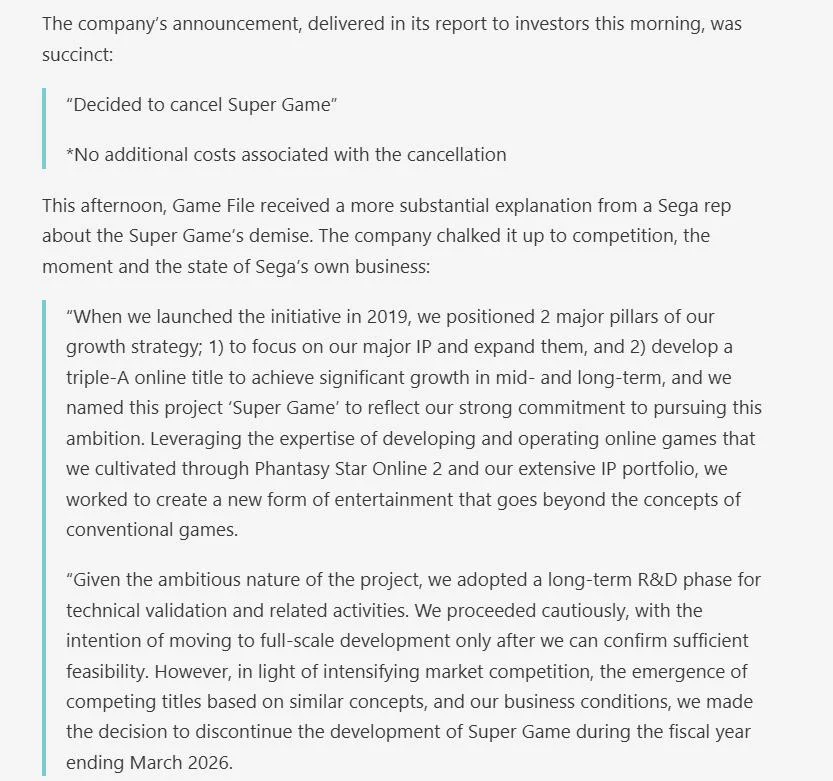
Tokyo, Japan – May 13, 2026 – Sega Corporation has officially announced the cancellation of its highly anticipated "Super Game" initiative, a project that had been in development for approximately five years. The decision, confirmed in a recent update to Game File and detailed in a statement released by the company, stems from a confluence of factors, including intense market competition and evolving business conditions within the global gaming industry. This cancellation marks a significant shift in Sega’s strategic direction, following a period of re-evaluation of its approach to game development and monetization.
Background: The Genesis of "Super Game" and Sega’s Strategic Pivot
The "Super Game" project was initially teased as a major undertaking by Sega, envisioned to be a global online experience with the ambition of achieving the scale and cultural impact of titles like Fortnite. While specific details about its gameplay mechanics and genre remained largely under wraps throughout its development, the project was widely understood to be Sega’s flagship effort in the expansive and increasingly competitive online gaming arena. The initial target release window for "Super Game" was reportedly the end of March 2026, a deadline that ultimately proved unattainable.
This cancellation arrives on the heels of a broader strategic pivot by Sega. In recent financial reporting, the company indicated a move away from free-to-play (F2P) monetization models, which have become a dominant force but also a highly saturated market. Instead, Sega has declared its intention to refocus resources on full-game development and the revival of its cherished classic franchises. This includes renewed efforts on beloved IPs such as Streets of Rage, Jet Set Radio, and Golden Axe, signaling a commitment to leveraging its legacy intellectual property for future growth.
Chronology of Events Leading to the Cancellation
The journey of "Super Game" from ambitious concept to canceled project can be traced through a series of developments and announcements:
- Circa 2021: Development of "Super Game" commences. The project is conceived as a major online multiplayer experience, aiming for significant market penetration.
- Early 2026: Rumors and speculation begin to circulate regarding the project’s progress and potential delays. Sega Sammy Holdings’ financial reports, released during this period, provide early indicators of a strategic re-evaluation within the company.
- March 2026: The originally anticipated release window for "Super Game" passes without a formal launch or substantial new information, further fueling speculation about its future.
- May 12, 2026: News breaks, initially reported by outlets such as Game File, that Sega has confirmed the cancellation of "Super Game" during a presentation discussing Sega’s financial results. Initial reports suggest that the decision was influenced by the company’s recent performance in the F2P market.
- May 13, 2026: Sega releases a more detailed statement to Game File, elaborating on the reasons behind the cancellation. The company cites intense competition and the prevailing business conditions as primary drivers for the decision. Concurrently, Sega reiterates its commitment to full-game development and the revival of its classic franchises.
Sega’s Official Statement: Competition and Business Conditions as Deciding Factors
In its updated statement, Sega provided a more granular explanation for the cancellation of "Super Game." The company emphasized that the decision was not a reflection of a single misstep but rather a strategic recalibration in response to the dynamic and highly competitive landscape of the global gaming market.
"The decision to cancel ‘Super Game’ was a difficult but necessary one, driven by a comprehensive assessment of the current market environment and our business objectives," a Sega spokesperson stated in a communication released on May 13th. "We recognized that the competitive pressures within the online gaming sector have intensified significantly. Furthermore, the evolving economic conditions and the strategic imperative to optimize our resource allocation led us to conclude that pursuing this particular initiative would not align with our long-term vision for sustainable growth."
The statement also alluded to the ambitious financial targets set for "Super Game." Reports indicate that Sega had projected the game to generate approximately 100 billion yen (equivalent to roughly $650 million USD at current exchange rates) over its lifetime. This projection underscores the scale of investment and the high expectations placed upon the project. The cancellation signifies the abandonment of this substantial revenue stream.

Analysis of Implications and Broader Industry Context
The cancellation of "Super Game" carries several significant implications for Sega and the broader gaming industry:
Strategic Realignment and Resource Allocation
Sega’s decision to abandon "Super Game" and pivot towards full-game development and legacy IP revival signals a clear strategic realignment. This shift suggests a move towards leveraging established brand recognition and proven development models, which may be perceived as less risky than launching a wholly new, large-scale online service in a crowded market. The focus on franchises like Streets of Rage, Jet Set Radio, and Golden Axe indicates a desire to tap into nostalgia while potentially revitalizing these IPs for modern audiences. This approach has proven successful for many other publishers in recent years, offering a more predictable path to revenue and brand engagement.
The Challenges of the Live-Service Model
The underperformance of Sega’s previous foray into the F2P market, exemplified by the reported disappointing performance of Sonic Rumble Party, likely contributed to the company’s cautious stance on large-scale online service games. The live-service model, while potentially lucrative, demands continuous content updates, robust community management, and significant investment in infrastructure and marketing. Success in this space is often characterized by a sustained, high-level of player engagement, which is challenging to achieve and maintain. The cancellation of "Super Game" underscores the immense difficulty of breaking into and succeeding within this highly competitive segment.
Financial Projections and Investor Confidence
The ambitious 100 billion yen revenue target for "Super Game" highlights the significant financial stakes involved. Its cancellation represents a substantial write-off of development costs and an unfulfilled revenue projection. This may have an impact on investor confidence in the short term, particularly given the significant investment in the project. However, Sega’s proactive communication and clear articulation of its revised strategy—focusing on established franchises and full-game releases—could help mitigate these concerns by presenting a more focused and potentially less risky path forward. The success of its classic game revivals will be crucial in demonstrating the viability of this new strategy.
The Future of Sega’s Classic Franchises
The renewed emphasis on Streets of Rage, Jet Set Radio, and Golden Axe offers a glimmer of hope for fans of these iconic series. These titles have a dedicated fanbase and a rich history, suggesting that their revival could resonate well with players. The success of these upcoming projects will be critical in determining whether Sega can effectively leverage its IP portfolio to drive future growth and recapture market share. A well-executed revival of one or more of these franchises could provide the financial boost Sega needs and re-establish its presence in various gaming genres.
Broader Industry Impact and Outlook
The cancellation of "Super Game" is a stark reminder of the high-stakes nature of game development, particularly for ambitious, large-scale online projects. It illustrates the challenges faced by established publishers in navigating the ever-evolving gaming landscape, where market saturation, shifting player preferences, and intense competition necessitate constant adaptation.
As Sega shifts its focus, the industry will be watching closely to see how effectively the company can execute its strategy of reviving classic franchises and delivering high-quality full-game experiences. The success or failure of these endeavors will not only shape Sega’s future but also provide valuable insights for other publishers contemplating similar strategic shifts in the face of market pressures. The era of the massive, all-encompassing online service game may be facing a period of intense scrutiny, with developers increasingly opting for more targeted and proven avenues for growth. The coming years will be pivotal for Sega as it embarks on this new chapter, aiming to rekindle its legacy and secure a prosperous future in the dynamic world of video games.








