Jia Lissa
The global amusement industry in 1980 stands at a critical crossroads, transitioning from the mechanical era of pinball and electromechanical games to the digital dominance of video screens. At the forefront of this transformation is Sega Enterprises, Ltd., a company that has undergone significant structural changes since its acquisition by the American conglomerate Gulf & Western (G&W) in 1974. In a comprehensive discourse originally published in the August 15, 1980, issue of Game Machine, Hayao Nakayama, Sega’s Executive Vice President and Representative Director, outlined the strategic roadmap that the company intends to follow as it navigates the "Golden Age" of arcades. Nakayama’s insights reveal a corporate philosophy centered on international synergy, aggressive intellectual property protection, and a decisive shift toward television-based gaming hardware.
The Gulf & Western Connection and Corporate Architecture
The relationship between Sega’s Japanese operations and its American parentage is a complex hierarchy designed to leverage the financial might of United States capital with the engineering precision of Japanese manufacturing. Since 1974, Sega has operated under the umbrella of Gulf & Western, a New York-based conglomerate that, in 1980, ranked 52nd in the United States with annual sales exceeding $5.3 billion. While G&W is a diversified giant with interests in automotive parts, energy, and household appliances, its leisure sector is most notably anchored by Paramount Pictures and the Sega Group.
Nakayama clarified that the corporate structure is technically layered: Gulf & Western owns Sega of America (Sega Enterprises Inc.), which in turn owns Sega of Japan (Sega Enterprises Ltd.). This "grandchild company" status for the Japanese branch does not, however, diminish its operational autonomy. Instead, it facilitates a cross-continental exchange of technology and market data. This synergy was further bolstered by the 1976 and 1979 acquisitions of Gremlin Industries in the U.S. and Esco Trading in Japan, respectively. These moves were calculated to consolidate manufacturing capabilities and distribution networks across the world’s two largest gaming markets.

The integration of Gremlin Industries, a San Diego-based manufacturer, has been particularly fruitful. While both Sega Japan and Gremlin develop and sell products independently, they function as a unified entity for global releases. Typically, a product developed in Japan is manufactured and distributed by Gremlin for the North American market, while Sega Japan handles domestic distribution and the broader Asian market. This dual-hub system allows the company to bypass the logistical hurdles of trans-Pacific shipping while ensuring that game designs are tailored to regional preferences.
Financial Trajectory and the Manufacturer-Operator Paradigm
Sega’s fiscal performance in the late 1970s reflects the explosive growth of the arcade industry following the "Invader" boom of 1978. For the fiscal year ending in April 1979, Sega Japan reported sales of 24 billion yen (approximately $109 million USD at 1980 exchange rates) and a declared income of 5.37 billion yen. This robust financial health has allowed the company to expand its workforce to 1,200 employees and maintain a sprawling infrastructure consisting of three branch offices, four sales offices, and 89 operational offices across Japan.
A unique characteristic of the Japanese amusement market is the dual role played by major firms as both manufacturers of hardware and operators of arcade venues. Nakayama acknowledged the inherent tension in this "manufacturer-operator" model. While Japanese competitors often maintain a strong operator mindset, Nakayama asserted that Sega identifies primarily as a manufacturer. He argued that the company’s duty is to protect the interests of independent operators, even as Sega maintains its own extensive chain of game centers. The strategy for Sega’s own venues focuses on "economies of scale" and long-term sustainability rather than short-term, aggressive profit-taking that might destabilize the broader market.
Strategic Shift Toward Television Games
The most significant policy shift articulated by Nakayama is the decision to dedicate 70% to 80% of Sega’s research and development resources to television (TV) games. This move is a direct response to global trends where digital visual content has proven to have higher novelty and entertainment value than traditional mechanical games. Despite potential criticisms regarding the industry’s over-reliance on visual screens, Nakayama believes the benefits of TV games—namely their flexibility and the ability to update software—far outweigh the negatives.

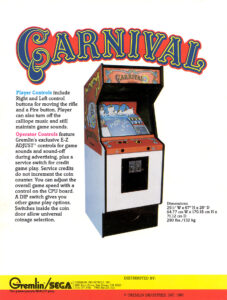
In 1980, the global market for TV games is dominated by a handful of players in the U.S. and Japan, with Europe serving primarily as a consumer market. Nakayama identified Atari, Midway, and the Sega/Gremlin alliance as the "Big Three" in the United States. To maintain its leadership position, Sega has been both an exporter of original technology and a licensor of third-party Japanese titles for the international stage. For instance, games like Astro Fighter were licensed for overseas markets, while internal hits like Carnival and Mini Monaco (Monaco GP) found unexpected success in Europe and America.
However, the transition has not been without cultural friction. Nakayama noted that the "table-type" cabinet has become the standard in Japan, whereas the "upright" cabinet remains the preference in Western markets. Sega’s attempt to reintroduce upright machines in Japan through titles like Car Hunt and Deep Scan met with mixed results, leading to a strategy of "trial and error" to find the right balance between cabinet aesthetics and operational efficiency.
Intellectual Property and the War on Copycats
As the value of video game software has skyrocketed, the industry has been plagued by the "copycat" phenomenon—unauthorized clones of popular games produced by smaller manufacturers. Nakayama took a hardline stance on this issue, noting that the legal landscape is finally beginning to favor original creators. During the height of the Space Invaders craze, a shortage of supply led some to justify copying as a necessary evil. By 1980, however, supply has stabilized, and the legal framework regarding trademarks and unfair competition has matured.
Sega/Gremlin’s legal victory against Exidy regarding the game Head-On served as a landmark case. Exidy eventually admitted fault, reinforcing the idea that video game software is a protectable form of intellectual property. Nakayama emphasized that Sega is actively pursuing "copycats" in Japan, shifting from a defensive posture to one of active enforcement. He warned that the cost of developing sophisticated, "uncopyable" hardware would inevitably lead to higher prices for operators, but argued that this is a necessary investment to ensure the industry’s creative future.
Diversification into Leisure and Hospitality
Beyond the arcade floor, Sega of America has begun experimenting with diversified leisure concepts to broaden the brand’s reach. This includes the "Sega Center" arcade chain and a new venture into the food service industry with "PJ Pizzazz," a pizza restaurant chain. These divisions represent an attempt to integrate gaming into family-oriented environments, a trend that mirrors the rise of "pizza theater" concepts in the United States, such as Chuck E. Cheese’s Pizza Time Theatre.
While these hospitality ventures are currently managed by the U.S. division, the data gathered from these operations informs Sega’s global strategy. The goal is to move beyond the image of arcades as dark, youth-centric spaces and toward a more mainstream, respectable leisure category.
Market Analysis and Future Outlook
The interview concluded with a look at the diversifying product line. While TV games are the priority, Sega is not abandoning traditional sectors. The company continues to see a steady market for pinball machines in Japan, sourcing high-quality units from American manufacturers like Williams and Stern. Additionally, Sega is revitalizing its "medal game" (token-based gambling-style games) lineup by repurposing older machines with improved software and game logic, such as Blackjack, Faro II, and Punto Banco.
Nakayama’s 1980 business policies paint a picture of a company that is no longer a regional player but a global powerhouse. By leveraging the financial backing of Gulf & Western and the creative output of both Japanese and American designers, Sega has positioned itself to lead the digital revolution. The emphasis on legal protection for software and the shift toward TV-based entertainment set the stage for Sega’s eventual transition into the home console market later in the decade. As the industry moves toward the 1981-1982 period, often cited as the peak of the arcade era, Sega’s focus on "novelty, entertainment value, and global cooperation" appears to be the definitive strategy for the new decade.