Jia Lissa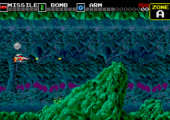
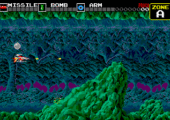
The release of Darius Extra Version for the Sega Mega Drive in 2021 represents a significant milestone in the history of retro game preservation and aftermarket software development. While the original 1986 arcade masterpiece by Taito was famous for its panoramic three-screen display and body-sonic seat, it famously bypassed Sega’s 16-bit hardware during the console’s primary commercial lifecycle. It was not until the 2019 release of the Mega Drive Mini that a functional port was officially commissioned, developed by the programmer Hidecade and polished by the emulation specialists at M2. However, the 2021 physical cartridge release, published by Columbus Circle in Japan and Strictly Limited Games in the West, transcends the initial "timeline correction" of the Mini version, offering a meticulously re-engineered experience that addresses technical limitations, gameplay imbalances, and audio fidelity.
Historical Context and Development Chronology
The journey of Darius to the Mega Drive is one characterized by decades of anticipation followed by a rapid series of technical iterations. To understand the significance of the 2021 cartridge, one must examine the timeline of the franchise’s home conversions. In the early 1990s, the PC Engine received several high-quality ports, including Super Darius and Darius Plus, which utilized the CD-ROM² and high-capacity HuCard formats respectively. The Sega Mega Drive, despite its popularity and arcade-adjacent architecture, was left without a direct port of the first entry in the series.
The chronology shifted in 2019 when Sega announced that the Mega Drive Mini would feature a brand-new port of Darius. This version was a technical marvel, fitting a three-screen arcade experience into a single-screen 16-bit format. However, as a digital-only release tied to emulation hardware, it faced certain constraints regarding input latency and audio reproduction. Recognizing the potential for a definitive physical release, M2 embarked on a second, more ambitious pass over the code. This culminated in the 2021 Darius Extra Version, which transitioned from a digital novelty to a high-specification physical cartridge compatible with original Mega Drive and Genesis hardware.
Technical Specifications and Arcade Revisions
Darius Extra Version is not merely a single game but a compilation of three distinct arcade revisions, each fine-tuned for the single-screen home environment. These revisions—referred to as OLD, NEW, and EXTRA—represent the evolution of Taito’s arcade balancing throughout the late 1980s.
The EXTRA version, originally released in arcades as a high-difficulty "tuned" edition, was historically controversial among the player base. In its original arcade form, EXTRA was designed to increase revenue by accelerating difficulty. Changes included the limitation of screen-clearing gold capsules and the introduction of "red roe" enemies that aggressively tracked the player’s ship, the Silver Hawk, prior to boss encounters. M2’s 2021 intervention involved a comprehensive re-balancing of these elements. Technical analysis shows that enemy formations in notorious areas, such as the Zone M asteroid field, were slightly thinned to prevent "unfair" deaths while maintaining a high level of challenge.
Furthermore, the cartridge introduces a "26 Boss" mode. In the original arcade hardware, ROM limitations forced Taito to reuse 11 boss designs across the game’s 28 zones. The Mega Drive cartridge utilizes its 32Mbit capacity to provide a unique boss encounter for every route, integrating bosses that were previously exclusive to the PC Engine versions, such as Steel Spine, but with updated patterns that align with the canonical behavior seen in later sequels like Darius Gaiden.
Audio Reconstruction and Fidelity Enhancements
One of the most critical improvements found in the 2021 cartridge is the overhaul of the sound subsystem. The 2019 Mini version relied on lower-quality PCM (Pulse Code Modulation) samples for sound effects and certain musical elements, which resulted in a "flattened" audio profile. For the physical release, M2 commissioned the sound artist WING☆ to rebuild the FM (Frequency Modulation) mix from the ground up.
The new audio engine maximizes the capabilities of the Yamaha YM2612 FM synthesizer and the Texas Instruments SN76489 DCSG (Digital Complex Sound Generator). This reconstruction restored the "low-end" bass frequencies essential to Hisayoshi Ogura’s avant-garde soundtrack. Iconic tracks such as "Captain Neo" and "Chaos" now exhibit greater stereo separation and clarity. Perhaps most notably, the cartridge restores the arcade-accurate "WARNING" vocal cue and the rolling, off-screen "BOOM" detonations during boss explosions—sequences that were simplified in previous home versions.
Gameplay Mechanics and Superplayer Integration
To ensure the highest level of mechanical accuracy, M2 collaborated with the renowned arcade "superplayer" KZS, a veteran of the Takadanobaba Mikado Arcade Center in Tokyo. This collaboration led to refined collision detection, rank (adaptive difficulty) adjustments, and weapon behavior tuning.
Key gameplay features included in the Extra Version:
- Variable Auto-fire: Players can set independent rapid-fire rates (10, 12, 15, 20, or 30 Hz) for different button rows, a feature essential for navigating the dense bullet patterns of the EXTRA revision.
- Scoring System Refinements: The "Remained Player Bonus" was implemented, awarding one million points per ship remaining upon completion, encouraging "no-miss" runs.
- Single-Screen Optimization: Boss patterns were adjusted to account for the reduced horizontal screen real estate. For example, the Zone X Octopus (8-Legs) had its flame spread pattern modified from a fixed three-way shot to a tracking four-way shot to prevent "safe-spot" camping.
The Secret "Arcade Mode" and Hardware Performance
Beyond the standard game modes, the cartridge contains a hidden "Arcade Mode," accessible via a specific button sequence at the title screen (R, L, B, R, L, B, L, R, B). This mode functions as a strict simulation of the original coin-operated experience. It disables the pause function and soft resets, limits rapid-fire to 10 Hz, and adheres to the original 11-boss rotation. This inclusion serves as a digital archive, allowing purists to experience the game’s original limitations within the context of the new hardware.
In terms of visual performance, the 2021 release leverages the Mega Drive’s VDP (Video Display Processor) and VRAM in unconventional ways. Despite the increased sprite count required for the EXTRA version’s denser patterns, M2 achieved a stable frame rate with minimal sprite flickering. The undulating movement of massive bosses, such as Green Coronatus, is rendered with a smoothness that rivals the original dual-68000 CPU arcade board. On original hardware, the input lag inherent in many modern emulated collections is virtually non-existent, providing the "tight" control response required for high-level shmup play.
Broader Impact on the Retro Gaming Industry
The release of Darius Extra Version is more than a simple product launch; it is a case study in how "legacy" software can be improved decades after its era has passed. By combining the talents of original developers, modern emulation experts, and high-level players, Taito and M2 have set a new standard for what a "retro port" can achieve.
Industry analysts suggest that the success of such high-quality physical releases encourages other intellectual property holders to revisit their back catalogs not just as simple ROM dumps, but as opportunities for "definitive" editions. The involvement of Columbus Circle and Strictly Limited Games also highlights the viability of the boutique physical media market for platforms that have been officially "obsolete" for nearly thirty years.
Conclusion
Darius Extra Version stands as a definitive technical achievement for the Sega Mega Drive. It successfully condenses a three-screen arcade epic into a single-screen home experience without sacrificing the scale or intensity that defined the original. Through its comprehensive inclusion of arcade revisions, unique boss encounters, and a superior FM audio mix, it provides a level of depth and replayability rarely seen in the shoot-’em-up genre. For historians and enthusiasts of the 16-bit era, the 2021 cartridge is not just a game, but a meticulously crafted piece of hardware that represents the absolute ceiling of what is possible on Sega’s legendary console.
Data Summary Table: Darius Version Comparison
| Feature | 2019 MD Mini Version | 2021 Cartridge (Extra Ver.) |
|---|---|---|
| Format | Digital / Emulated | Physical Cartridge (MD/Genesis) |
| Arcade Revisions | OLD, NEW | OLD, NEW, EXTRA |
| Boss Count | 11 (Arcade Structure) | 26 (Unique per Zone) |
| Audio Engine | PCM Samples / Basic FM | Enhanced FM (WING☆) |
| Autofire | Standard | Customizable (10Hz – 30Hz) |
| Input Lag | Dependent on Display/SoC | Zero (Native Hardware) |
| Special Modes | Boss Rush | Boss Rush, Arcade Mode, Music Test |
The 2021 release effectively renders previous home versions of the original Darius obsolete, serving as both a tribute to the past and a masterclass in modern engineering for vintage systems.