Jia Lissa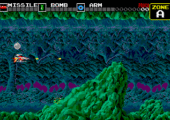
The release of Darius Extra Version for the Sega Mega Drive represents a technical milestone in the preservation and optimization of classic arcade software. Developed by the renowned studio M2 and published by Taito in collaboration with Columbus Circle and Strictly Limited Games, this 2021 cartridge release serves as a comprehensive correction of the 2019 Mega Drive Mini version, which originally brought the seminal horizontal shooter to Sega hardware for the first time. By refining the arcade’s internal revisions—OLD, NEW, and EXTRA—M2 has successfully transitioned a game historically constrained by triple-monitor arcade hardware into a cohesive, high-performance experience for single-screen displays.
Historical Context and Technical Evolution
The original Darius, released in 1986, was an anomaly of its time. Designed for a unique triple-screen arcade cabinet, the game utilized an expansive field of view that created a sense of scale rarely replicated in the 1980s. When M2 first approached the task of porting this experience to the Sega Mega Drive, the primary challenge was not merely hardware emulation, but the necessity of re-engineering the gameplay logic to suit a standard 4:3 aspect ratio.
The 2021 cartridge represents a second, more intensive pass at this goal. M2 collaborated with KZS, a veteran "superplayer" known for his expertise at the Takadanobaba Mikado Arcade Center in Tokyo. Together, they scrutinized the durability, rank, collision detection, and weapon behavior of the arcade versions to ensure that the transition to home hardware did not sacrifice the aggressive, rhythmic intensity of the source material.
Chronology of the Darius Arcade Revisions
To understand the scope of the 2021 release, one must examine the progression of the arcade revisions included on the cartridge:
- OLD Revision: Represents the initial, foundational arcade build.
- NEW Revision: A standard update that addressed initial stability and gameplay flow.
- EXTRA Revision: Historically controversial, this version was designed to increase player credit intake. It introduced aggressive enemy patterns, such as the tracking red roe before boss encounters, and restricted the availability of screen-clearing gold capsules. While it increased the difficulty ceiling, it also added elements such as the Remained Player Bonus, which rewarded high-skill play—a feature that would become a staple in later entries like Darius Gaiden.
M2’s work on the EXTRA version involved a careful rebalancing act. The team identified "unfair" difficulty spikes, such as the overwhelming debris in Zone M or the oppressive bullet walls in underwater routes, and reduced these to levels that favor player agency over arbitrary attrition. By adjusting the rank and collision parameters, the developers maintained the game’s signature intensity while removing the mechanical frustrations that had plagued the original 1980s coin-op build.
Data-Driven Performance Enhancements
The technical achievements of the 2021 cartridge extend beyond mere gameplay balance. M2 successfully optimized the game to handle the increased sprite density of the EXTRA version without the slowdowns that characterized the original arcade hardware.
The sound engine also received a significant overhaul. Sound artist WING—known for contributions to the Mega Drive Mini 2’s audio—was commissioned to rebuild the FM synthesis mix. Utilizing the YM2612 and DCSG chips, the team improved stereo separation and restored high-fidelity PCM samples for sound effects, including the iconic "WARNING" alert. Furthermore, the cartridge restores the authentic off-screen explosion sequences, which were previously downsampled or flattened in earlier home interpretations.
The cartridge also offers granular control for enthusiasts. Players can toggle auto-fire settings between 10, 12, 15, 20, and 30 Hz, with independent settings for different button rows. These options, combined with the removal of input lag, place the performance of this version above that of the 2019 Mini release.
Expansion of the Boss Encounter Structure
A significant addition to the 2021 release is the expanded boss structure. Due to ROM size limitations in 1986, the arcade version reused 11 bosses across its branching map. The current cartridge allows players to choose between the original structure and a "26 Bosses" mode. In the latter, every route features a unique boss encounter, turning the game’s branching map into a strategic decision-making process where route selection dictates both the difficulty and the specific mechanical challenges the player will face.
Notably, M2 updated the behavior of certain bosses to reflect their modern iterations. For instance, the Steel Spine in Zone J now behaves in accordance with its patterns from later sequels, rather than the simplified versions found in the early PC Engine ports. This attention to detail transforms the game from a static arcade port into a living document of the series’ evolution.
Strategic Implications and Gameplay Mechanics
The gameplay loop of Darius Extra Version is defined by the tension between scoring and survival. The branching map forces the player to manage weapon progression; upper routes, for example, offer an abundance of blue power-ups but starve the player of the green variety, potentially leaving the player underpowered for the boss of a given zone.
The inclusion of an "Arcade Mode"—accessible via a hidden command sequence (R, L, B, R, L, B, L, R, B)—provides a rigorous, "purist" experience. This mode enforces a strict ruleset: no pausing, no soft resets, limited rapid-fire, and a return to the original 11-boss structure. This caters specifically to the competitive arcade community, allowing for separate, verified high-score tracking.
Broader Impact on the Retrogaming Industry
The release of this cartridge underscores a growing trend in the gaming industry: the shift from "emulation as convenience" to "emulation as curation." By treating the source code not as a static file to be run, but as a framework to be perfected, M2 has set a high bar for future releases of legacy titles.
The commitment to fixing edge-case bugs, such as power-up orbs becoming trapped in stage geometry, demonstrates a level of quality assurance rarely seen in retro-collection releases. Furthermore, the inclusion of a comprehensive music test with a repeat function and a soft-reset command (A+B+C + Start) indicates a deep understanding of user needs for high-level play.
Conclusion
Darius Extra Version serves as a masterclass in software preservation. By synthesizing the best elements of the arcade revisions with modern technical refinements, M2 has delivered an experience that feels both authentic to its 1986 roots and polished for contemporary standards. For owners of the Sega Mega Drive, this release represents not just a piece of software, but the culmination of years of technical research and community feedback. It stands as a definitive, highly replayable, and technically superior title that justifies its status as one of the most significant releases in the system’s long, storied history. The precision of the controls, the depth of the branching paths, and the fidelity of the audio make it a mandatory addition for any serious collector of the 16-bit era.