Edi Durjana
The open-source emulation powerhouse, RetroArch, has officially released its highly anticipated 1.20.0 update, marking a significant stride forward in delivering an unparalleled retro gaming experience. Available for download immediately, this latest iteration introduces groundbreaking features, including a revolutionary CRT beam simulation shader developed in collaboration with industry luminaries, and pioneering illuminance sensor support for Linux, promising a new level of authenticity for classic titles. The release reinforces RetroArch’s long-standing commitment to its user base, emphasizing a philosophy free from in-app advertisements, monetization SDKs, or paywalled features, a stance that has garnered widespread appreciation within the global emulation community.
A Pillar of Open-Source Emulation: The RetroArch Ethos
RetroArch functions as the official frontend for the Libretro API, a powerful and modular framework designed to allow developers to create cross-platform applications that utilize rich features like OpenGL, cross-platform camera support, location services, and more. At its core, RetroArch provides a unified interface for a vast array of emulation "cores," each representing a different game console or computer system. This architecture allows users to play games from dozens of different platforms—from classic arcade machines and 8-bit consoles to more modern systems—all within a single application. This approach has consolidated the emulation landscape, offering advanced features like savestates, rewind functions, netplay, and highly customizable video and audio settings that transcend the capabilities of individual standalone emulators.
Since its inception, the Libretro project, and by extension RetroArch, has been built on the principles of open-source development and community contribution. This collaborative model has fostered a vibrant ecosystem where volunteer developers continually refine existing cores, add new ones, and implement innovative features. The project’s explicit rejection of commercial monetization strategies—such as in-app ads, predatory microtransactions, or subscription-based access to core functionalities—stands in stark contrast to many contemporary software models. This unwavering dedication to a user-first experience is not merely a philosophical preference but a practical decision that builds trust and loyalty within its extensive user base. The team openly invites user support through donations via platforms like Patreon and GitHub Sponsors, as well as merchandise purchases from their Teespring store, allowing the community to directly contribute to the project’s sustainability and continued innovation. This funding model ensures that development remains driven by technical excellence and user needs rather than commercial pressures, a fact frequently highlighted by community members as a key differentiator.
Revolutionizing Visuals: The Shader Subframes Innovation
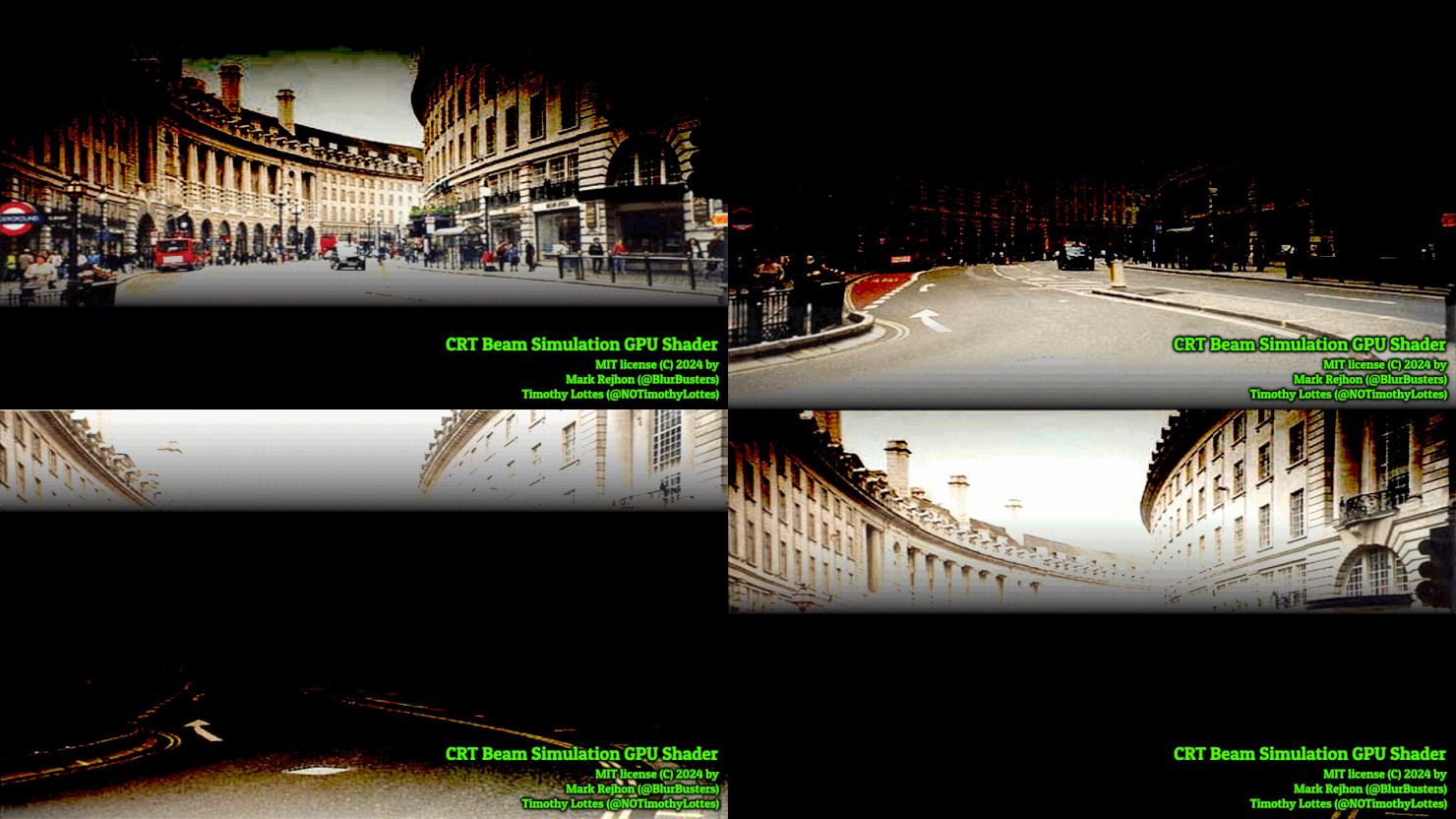
One of the most compelling enhancements in RetroArch 1.20.0 is the introduction of a new CRT beam simulation shader, a collaborative effort between display technology expert Mark Rejhon of BlurBusters and graphics programming legend Timothy Lottes. This feature represents a significant leap forward in recreating the authentic visual experience of cathode ray tube (CRT) displays on modern flat-panel screens.
For decades, retro gaming enthusiasts have grappled with the challenge of accurately replicating the unique visual characteristics of CRTs, which intrinsically delivered superior motion clarity and distinct scanline effects due to their refresh mechanisms. Modern LCD, OLED, and other panel technologies, while offering higher resolutions and vibrant colors, often struggle to reproduce the fluid motion and characteristic phosphorescent glow of CRTs. Previous attempts to simulate this often involved techniques like Black Frame Insertion (BFI), which works by inserting a black frame between each displayed frame to reduce motion blur. However, BFI implementations typically suffer from notable drawbacks, including a significant reduction in overall screen brightness, dulled color saturation, and a heightened risk of image persistence—a temporary form of image retention that, while not permanent "burn-in," can still be a concern for many users, especially on certain LCD panel types.
The new CRT beam simulation shader leverages RetroArch’s recently implemented "subframe" shader capabilities to bypass these limitations. In essence, subframe rendering allows the emulator to process and display multiple distinct visual states within a single refresh cycle of the monitor. Instead of simply inserting a black frame, this advanced technique dynamically renders elements that simulate the intricate nuances of a CRT’s electron beam scanning across the screen, including subtle brightness fluctuations and persistence effects that contribute to the authentic CRT "look." This method meticulously recreates the rapid illumination and decay of phosphors, which are critical for the perception of smooth motion and sharp pixel definition inherent to CRTs, without sacrificing brightness or color vibrancy.
Mark Rejhon, widely recognized for his work at BlurBusters in analyzing and improving display motion clarity, brings a deep understanding of human visual perception and display technology to this collaboration. His insights into how the eye perceives motion and flicker on different display types have been instrumental. Timothy Lottes, famous for creating the original FXAA (Fast Approximate Anti-Aliasing) shader and the popular crt-lottes shaders, contributes his extensive expertise in real-time graphics rendering and shader development. Their combined knowledge has culminated in a solution that offers superior motion clarity, reduced perceived flicker, and a more faithful emulation of CRT aesthetics, pushing the boundaries of what is achievable on contemporary displays. This innovation not only enhances the visual fidelity of retro games but also reduces potential eye strain that can be associated with less sophisticated motion blur reduction techniques. The implications extend beyond mere aesthetics, contributing to a more immersive and historically accurate gameplay experience for titles originally designed with CRT displays in mind. Users keen to delve deeper into the technical specifics of this groundbreaking shader can find a dedicated article on the Libretro website, detailing its functionality and benefits.
Bridging Worlds: Illuminance Sensor Support for Linux
Another standout feature in the 1.20.0 update is the introduction of illuminance sensor support for Linux, a pioneering effort spearheaded by developer Jesse Talavera. This innovative integration directly addresses a unique challenge posed by certain retro games that incorporated real-world environmental interactions. The most prominent example is Hideo Kojima’s Boktai: The Sun Is Your Hand for the Game Boy Advance. This series famously required players to physically expose their GBA console to sunlight, utilizing a built-in solar sensor to charge in-game weapons and solve puzzles. For years, emulating this core mechanic presented a significant hurdle, often requiring players to resort to cheats or manually adjust emulated light levels, thereby diminishing the intended immersive experience.
With RetroArch 1.20.0, Linux users, particularly those on devices like the Steam Deck which often feature integrated ambient light sensors, can now enjoy Boktai and similar titles as originally intended. Jesse Talavera’s work allows RetroArch to interface with the system’s illuminance sensor data, translating real-world light levels directly into the emulated environment. A compelling demonstration video showcases Lunar Knights (the Nintendo DS sequel to Boktai) running on a Steam Deck, with the in-game environment dynamically responding as the user adjusts the surrounding lighting conditions. This direct hardware integration moves emulation beyond mere software replication, bridging the gap between digital simulation and physical interaction.
The implementation for Linux lays the groundwork for broader hardware sensor support across more platforms in future updates. The announcement specifically mentions that melonDS DS, a popular Nintendo DS core for RetroArch, will soon include solar sensor support, further enhancing the authenticity for DS titles. Additionally, future updates are slated to include camera support for a wider range of platforms, opening up possibilities for emulating games that utilized camera peripherals, such as Game Boy Camera or specific PlayStation 2 titles. This progressive integration of real-world sensor data underscores a growing trend in emulation to achieve maximal fidelity to the original gaming experience, acknowledging that hardware interactions were often integral to a game’s design. This commitment to physical accuracy is particularly exciting for preservationists and enthusiasts who seek to experience these unique titles in their most authentic form.
Behind the Scenes: The Continuous Evolution of RetroArch
While the shader subframes and illuminance sensor support are the headline features of RetroArch 1.20.0, the update encompasses a much broader range of improvements typical of the project’s continuous development cycle. Though the full changelog was not detailed in the initial announcement snippet, RetroArch releases routinely include numerous bug fixes, performance optimizations, and backend enhancements that collectively improve stability, compatibility, and user experience across its myriad supported platforms and cores. These often involve updates to specific Libretro cores, addressing glitches, improving accuracy, or adding new features to individual emulators. Furthermore, underlying infrastructure improvements ensure better compatibility with evolving operating systems, graphics APIs, and hardware configurations.
The iterative nature of RetroArch’s development, driven by a global community of volunteers, means that each release builds upon previous versions, incrementally refining and expanding its capabilities. This dedication to ongoing improvement, from fixing obscure bugs in niche cores to implementing cutting-edge display technologies, is a testament to the passion and technical prowess of the Libretro team and its contributors.
Broader Impact and Future Implications
The release of RetroArch 1.20.0 solidifies the project’s position at the forefront of the emulation scene, not just as a comprehensive frontend, but as an innovator pushing the boundaries of what open-source software can achieve. The shader subframes technology sets a new benchmark for visual authenticity in retro gaming, offering a solution to motion clarity that surpasses previous methods and elevates the fidelity of emulated visuals. This could potentially influence display manufacturers or other emulation projects to explore similar subframe rendering techniques, contributing to a wider industry understanding of motion perception on modern screens.
Similarly, the illuminance sensor support represents a significant step towards full hardware parity in emulation. By enabling real-world interactions for games like Boktai, RetroArch is not only enhancing the user experience but also contributing to the preservation of unique gameplay mechanics that were previously challenging to replicate outside of original hardware. This trend towards deeper hardware integration, including future camera support, suggests a future where emulation can offer an experience indistinguishable, or even superior, to playing on original systems, without the inherent limitations of aging hardware.
The project’s unwavering commitment to its open-source, user-centric philosophy continues to be a powerful model for software development. In an industry increasingly dominated by monetization strategies, RetroArch stands as a beacon for free and accessible software, sustained by the direct support and belief of its community. This approach fosters a unique relationship between developers and users, where innovation is driven by passion and collective desire for the best possible retro gaming experience. As technology continues to evolve, RetroArch’s ability to adapt and integrate new advancements, while staying true to its core principles, ensures its continued relevance and leadership in the world of digital preservation and retro gaming. The 1.20.0 update is not merely a collection of new features; it is a declaration of intent, signaling RetroArch’s ongoing mission to deliver the definitive platform for experiencing the rich history of video games.