Farhan hamdan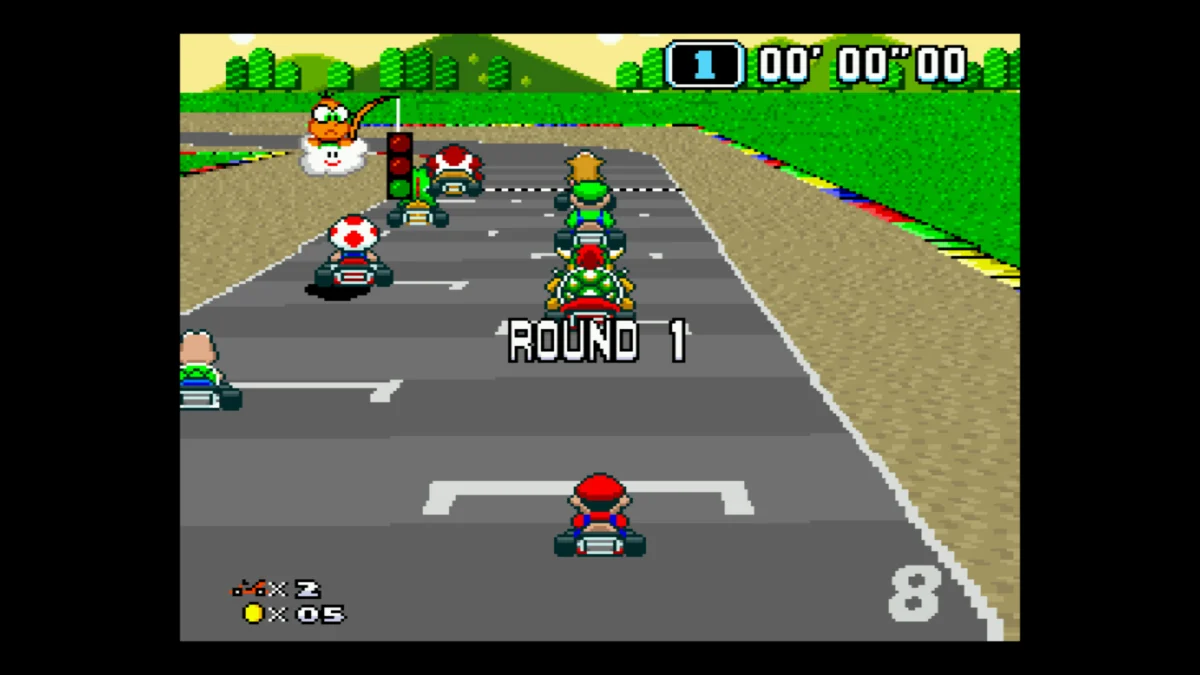
The landscape of retro video game modification has reached a significant milestone with the release of a new ROM hack for the Super Nintendo Entertainment System (SNES) classic, Super Mario Kart. Developed by modder Psicopompo, the newly released version 1.2 patch fundamentally transforms the game’s single-player mode, expanding the action from the traditional split-screen layout to occupy the console’s complete 256×224 display resolution. While simple in concept, the engineering feat required to achieve this visual overhaul represents a deep, hardware-level intervention into one of the 16-bit era’s most technically defining titles.
Main Facts and Technical Achievement
Released in 1992 by Nintendo EAD under the direction of Tadashi Sugiyama and Hideki Konno, Super Mario Kart was a pioneer in the racing genre, largely due to its groundbreaking implementation of Mode 7 graphics scaling and rotation on the SNES hardware. To manage the processing overhead of rendering pseudo-3D environments and maintaining a consistent framerate, the developers partitioned the display. In single-player mode, the top half of the screen rendered the primary gameplay camera, while the bottom half displayed a real-time overhead map and a rear-view mirror.
Psicopompo’s patch eliminates this division for single-player sessions, utilizing the entire vertical screen space for the racing action. However, the modification is far from a superficial configuration tweak. Because the original game logic—including collision detection, item deployment routines, kart physics, and camera tracking—was intrinsically hardcoded around the half-view coordinate system, expanding the viewport broke fundamental mechanics.
To overcome this, the developer engaged in extensive low-level analysis, scrutinizing Object Attribute Memory (OAM) registers and Direct Memory Access (DMA) routines. According to hardware-level testing, the patch requires tracing specific pathways on the SNES motherboard and examining internal chip operations to redirect how graphical data is rendered. Notably, the two-player competitive modes remain entirely untouched by the patch, preserving the classic split-screen experience for head-to-head play. Early hardware testing confirms that version 1.2 runs stably on authentic SNES consoles via flash carts, matching the performance and framerate of the unmodded 1992 release.
Chronology of the Mod’s Development and Release
The progression of Super Mario Kart modification reflects decades of community-driven reverse engineering. While sprite swaps, custom track design (via tools like Super Mario Kart Track Editor), and music hacks have existed for years, core engine overhauls remained exceedingly rare due to the complexity of Mode 7 programming.
- 1992: Nintendo releases Super Mario Kart for the Super Famicom in Japan and the SNES internationally, establishing the template for kart racers.
- Late 1990s to 2010s: The ROM-hacking community maps out the game’s data structures, enabling custom cup creation and physics adjustments, though the display layout remains universally constrained by the original engine’s design.
- Mid-2020s: Modder Psicopompo begins investigating the feasibility of removing the bottom-screen map to achieve a full-screen presentation. Preliminary tests focus on dismantling the display logic tied to the Mode 7 rendering pipeline.
- October 2026: Psicopompo officially releases version 1.2 of the Fullscreen patch on ROMhacking.net, accompanied by technical demonstrations shared via social media platform X by community members such as Wobbling Pixel.
Supporting Data and Structural Compromises
Achieving a true fullscreen experience necessitated certain functional sacrifices. Most notably, the real-time track map and the rear-view mirror have been entirely excised from the single-player presentation.
In technical documentation accompanying the release, Psicopompo addressed the omission of these UI elements: both features relied heavily on distinct Mode 7 rendering passes, High-Definition Multiplexing (HDMA) window effects, and specialized arithmetic calculations bound directly to the split-screen layout. Attempting to integrate the map back into the expanded viewport would have required reintroducing frame-splitting logic, effectively negating the foundational code restructuring achieved by the patch.

Despite the absence of an on-screen map, retro gaming analysts note that the trade-off offers a radically different perspective on classic tracks like Mario Circuit, Ghost Valley, and Rainbow Road. For over three decades, players accustomed to flat-panel displays have relied on external hardware scalers—such as line-doublers and upscalers like the RetroTINK series—to artificially zoom in on the top half of the native display, sacrificing image clarity and cropping the presentation. Psicopompo’s patch bypasses these display-level workarounds by modifying the software rendering pipeline directly at the ROM level.
Community Reaction and Industry Context
The release has drawn considerable attention across retro gaming preservation and modification forums. The community response highlights a growing appetite for deep engine-level hacks that challenge the perceived limitations of 16-bit hardware.
Independent retro media creators have also contextualized the release within the broader history of the franchise. Documentarians and historians—such as Yahel of Wrestling With Gaming, who produced an in-depth retrospective on the development of Super Mario Kart—have frequently pointed out that the game’s creators were forced to make immense compromises to deliver a fluid multiplayer experience within the strict memory and processing constraints of the 3.58 MHz Ricoh 5A22 CPU.
By removing the split-screen map in a single-player context, modern modders are effectively revisiting design choices made by Nintendo nearly thirty-five years ago, repurposing idle processing cycles to prioritize immersion and visual scope.
Broader Impact and Implications for Retro Preservation
While ROM hacks traditionally focus on content additions—such as new tracks, characters, or graphical overhauls—engine-level modifications like Psicopompo’s fullscreen patch demonstrate an evolving technical sophistication within the emulation and homebrew communities.
As original hardware ages and the demand for modern display compatibility grows, software-level patches offer a bridge between vintage consoles and contemporary hardware setups. By altering the core rendering architecture without sacrificing frame rate or system stability, the project sets a precedent for how classic 2D and pseudo-3D engines can be modernized.
The patch is currently available for public download via ROMhacking.net, where comprehensive installation instructions and technical readmes are hosted for enthusiasts looking to apply the modification to their legally dumped ROMs and test it on original SNES hardware or accurate FPGA-based emulation platforms.