Indra Gunadi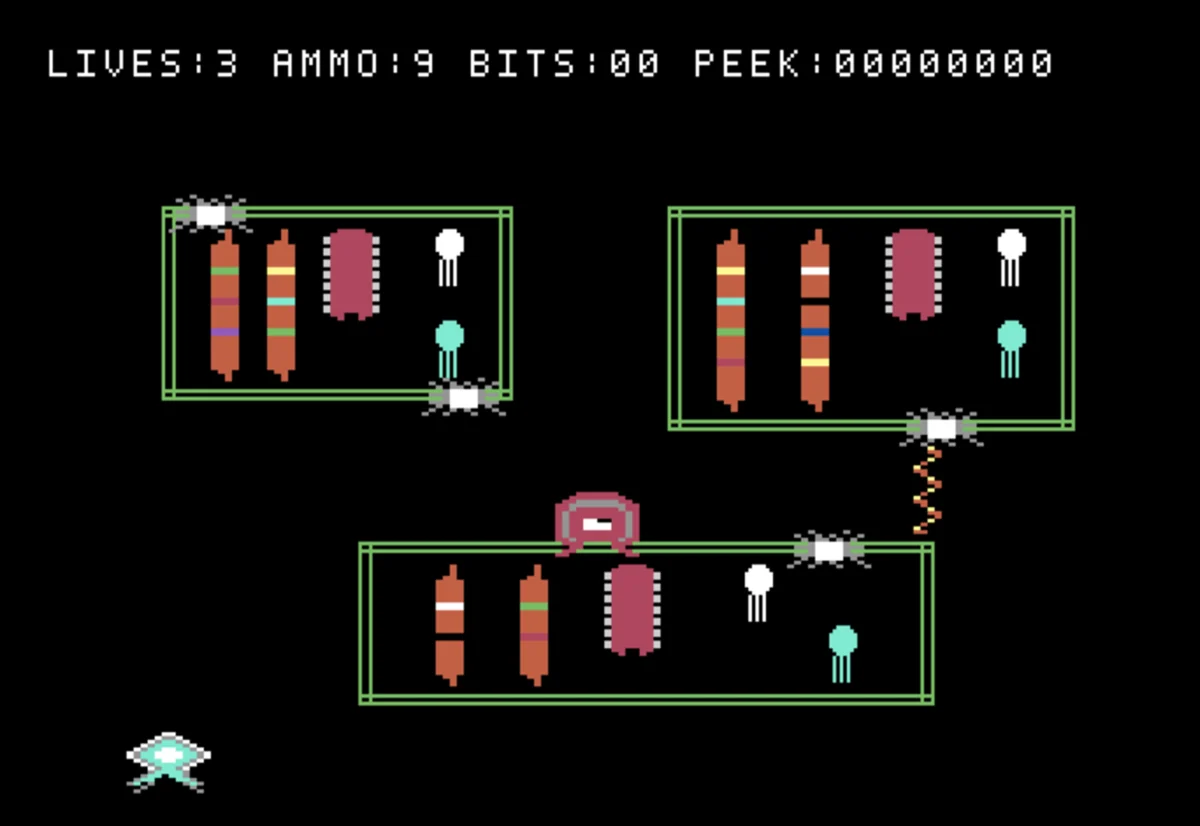
The Conceptual Foundation of Motherboard
At its core, Motherboard is a thematic exploration of the Commodore 64’s hardware limitations and capabilities. By setting the action inside the machine’s own circuitry, the developer bridges the gap between low-level machine language programming and mainstream gaming mechanics. The gameplay loop centers on the manipulation of fundamental C64 operations. Players are tasked with shooting POKEs to acquire PEEK values, a direct reference to the BASIC commands used by programmers in the 1980s to manipulate memory addresses. By turning these abstract commands into gameplay mechanics, the title offers a layer of meta-commentary on the history of 8-bit software development.
The environmental hazards within the game are similarly themed. Players must navigate and dodge "grid bugs" that occupy the virtual traces of the motherboard, a nod to the hardware-level errors that often plagued early computing enthusiasts. The climax of the gameplay involves defending the system’s memory from encroaching "FLIP-FLOPs," the fundamental building blocks of digital logic circuits. This integration of technical terminology into an arcade format serves both as an educational homage to the hardware and a functional challenge for the player.
Chronology of Modern C64 Development
The release of Motherboard occurs within a broader context of a sustained revival for the Commodore 64, a platform that has maintained a dedicated community for over four decades. While the C64 was commercially discontinued in 1994, the homebrew scene has seen a significant surge in activity since the mid-2010s.
- 1982: The Commodore 64 is released, becoming the highest-selling single computer model of all time.
- 1994: Commodore International declares bankruptcy, marking the end of official support.
- 2010–2015: The "Modern Retro" movement begins, characterized by the release of high-quality disk magazines and the development of new game engines, such as the C64 OS.
- 2020–2025: Increased accessibility to cross-development tools allows modern developers to write C64 software on contemporary PCs, leading to a surge in high-fidelity titles.
- September 2026: Motherboard is launched as a testament to the platform’s enduring flexibility and the capabilities of modern cross-platform development toolchains.
The development of titles like Motherboard is made possible by modern software cross-compilers and emulators that allow developers to push the boundaries of the MOS Technology 6510 processor far beyond what was thought possible during the machine’s initial production run.
Technical Analysis and Supporting Data
The Commodore 64 features a 1.023 MHz (NTSC) or 0.985 MHz (PAL) processor and 64 kilobytes of RAM. For a developer like chadlung to create a smooth, responsive shooter, the game must navigate these strict constraints. Unlike modern software, which often relies on bloated libraries and high-level abstractions, C64 software must operate within the raw cycles of the 6510 CPU.
The inclusion of AI-assisted content, as noted in the developer documentation, highlights a growing trend in the retro-development community. The use of generative tools to assist in graphics design, coding snippets, and sound production is increasingly common, allowing solo developers to achieve results that previously would have required a full team in the 1980s. This hybrid approach—combining modern generative AI with the constraints of vintage hardware—allows for more complex sprites, smoother animations, and more varied soundscapes than the titles of the original C64 era.
Broader Impact on the Retro-Computing Ecosystem
The release of Motherboard is indicative of a shift in the retro-computing ecosystem from mere preservation to active creation. Historically, the community focused on archiving existing software, repairing physical hardware, and documenting the history of the 8-bit era. However, the last five years have demonstrated that the community is now heavily invested in expanding the library of "new-old" software.
This shift has significant implications for the longevity of the platform. By creating new games that utilize the C64’s architecture in innovative ways, developers ensure that the machine remains a viable tool for creative expression rather than a static relic of computer history. Furthermore, the interest in such titles often drives demand for hardware peripherals, such as modern SD-card-based disk emulators (e.g., the 1541 Ultimate or Pi1541), which allow users to run new software on original, restored hardware.
Professional and Community Perspectives
While official statements from major software houses regarding niche 8-bit releases are rare, the reception from the enthusiast community has been overwhelmingly positive. Observers note that games like Motherboard serve a vital role in keeping the community engaged. By incorporating educational elements—such as the PEEK and POKE references—the game acts as an entry point for younger generations to understand the basics of memory management and digital logic.
Analysts in the field of digital preservation often highlight the importance of "active engagement" in preserving technological history. When a developer builds a game for a 44-year-old platform, they are not just creating entertainment; they are performing a deep-dive technical audit of the hardware’s limits. The process of debugging such a game on actual Commodore 64 hardware provides valuable data on how the machine’s custom chips, the VIC-II (video) and the SID (audio), handle modern stress testing.
Implications for Future Development
The release of Motherboard suggests that the ceiling for what can be achieved on the Commodore 64 is still rising. As generative AI tools become more integrated into the development pipeline, the barrier to entry for complex, high-quality 8-bit software is lowering. We can expect to see an increase in games that, like Motherboard, move away from standard platformer and sports tropes to explore the technical nature of the computer itself.
Furthermore, the game serves as a successful example of how independent developers can utilize internet-based distribution platforms—such as pdroms.de—to reach a global audience. The ability to distribute software instantaneously, regardless of the platform’s age, has essentially eliminated the geographical barriers that hindered the original 8-bit software market.
In conclusion, Motherboard by chadlung is more than a simple arcade shooter. It is a piece of contemporary software that honors its heritage through thematic design while embracing modern development methodologies. It reinforces the status of the Commodore 64 as a platform that continues to evolve, providing a canvas for developers to blend historical hardware constraints with the possibilities of modern artificial intelligence. As the community moves toward 2027 and beyond, the legacy of the C64 will likely be defined not just by what it achieved in the 20th century, but by how it continues to inspire technical innovation in the present day. The commitment shown by developers like chadlung ensures that the internal circuitry of the C64—both real and virtual—remains a vibrant space for creative exploration for years to come.