Vera Clarissa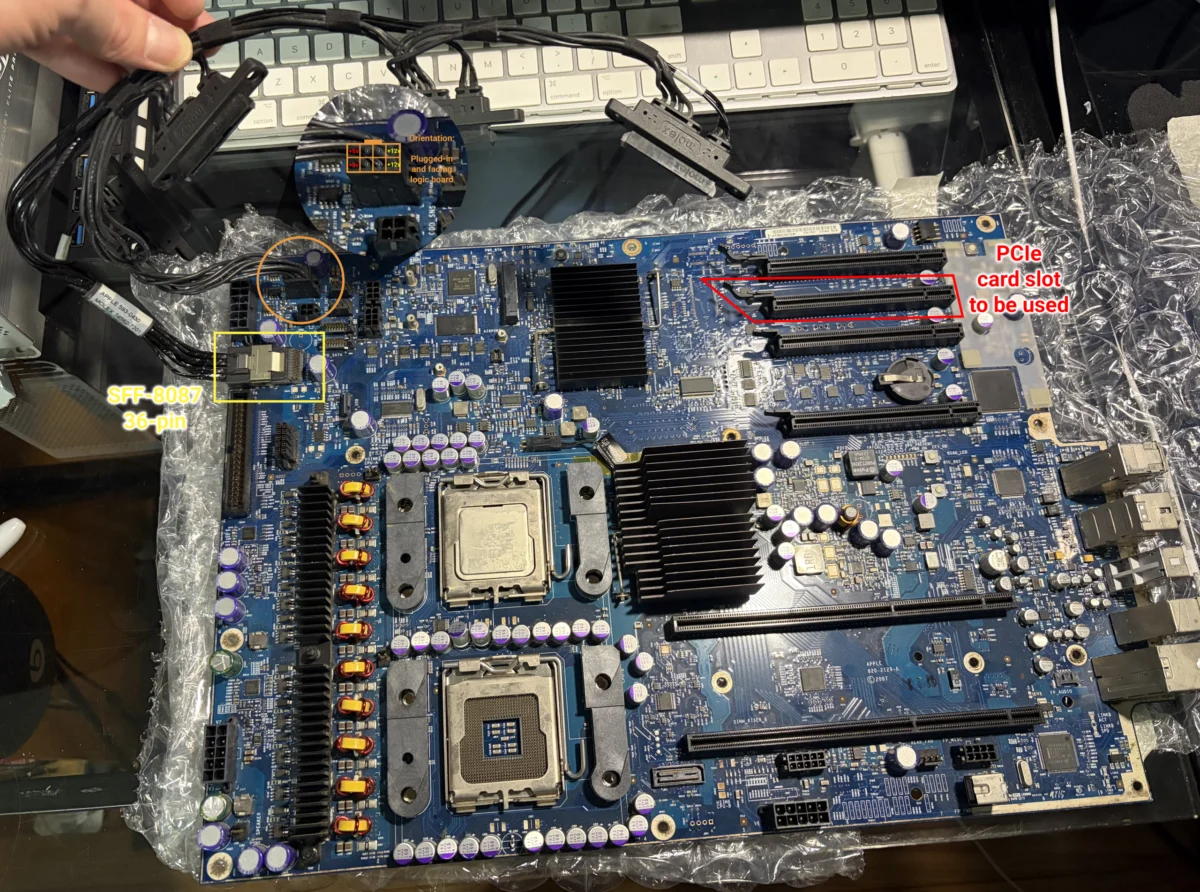
The classic Mac Pro 1,1 and 2,1 towers, introduced in 2006 and 2007 respectively, remain popular platforms for vintage computing enthusiasts and hardware modifiers. While these machines were marvels of engineering during their initial release, their onboard storage architecture—specifically the SATA II interfaces—now acts as a significant bottleneck for modern solid-state drives (SSDs) and high-density mechanical storage arrays. Bridging the gap between legacy Apple hardware and modern PCIe-based RAID controllers, such as the HighPoint RocketRAID 2720SGL, requires custom solutions that often involve repurposing internal cabling and proprietary power connectors. This technical overview examines the methodology for integrating modern RAID cards into early-generation Mac Pro systems, the electrical considerations of such modifications, and the performance implications for legacy systems running modern operating systems like OS X El Capitan.

Historical Context and Hardware Constraints
The Mac Pro 1,1 and 2,1 were designed with a unique internal layout featuring a modular drive backplane that simplified the installation of four 3.5-inch hard drives. These drives connect to a logic board via a proprietary wiring harness. By modern standards, the integrated SATA II ports, which operate at a maximum theoretical speed of 3.0 Gbps, are insufficient for maximizing the potential of contemporary SATA III SSDs, which can reach speeds exceeding 500 MB/s.
To circumvent this limitation, users often install aftermarket PCIe RAID cards. However, the Mac Pro 1,1/2,1 logic board utilizes specific SFF-8087 36-pin Mini-SAS connectors for internal data transmission. Integrating a third-party card like the RocketRAID 2720SGL requires physical adaptation of both the data path and the power delivery system, as the standard Mac Pro drive backplane does not natively interface with the power requirements of modern third-party RAID controller cards when they are installed in PCIe slots located far from the original drive cage.

Chronology of the Modification Process
The process of upgrading storage performance in these legacy systems typically follows a defined technical sequence. Initially, the user must establish connectivity between the RAID controller—situated in a PCIe slot—and the physical drive bays. When an official SFF-8087 to SATA/SAS cable is unavailable, technicians often opt for a custom approach involving the repurposing of existing internal harnesses.
- Assessment Phase: Upon opening the chassis, the technician identifies that the drive bay wiring harness power connector is geographically isolated from the RAID controller’s Mini-SAS port.
- Power Extraction: To supply the necessary voltage to the drives, power is typically tapped from the optical bay’s Molex headers. This requires a 6-pin to 8-pin PCIe power adapter, which must be modified to match the proprietary pinout of the Mac Pro’s internal power distribution system.
- Pin Modification: The Molex adapter pins are carefully removed from their plastic housing. Each pin is flattened and vertically trimmed to ensure a secure, interference-free connection to the mini 8-pin PCIe power socket.
- Insulation and Security: Once the connections are established, the exposed wiring is sleeved to prevent short circuits. Given the cramped environment of the Mac Pro chassis, securing these connections is critical to long-term reliability.
- Driver and Kernel Integration: For users operating on OS X El Capitan, the installation of modified kernel extensions (kexts) is often required to ensure the system recognizes the RocketRAID 2720SGL as a functional boot or storage device.
Electrical and Technical Specifications
The power distribution within the Mac Pro is highly sensitive. The 8-pin PCIe power connector on the motherboard requires precise voltage delivery. Analysis of the pinout indicates that users must exercise extreme caution when drawing power from the optical bay.

For setups utilizing multiple 3.5-inch desktop hard drives, the power draw exceeds what a single Molex connector can reliably provide. In such instances, engineers recommend utilizing two separate Molex connectors—one for each row of the 8-pin plug—to ensure balanced electrical load and prevent potential thermal damage to the cabling. Conversely, when powering high-efficiency SSDs, a single Molex source is generally sufficient, provided the connections remain stable and free of impedance issues.
Performance Benchmarking and Data Throughput
Testing the RocketRAID 2720SGL in a Mac Pro 1,1 configured with a Corsair Force GT 240GB SSD yields significant performance improvements over the native onboard SATA II controllers. In benchmark trials, the modified configuration achieved read speeds of approximately 477 MB/s and write speeds of 388 MB/s.

These figures demonstrate that the bottleneck is no longer the motherboard interface but rather the limitations of the PCIe bus allocation on the early Mac Pro models. Notably, the RAID card demonstrates adaptive behavior; when a single HDD or SATA II SSD is connected, the card may only utilize a single PCIe lane. However, when paired with high-speed SSDs, the card effectively leverages its x8 lane availability, providing a substantial boost in throughput that effectively modernizes the data storage capabilities of the decade-old hardware.
Broader Implications for Legacy Systems
The ability to successfully integrate modern RAID controllers into the Mac Pro 1,1 and 2,1 has broader implications for the longevity of high-end, early-2000s computing hardware. By upgrading storage, users can significantly reduce the latency associated with legacy operating systems like OS X El Capitan, which, while no longer receiving security updates, remains a stable environment for specific legacy software suites.

Furthermore, this modular approach challenges the planned obsolescence often associated with high-end workstations. By repurposing internal wire harnesses and utilizing standardized third-party controllers, users can achieve performance metrics that rival lower-end modern consumer desktops.
Future Considerations and Bootloader Challenges
While the storage performance is vastly improved, the primary obstacle remaining for this configuration is the boot sequence. Standard RAID cards often lack the EFI firmware required for the Mac Pro’s native bootloader to recognize them as bootable volumes. Future efforts are currently directed toward testing the compatibility of bootloaders such as rEFIt or OpenCore to determine if a full OS X El Capitan installation can be successfully booted from the RocketRAID array.

If successful, this would represent a complete revitalization of the Mac Pro 1,1. The prospect of utilizing a RAID 0 SSD array on this platform—a configuration that would have been cost-prohibitive and technically difficult to achieve in 2007—suggests that with minor hardware modifications and software-level intervention, legacy hardware can be effectively utilized for contemporary, high-bandwidth data tasks.
Conclusion
The modification of internal Mac Pro cabling to support modern RAID controllers is a technically sound method for extending the utility of legacy Apple workstations. By carefully managing electrical loads and navigating the complexities of PCIe lane allocation, users can overcome the inherent limitations of the 2006-era architecture. As the community continues to explore the limits of these machines, the integration of high-speed RAID solutions stands as a testament to the robust, modular engineering that originally defined the Apple professional product line. Future research into bootloader compatibility remains the final frontier in fully unlocking the potential of these enduring computing platforms.