Farhan hamdan
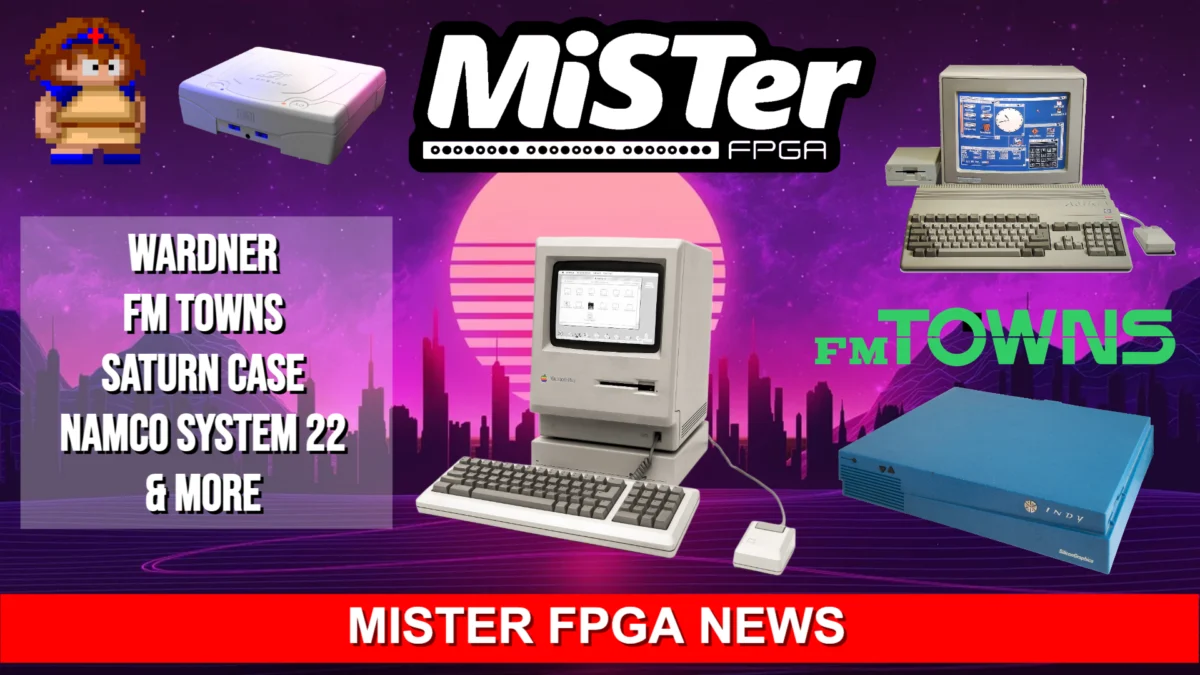
The MiSTer FPGA project continues to cement its status as the premier open-source hardware emulation platform, driven by a relentless community of developers pushing the boundaries of what programmable logic arrays can achieve. Over the recent development cycle, the ecosystem has witnessed a massive influx of new core releases, hardware integrations, architectural enhancements, and software utilities. From classic 1980s arcade cabinets and iconic 16-bit personal computers to complex 32-bit workstations and cutting-edge custom hardware add-ons, the scope of retro preservation on the MiSTer platform has expanded exponentially.
This comprehensive roundup details the latest hardware milestones, core betas, platform expansions, and community utilities shaping the future of FPGA-based hardware preservation.
Arcade Preservation and Core Releases
The heart of the MiSTer platform has always been its faithful, cycle-accurate arcade hardware implementations. Recent weeks have added significant titles to this expanding catalog, bridging gaps in arcade history ranging from early shoot-’em-ups to advanced 3D polygon-pushing hardware.
Konami’s classic catalog received a notable expansion with the public beta release of the Battlantis MiSTer core. Released originally in 1987, Battlantis shares thematic and mechanical similarities with genre-defining titles like Space Invaders, though it incorporates distinctive tactical differences and structured boss battles that challenged arcade-goers of the late eighties. Joining Battlantis is another Konami staple, Detana!! TwinBee. As the fifth installment in the beloved TwinBee series, this vertically scrolling cute-em-up brings its vibrant color palette and distinctive power-up mechanics to the FPGA landscape.
Coin-Op Collection’s ongoing preservation efforts have also yielded major milestones. The platform has officially released the final entry for the Twin Cobra hardware family with the arrival of Wardner, a side-scrolling action platformer. Users can readily access Wardner by enabling the Coin-Op Collection repository within their update scripts. Simultaneously, Coin-Op Collection has unleashed the first public wave of Data East’s formidable DECO-16 platform. This rollout encompasses a stellar lineup of arcade heavyweights, including Vapor Trail, Crude Buster (Two Crude), Dark Seal (Gate of Doom), The Cliffhanger: Edward Randy, Caveman Ninja (Joe & Mac), RoboCop 2, Tumble Pop, Boogie Wings (The Great Ragtime Show), and Thunder Zone.
Shooter fans have additional reasons to celebrate with the deployment of dedicated cores for Raiden II and Raiden DX. These vertically scrolling masterpieces require precise timing and high-speed rendering capabilities, both of which are expertly handled by the MiSTer framework. Furthermore, developer Ross Esposito has contributed a monumental release to the GitHub repository: a fully functional core for Sega’s X Board. As one of Sega’s legendary Super Scaler arcade hardware platforms, the X Board powers a string of monumental arcade hits. The new core successfully executes After Burner and After Burner II, Thunder Blade, Super Monaco GP, Racing Hero, A.B. Cop, GP Rider, Last Survivor, and Line of Fire.
Finally, high-end arcade architecture is seeing unprecedented progress. Two distinct development efforts are currently advancing cores for Namco System 22 and Super System 22 hardware, enabling playable experiences for titles like Prop Cycle, Time Crisis, and Armadillo Racing despite varying degrees of preliminary compatibility. Additionally, a dedicated core for the rare Namco System FL hardware has landed via Patreon, bringing support to the platform’s exclusive software library: Speed Racer and Final Lap R.
Computing Platforms and Retro Workstations
Beyond coin-op machines, the MiSTer platform has made staggering leaps in emulating complex personal computers and professional computing workstations from decades past.
The architectural frontier has been pushed forward significantly by developer Kitrinx, who is spearheading the development of a comprehensive core for the FM Towns Marty and the broader FM Towns computer family. This Japanese hardware line is celebrated for its exceptional arcade ports and enhanced DOS software adaptations. The core features robust support for CD, floppy, and hard disk images, alongside mt32-pi integration for alternative music playback. Notably, the core includes an intelligent database-matching feature sourced from GitHub, which automatically configures system speed, RAM allocation, and input profiles to match the specific demands of individual software titles. The project relies on the underlying z386 CPU core architecture developed by nand2mario.
Speaking of z386 and its sibling project z486, nand2mario has issued major performance updates to the z486 processor core. Recent optimizations have yielded a measurable 9.3% performance boost in running Doom, allowing the classic title to run with remarkable fluidity. While Quake has also seen a 19% performance improvement, it continues to hover just below full-speed playability. More impressively, the architectural enhancements have reached a milestone where Windows 95 can now successfully boot and run within the environment.
The retro computing landscape also welcomes the Atari Falcon core, now available for download via the MiSTer FPGA forums. Representing the final personal computer released by Atari Corporation, the Falcon was the high-end flagship of the Atari ST lineage, famed for its digital signal processing (DSP) capabilities and expanded multimedia potential. Similarly, developer danielb has introduced a test core for the Macintosh Plus on the community forums, featuring revamped SCSI controller handling and native CD-ROM support.
In the Japanese computing sector, alanswx has published a new core dedicated to the FM-7 and FM-77AV computers, expanding the platform’s reach into international microcomputer history. Meanwhile, a new System 80 core has been introduced to emulate the Z80-based microcomputer sold across Australia and New Zealand by Dick Smith Electronics. Though functionally compatible with TRS-80 Model I software, the System 80 featured distinctly divergent internal hardware architecture, making its accurate FPGA preservation a notable technical achievement.
Advanced PC Emulation and Silicon Graphics Workstations
The emulation of x86 architecture and Unix-based workstations within the MiSTer ecosystem has reached unprecedented levels of sophistication, particularly regarding the PCXT-EGA core and the introduction of professional graphical computing hardware.
The PCXT-EGA core has received a staggering update package. Video subsystems have been dramatically overhauled to include BIOS-accurate IBM EGA monitor profiles, improved timing calibration, and corrected dot-clock phase. Users can now utilize native 15 kHz CRT output profiles with stable EGA timing, alongside flexible scaling options that present 350-line display modes in either 480i or 240p. VGA 13h+ capabilities have similarly been refined with native 70 Hz and TV 60 Hz output profiles, alongside Mode X and planar Mode 0Dh support.
Under the hood, the PCXT-EGA core features reworked CPU and memory paths, an updated MCL86 integration, selectable 8088 or 8086 operation, runtime Fake 286 FLAGS control, and user-selectable CPU speed profiles spanning 4.77 MHz, 7.16 MHz, 9.54 MHz, and an uncapped Max setting. Audio capabilities have been bolstered with Sound Blaster Pro support (featuring selectable IRQ 5 or 7), optional Tandy 1000 sound generation, and configurable MPU-401 or MT32-pi MIDI routing. A newly minted XTEGACTL utility replaces the legacy XTCTL program, offering granular per-program configuration overrides and an effective-configuration status display.
Perhaps the most astonishing architectural leap is the initial public release of the SGI Indy core. Emulating a Silicon Graphics workstation is a monumental task, yet this early core successfully boots its PROM, runs IRIX 5.3, and loads the Desktop/X11 environment. Powered by a simulated MIPS R4600 CPU running at 50 MHz with an FPU and 16 KB instruction/data caches, the core supports 32MB to 64MB of RAM and includes a SCSI controller supporting dual hard disks and a CD-ROM drive. While networking, sound, parallel port operations, ISDN, and video capture features remain unimplemented—and execution speed is currently slower than physical hardware—this release marks a monumental stepping stone for high-end Unix emulation on FPGA.
Hardware Add-Ons, Custom Cases, and Peripherals
The hardware ecosystem surrounding the MiSTer FPGA continues to evolve, offering users bespoke enclosure designs and professional-grade input solutions.
Noted hardware creator d3fmod, celebrated for the Ironclad IO board series, has announced the Mercury. Designed as an integrated IO board and custom enclosure, the Mercury effectively transforms a standard DE0-Nano board (or compatible clone) into a compact, tribute console styled after the Sega Saturn. Measuring a modest 16x14x5 cm, the Mercury consolidates a comprehensive suite of features: dual SDRAM support, internal mt32-pi integration, a SATA SSD mounting system, and an onboard NFC reader. For display and audio, it provides Saturn RGB or S-Video output, front-amplified Hi-Fi headphone outputs, and a 24-bit color analog video DAC paired with a Hi-Fi TI analog audio DAC. The unit also incorporates dual front USB charging ports, an infrared remote control with learning capabilities, internal USB headers for wireless dongles, user I/O supporting full SNAC and DB9 adapters, a USB-C power input supporting Power Delivery exceeding 24 watts, and a smart active cooling system tailored for overclocked configurations.
Complementing the Mercury hardware are d3fmod’s newly announced multi-SNAC adapters: the IRONSNAC-N and IRONSNAC-S. The IRONSNAC-N provides native, low-latency multi-player support for Nintendo hardware, accommodating two-player setups for the NES, Super Nintendo, and Nintendo 64. Meanwhile, the IRONSNAC-S caters to Sega and Sony enthusiasts, offering two-player support for the PlayStation (complete with lightgun compatibility and in-spec 7.6V rumble feedback), alongside single-player support for the Mega Drive/Genesis, Master System, and Sega Saturn.
In experimental hardware developments, the Amiga ecosystem is exploring radical departures from traditional FPGA architecture. The BigMig Amiga core employs an ARM processor for CPU emulation while offloading the Amiga custom chipset entirely to the FPGA fabric. This hybrid approach yields dramatic CPU performance multipliers, freeing up crucial FPGA resources that developer ingenuity has repurposed to integrate a Voodoo 3-class graphics processing unit directly into the core, promising a paradigm shift for high-performance Amiga computing.
Software Ecosystem and QoL Utilities
To help enthusiasts navigate the rapidly expanding library of cores, games, and system configurations, the software utility landscape has likewise matured.
The introduction of MiSTerZine brings a suite of powerful applications and tracking tools directly to the platform. Among its primary offerings is the Core Tracker, a searchable and sortable database aggregating every public MiSTer core and arcade release dating back to the platform’s 2017 inception. Updating automatically four times daily from the same data feeds utilized by standard update scripts, it provides users with historical release dates, update logs, technical specifications, RSS feeds, and direct game-launching capabilities.
For users seeking an integrated experience, the Arcade Frontend utility runs natively from the MiSTer main menu. It mirrors the core tracking database directly within the FPGA interface, cross-referencing files currently present on the user’s SD card while offering custom filters, favorites management, and visual metadata. The frontend is fully optimized to output at native 240p for CRT displays (in both horizontal and vertical orientations) as well as modern HDMI connections. Furthermore, MiSTerZine introduces a Plex Core client, allowing users to stream media directly from a Plex server within the MiSTer environment. Complete with continue-watching tracking, library search, subtitle support, and automated episode queuing, the Plex client renders in a native 4:3 aspect ratio tailored for 480i CRT displays and 480p HDMI outputs.
Outlook and Future Implications
The sheer velocity of development within the MiSTer FPGA community demonstrates the enduring viability of open-source hardware emulation. By moving away from purely software-based simulation and anchoring execution in reprogrammable silicon, developers are achieving a level of fidelity, determinism, and performance that traditional emulation struggles to match on commodity PCs.
As developers continue to crack complex 32-bit architectures like Silicon Graphics workstations, implement custom hardware accelerators like Voodoo-class GPUs, and streamline user navigation with sophisticated frontend utilities, the MiSTer platform is successfully bridging the gap between historical preservation and modern convenience. Whether for casual retro gaming, academic computing research, or industrial preservation, the platform remains an unmatched achievement in digital archaeology.