Jia Lissa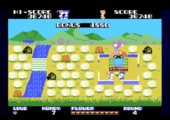
Development Background and the Genesis of a Legend
The development of Girl’s Garden occurred during a transitional period for Sega. In the early 1980s, the company was primarily known for its arcade prowess, but the release of the SG-1000 (Sega Game 1000) in 1983 marked its serious entry into the home console market. To compete with Nintendo’s Family Computer (Famicom), Sega sought to diversify its software library.
Yuji Naka joined Sega in April 1984 as a programmer. Girl’s Garden was conceived as a training project under the supervision of Hiroshi Kawaguchi, who would later become a legendary composer for titles such as Out Run and After Burner. However, in this instance, Kawaguchi served as a programmer and mentor. The directive from Sega management was clear: create a game that would appeal to girls. Working alongside artist Hiroshi Nakabayashi, Naka spent approximately five months developing the title. The result was so polished that Sega transitioned the project from a training exercise to a full commercial release, a rare occurrence for a novice developer’s first effort.
Core Gameplay Mechanics and Narrative Structure
Girl’s Garden places players in the role of Papri, a young girl on a quest to win the affection of her crush, Minto. The narrative conflict arises from a rival character, Cocco, who is also vying for Minto’s attention. This romantic rivalry is not merely flavor text but is integrated directly into the game’s mechanics through a visual timer system.
The objective of each stage is for Papri to collect ten blooming flowers to form a bouquet. Once the bouquet is complete, she must deliver it to Minto at his house before he reaches Cocco. The "timer" is represented by a progress bar at the top of the screen showing Minto walking from his house toward Cocco. If the player fails to deliver the flowers in time, or if they deliver an incomplete or wilted bouquet, the round is lost.
Flower Collection and Environmental Hazards
The gameplay loop requires precise timing and environmental awareness. Flowers transition through six stages of growth. Papri can only harvest a flower during its fourth stage—when it is in full bloom. Harvesting a flower too early yields no result, while harvesting a wilted flower (the final stage) results in a penalty, stripping the player of half their collected bouquet.
The environment is populated by hostile bears that patrol the garden. These bears act as the primary antagonists, requiring the player to utilize "honey pots" to distract them. If Papri is caught by a bear or falls into the water hazards (lakes and streams), she loses a life and half of her current flower count. This risk-reward system, combined with the shifting terrain and increasing difficulty of the garden layouts, provided a level of depth seldom seen in 1984 home console titles.
Technical Innovation on Restricted Hardware
The SG-1000 was built on the Texas Instruments TMS9918A video processor, a chip also found in the ColecoVision and MSX computers. This hardware had significant limitations, most notably the "one color per sprite line" constraint and a lack of hardware-level scrolling. Despite these hurdles, Naka and his team implemented several advanced visual techniques that pushed the system to its absolute limits.
Parallax Scrolling
One of the most impressive feats in Girl’s Garden is the illusion of parallax scrolling. By manipulating the background character tiles at different rates, the developers created a sense of depth. The clouds in the sky move at one speed, the distant mountains at another, and the immediate foreground at a third. While the scrolling appears somewhat "choppy" compared to later 16-bit titles, it was a revolutionary inclusion for an 8-bit system in 1984, predating similar effects in more powerful hardware.
Sprite Manipulation
The game also features a "Challenging Stage" every two rounds. In this mode, the hardware’s sprite magnification feature is utilized to display "giant" versions of Papri and the bears. Papri must jump over waves of bears in a simplified side-scrolling environment. This showcased Naka’s early interest in high-speed character movement and sprite-handling, themes that would eventually define his work on the Master System and Genesis.
Chronology of Release and Legacy
- December 1984: Girl’s Garden is released on cartridge for the Sega SG-1000 in Japan. It becomes a sleeper hit, praised for its charming aesthetics and technical polish.
- 1985-1988: As the SG-1000 is superseded by the Mark III and the Master System, Girl’s Garden remains a cult classic, often cited as one of the best reasons to own Sega’s debut console.
- 1991: Yuji Naka achieves global fame with the release of Sonic the Hedgehog. Retrospective interest in his early career brings Girl’s Garden back into the spotlight for gaming historians.
- 2016: The game receives its first official modern "port" as part of the Sega 3D Reprint Archives 3: Final Stage for the Nintendo 3DS. This version includes stereoscopic 3D effects and serves as a preservation effort for the title.
Audio Design and Collaborative Talent
The soundtrack of Girl’s Garden is notable for its variety and use of classical motifs. The audio team, which included Tohru Nakabayashi and Katsuhiro Hayashi, maximized the capabilities of the SN76489 Programmable Sound Generator (PSG).
The game features distinct themes for the garden stages and the bonus rounds. Notably, it incorporates a digital rendition of Felix Mendelssohn’s "Wedding March" during the victory sequence when Papri successfully reaches Minto. The use of varied musical cues for different game states—such as the "danger" music when a bear is close or the "success" jingle—contributed to the game’s reputation for high production values.
Comparative Analysis: SG-1000 vs. Contemporary Rivals
To understand the impact of Girl’s Garden, it must be compared to its contemporaries. In 1984, the Famicom was dominating the Japanese market with titles like Super Mario Bros. (which would arrive a year later) and arcade ports like Donkey Kong.
While many SG-1000 games were criticized for being inferior versions of arcade titles, Girl’s Garden was a bespoke console experience. It offered a level of character animation—such as Papri crying when losing a life—that was more expressive than the era’s standard. Unlike Smurf: Rescue in Gargamel’s Castle on the ColecoVision, which used a generic energy bar, Girl’s Garden used its timer to reinforce the narrative, creating a more cohesive emotional experience for the player.
Broader Impact on Sega’s Corporate Strategy
The success of Girl’s Garden validated Sega’s decision to invest in original intellectual property rather than relying solely on arcade conversions. It also established a precedent for Sega’s "Blue Sky" design philosophy—creating bright, colorful, and optimistic worlds. This aesthetic would become a hallmark of Sega’s identity throughout the late 80s and early 90s.
Furthermore, the game served as the ultimate proof of concept for Yuji Naka’s talent. His ability to extract performance from limited hardware led to him being assigned to high-profile projects like the Master System port of Space Harrier and eventually the creation of the Phantasy Star series. Without the successful delivery of Girl’s Garden, the trajectory of Sega’s internal development teams might have looked very different.
Conclusion and Modern Relevance
Girl’s Garden remains a fascinating artifact of video game history. It is a rare example of a "girl-centric" game from the early 80s that did not rely on licensed characters or overly simplistic gameplay. Instead, it offered a challenging, technically sophisticated experience that pushed its host hardware to the limit.
For modern collectors and historians, the game is a testament to the importance of the SG-1000 in Sega’s lineage. While the system was eventually overshadowed by the NES, titles like Girl’s Garden prove that Sega was already cultivating the creative talent and technical ambition that would eventually allow them to challenge for industry leadership. With a score of 8 out of 10 from contemporary retro-critics, it stands as a high-water mark for 1984 software and a essential piece of the Yuji Naka legacy.