
 Jia Lissa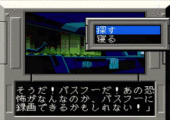
The Origins and Development of Detonator Orgun
The project was born from the burgeoning "Digital Comic" or "Visual Novel" trend that swept through the Japanese PC and console markets in the early 1990s. The source material, the Detonator Orgun OVA, was a production of Anime International Company (AIC), directed by Masami Ōbari. Ōbari was renowned for his distinct mechanical designs and stylized character art, which had already gained a following through works like Bubblegum Crisis and Dangaioh. The OVA was a reimagining of the classic Tekkaman concept, blending hard science fiction with psychological themes and high-stakes space combat.
Hot-B, a publisher known for eclectic titles such as Steel Empire and Insector X, recognized the potential of the Mega CD’s storage capacity to house an interactive version of this story. By utilizing the CD-ROM format, the developers aimed to include Full Motion Video (FMV) and high-quality voice acting—features that were impossible on contemporary cartridge-based systems like the Super Famicom or the standard Mega Drive. The development was handled by Darts, a studio that focused on translating the cinematic pacing of the anime into a menu-driven adventure format.
Chronology of the Detonator Orgun Franchise
The timeline of the Detonator Orgun intellectual property is relatively brief but impactful within the niche of early 90s sci-fi anime:
- July 1991: The first episode of the Detonator Orgun OVA is released in Japan, introducing the character Tomoru Shindo and the mysterious mechanized entity known as Orgun.
- 1991–1992: Subsequent episodes are released, concluding the three-part saga. The series gains a reputation for its complex plot and impressive animation quality for the time.
- July 31, 1992: Hot-B releases the video game adaptation for the Mega CD. This version focuses heavily on the first two episodes of the OVA, effectively serving as an interactive primer for the series.
- Mid-1992: Despite the popularity of mecha anime in the West, no plans for a North American or European localization are announced, largely due to the prohibitive costs of translating the extensive Japanese script and re-dubbing the audio.
- Legacy: While the Detonator Orgun game remained a Japanese exclusive, the character Orgun later appeared in crossover titles such as the Super Robot Wars series (notably Super Robot Wars W), ensuring the property maintained a level of visibility in the decades following its release.
Narrative Structure and Plot Summary
The game follows the journey of Tomoru Shindo, a university student living in the futuristic metropolis of City No. 5. Tomoru is haunted by recurring dreams of a mechanical knight and a distant battlefield on the Moon. These dreams manifest as reality when he is telepathically contacted by Orgun, a defector from the Evoluders—a race of hostile, biomechanical extraterrestrials intent on the subjugation of Earth.
The plot explores the symbiotic relationship between Tomoru and Orgun. As an Evoluder "Detonator," Orgun possesses immense power but requires a human host to function at full capacity within Earth’s atmosphere. The story unfolds as Earth’s Defense Force (EDF) attempts to decipher the alien threat while Tomoru struggles with the burden of becoming humanity’s primary shield. The game’s narrative is structured to mirror the "slow burn" pacing of the OVA, focusing on character interactions and the gradual revelation of the Evoluders’ origins before culminating in the large-scale conflicts depicted in the latter half of the series.
Gameplay Mechanics and Interactive Design
In terms of gameplay, Detonator Orgun eschews the action-oriented tropes of the mecha genre. There are no manual flight sequences or real-time combat maneuvers. Instead, the game utilizes a classic point-and-click interface typical of Japanese adventure games of the era, such as Hideo Kojima’s Snatcher or the Macross digital comics.
Players interact with the environment through a set of static commands:
- Look: Examine specific objects or characters on the screen to gain information.
- Think: Provides internal monologue from Tomoru, often serving as a hint system for the player’s next move.
- Talk: Engages in dialogue with NPCs to advance the plot.
- Move: Allows the player to travel between different locations within the city or military facilities.
Progress is strictly linear, dictated by the player’s ability to trigger specific flags through conversation or observation. This design choice was intended to keep the player immersed in the story, though it has been noted by critics that the lack of agency can make the experience feel more like an "interactive movie" than a traditional video game.
Technical Analysis of the Mega CD Hardware Utilization
The Mega CD was marketed on its ability to provide "multimedia" experiences, and Detonator Orgun serves as a case study for both the strengths and weaknesses of the platform.
Visual Presentation and FMV
The game incorporates numerous FMV sequences taken directly from the OVA. While impressive in 1992, these scenes highlight the limitations of the Sega Genesis hardware, which could only display a maximum of 64 colors simultaneously. The video is heavily compressed, resulting in significant pixelation and a reduced frame rate. However, the game’s hand-drawn static backgrounds and character portraits are high-quality, successfully capturing the "cyberpunk" aesthetic of Masami Ōbari’s original vision.
Audio Discrepancies
The audio performance of Detonator Orgun is a point of contention among technical analysts. The game features a score by Kouji Hayama, a composer known for his energetic and synth-heavy work. While the opening cinematic utilizes Red Book CD-DA audio for high-fidelity sound and voice acting, the majority of the in-game background music transitions to the Mega Drive’s internal YM2612 FM synthesis chip. This transition results in a noticeable drop in audio quality, a common shortcut in early CD-ROM development where disc space or data transfer speeds were prioritized for video rather than continuous high-quality audio.
Market Context and Regional Reception
During its release window, the Mega CD was struggling to define itself against the rising popularity of the Super Famicom and the niche but powerful PC Engine CD-ROM² in Japan. Detonator Orgun was part of a wave of licensed titles intended to draw in the "otaku" demographic.
Industry data from the early 90s suggests that while licensed adventure games performed respectably in the Japanese market, they faced a "language barrier" that made them unsuitable for the burgeoning global market. In the United States, Sega of America focused on "Sega CD" titles that featured Western actors or sports licenses, viewing Japanese visual novels as too niche and text-heavy for the American consumer. Consequently, Detonator Orgun remained a "grey market" import for Western fans of the OVA, often requiring fan-made translation guides to navigate.
Broader Impact and Historical Significance
The release of Detonator Orgun reflects a pivotal moment in gaming history where developers were experimenting with narrative delivery. It preceded the era of fully 3D cinematic games, relying instead on the established language of Japanese animation to tell a complex story.
For the Mega CD, the game is a reminder of the platform’s role as a bridge between the 16-bit era and the 32-bit "multimedia" revolution. While it may lack the enduring fame of titles like Lunar: The Silver Star or Sonic CD, it remains a faithful adaptation of its source material. It serves as a historical document of the 1990s OVA boom, capturing the specific visual and thematic preoccupations of that decade—specifically the fascination with biotechnology, alien invasion, and the fusion of man and machine.
Ultimately, Detonator Orgun is viewed by modern historians as a "quick-turnaround" project that, despite its technical inconsistencies, successfully brought a popular anime experience to home consoles. Its reliance on the Japanese language and its static gameplay mechanics ensure it remains a curiosity for collectors and enthusiasts of the Sega CD’s idiosyncratic library, representing a time when the "CD revolution" was still finding its footing in the interactive landscape.








