
 Jia Lissa
The emergence of the Sega Genesis as a formidable competitor to Nintendo’s dominance in the early 1990s was fueled not only by its arcade ports and high-speed mascots but also by its burgeoning library of role-playing games (RPGs). While Nintendo fans frequently championed franchises like The Legend of Zelda and Final Fantasy, Sega established a parallel legacy with the Shining series. Launched in 1991, Shining in the Darkness served as the foundational entry for a franchise that would eventually span nearly two dozen titles across various hardware generations. Unlike its contemporaries, the game distinguished itself through a unique first-person dungeon-crawling perspective, a streamlined user interface, and an artistic direction that eschewed traditional manga tropes in favor of a Western-influenced aesthetic. The development of the title marked a pivotal moment in the industry, representing the departure of key talent from the Dragon Quest lineage to form Climax Entertainment, a studio dedicated to innovation and global appeal.
The Genesis of Climax Entertainment and the Chunsoft Connection
The DNA of Shining in the Darkness is inextricably linked to the Dragon Quest series, the juggernaut of Japanese RPGs. The architects of Climax Entertainment, Hiroyuki Takahashi and Hiroshi (Kan) Naitō, met while working at Chunsoft, the developer responsible for the early Dragon Quest titles published by Enix. Takahashi, who transitioned into game development after a career in television production and corporate planning, had distinguished himself at Chunsoft by creating exhaustive analytical notebooks for Dragon Quest III. These notes, which mapped every line of dialogue and quest flow, earned him an assistant producer role on Dragon Quest IV.
Naitō, meanwhile, was a programming prodigy with a lifelong obsession with 3D imagery. Having taught himself Assembly language and BASIC, Naitō worked at Ample Software and Zap Corporation before joining Chunsoft. His expertise in creating 3D wireframe environments and his frustration with the technical limitations of 8-bit hardware set the stage for a new kind of RPG. By 1990, both men felt restricted by the rigid structures of established franchises. Takahashi, in particular, was motivated by a desire to create original software that could garner international respect. He noted during focus testing in the United States that American gamers often viewed Japanese titles as mere imitations of Western computer software. This perception fueled his resolve to establish an independent studio that would prioritize innovation over imitation.

Strategic Shift to 16-Bit Hardware
In April 1990, Takahashi and Naitō founded Climax Entertainment. Their initial project was conceived as a "real-time haunted house fantasy" set in a 3D environment. While the team was intimately familiar with the Nintendo Famicom, they strategically chose to develop for the Sega Mega Drive (Genesis). This decision was driven by the 16-bit console’s superior processing power, specifically its Motorola 68000 CPU. The Famicom’s 8-bit architecture was deemed insufficient for the fluid, spatial awareness required for a high-quality 3D dungeon crawler.
Sega, eager to bolster its third-party support against Nintendo, provided Climax with advanced development tools and high-performance Hewlett-Packard workstations. However, the transition was not without friction. Naitō found Sega’s initial in-circuit emulators (ICE) lacking, as they provided no feedback on graphics output. To rectify this, Climax essentially built its own development environment, creating custom graphics tools that allowed them to push the Mega Drive’s hardware beyond its standard operating procedures. This technical foundation enabled the team to implement larger character sprites and more complex visual effects than were common on the platform at the time.

Artistic Direction and the Disney Influence
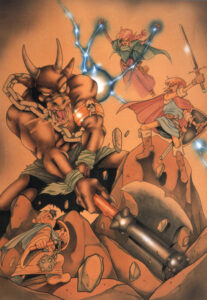
A defining characteristic of Shining in the Darkness is its visual style, which was intentionally designed to appeal to both Japanese and Western audiences. Takahashi and Naitō recruited Yoshitaka Tamaki, a freelance artist who shared their affinity for classic Disney animation. Drawing inspiration from films like Sleeping Beauty and Alice in Wonderland, Tamaki crafted a "caricature" style for the characters and monsters.
This approach was a calculated departure from the manga-inspired art that dominated the Japanese market. By utilizing a more universal, cinematic aesthetic, Climax aimed to create a world that felt like an "event-based" experience. The game’s setting, the Kingdom of Thornwood, was depicted through a technique the studio termed "Panorama 3D." This involved manually placing pixels to create angled views of the town and castle, simulating depth and perspective in a 2D environment. Despite the lack of hardware-level rotation and scaling on the Genesis, the team used software-based tricks to animate shopkeepers and NPCs, making the world feel reactive and alive.

Engineering the 3D Labyrinth
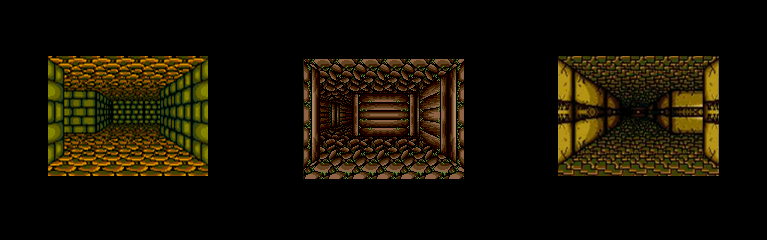
The core gameplay of Shining in the Darkness takes place within a multi-level labyrinth. While the game drew inspiration from Western classics like Wizardry, Climax sought to improve the "clunky" nature of traditional first-person movement. Special Effects Programmer Yasuhiro Taguchi was tasked with creating a smooth-scrolling engine. Because the Genesis lacked the "Mode 7" background scaling found in the Super Famicom, Taguchi relied on tile-based manipulation.
The engine used a single-point perspective where wall segments were rearranged and scrolled in real-time to simulate motion. To maintain a high frame rate and allow for detailed monster animations, the team reduced the size of the active gameplay window. This trade-off allowed for "special effects" such as shimmering magic and fluid transitions between floors. The monsters themselves were designed with minimal frames of animation to save memory, instead using positional shifting and palette swapping to create a sense of life and variety.

User Interface Innovation: The Icon-Based Menu
One of the most enduring legacies of Shining in the Darkness is its streamlined command system. Takahashi and Naitō believed that wordy, obstructive menus hindered the immersion of RPGs. They developed a cross-shaped icon menu that corresponded to the directional pad on the controller. This "icon-based" system allowed players to select actions—such as magic, items, or combat commands—without navigating layers of text.
While some industry observers later compared this system to the one found in Phantasy Star III, Climax’s implementation was significantly more detailed and intuitive. The icons were animated and accompanied by sound effects, creating a tactile feel that would become a staple of the Shining series and would eventually influence UI design across the genre. The goal was a "manual-less" experience where the controls were self-explanatory.

Navigational Philosophy and the Absence of Auto-Mapping
A controversial design choice in Shining in the Darkness was the deliberate omission of an auto-mapping system. In an era where competing titles were beginning to include maps to aid navigation, Climax insisted that players should learn the environment through observation. Naitō argued that relying on a map reduced the dungeon to a series of lines rather than a physical space.
To encourage exploration, the team integrated environmental landmarks—such as puddles, torches, and specific wall textures—to serve as navigational cues. While the game provided limited assistance through the "Wisdom Seed" item and the "View" spell, the primary intent was to foster a sense of accomplishment as players mastered the labyrinth’s layout. This "no-hand-holding" philosophy was intended to enhance the realism of the adventure, forcing players to engage directly with the world.

Sound Design and Atmospheric Immersion
The auditory experience of the game was crafted by Masahiko Yoshimura, a composer with a background in music business and live audio mixing. Yoshimura aimed to create a score that defined the identity of each location, contrasting the regal tones of the castle with the mysterious and claustrophobic themes of the labyrinth.
Working within the constraints of the Mega Drive’s YM2612 sound chip, Yoshimura collaborated closely with the art team to ensure the music matched the tone of specific scenarios. The soundtrack’s distinctive brassy and orchestral style became a hallmark of the franchise. Sega later recognized the score’s quality by releasing an arranged "Sound Story" CD in Japan, which showcased the compositions without the hardware’s compression.
Commercial Reception and Chronological Legacy
Shining in the Darkness was released in Japan on March 29, 1991, and became an immediate commercial success. It sold approximately 300,000 units, representing a 16% attach rate for the Mega Drive’s installed base at the time. In the United States, despite a higher price point due to the 8-megabit cartridge and battery backup, the game found a dedicated audience among RPG enthusiasts. Industry analysts noted that the game’s success was particularly impressive given the minimal marketing budget allocated by Sega of America, which was focusing its resources on the upcoming launch of Sonic the Hedgehog.
The game also established a complex timeline for the Shining universe. Although it was the first title released, it is chronologically situated as the sixth entry in the series’ lore, following the events of Shining Force, the Game Gear titles, and Shining Force II. This retrospective continuity allowed Sega and Climax to build a shared history that rewarded long-term fans while keeping each entry accessible as a standalone experience.

Broader Impact and Industry Implications
The success of Shining in the Darkness validated the decision of Takahashi and Naitō to pursue independent development. It proved that a small, dedicated team could produce a high-fidelity RPG that appealed to a global market. However, the relationship between Climax and Sega would later become strained due to shifting corporate management and budgetary disagreements. Takahashi frequently noted that as Sega grew into a massive hardware manufacturer, it began to view second-party developers as "unruly subsidiaries" rather than creative partners.
Despite these later conflicts, the legacy of Shining in the Darkness remains secure. It transformed the dungeon-crawler subgenre from a niche PC-centric experience into a polished console staple. The innovations introduced in the title—specifically the icon-based UI and the emphasis on cinematic "Panorama 3D" presentation—set a new standard for 16-bit role-playing games. As the first entry in a franchise that would help define Sega’s identity for decades, Shining in the Darkness remains a landmark achievement in game design and a testament to the power of artistic and technical independence.








