Jia Lissa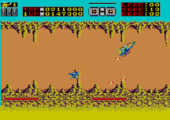
The 1986 release of Choplifter on the Sega Master System represents a pivotal moment in the history of arcade-to-home conversions, marking the transition of a computer-born classic into a cornerstone of the 8-bit console era. Originally conceptualized and developed by Dan Gorlin for the Apple II in 1982 and published by Brøderbund, Choplifter departed from the traditional "destroy-everything" philosophy of contemporary shoot-em-ups (shmups). Instead, it introduced a humanitarian objective: the rescue of hostages from behind enemy lines. When Sega Enterprises acquired the rights to adapt the title for arcades in 1985, and subsequently for its home console in 1986, the game underwent a significant mechanical and graphical overhaul that would define its legacy for decades.
Historical Context and Development Origins
To understand the impact of the Master System port, one must first examine the game’s origins. In the early 1980s, the video game industry was dominated by abstract shooters like Space Invaders and Galaga. Dan Gorlin’s original Apple II version was revolutionary because it utilized a physics-based movement system for the player’s helicopter, requiring a nuanced understanding of momentum and orientation. The player had to rotate the craft to face the screen, fly laterally, or bank to fire at ground targets.
In 1985, Sega’s arcade division, led by the esteemed programmer Rikiya Nakagawa, saw the potential in Gorlin’s concept. Nakagawa, who would later achieve fame for his work on Alien Syndrome and Thunder Blade, was tasked with "Sega-fying" the experience. This involved enhancing the visual palette, increasing the frame rate, and adding environmental variety that the original 1982 hardware could not support. The arcade version debuted in October 1985 as a conversion kit, often appearing alongside Sega’s flagship racer, Hang-On. The success of the arcade version necessitated a high-quality home port for Sega’s burgeoning 8-bit hardware, the Master System (known as the Mark III in Japan).
Technical Specifications and Hardware Utilization
The Sega Master System version of Choplifter is frequently cited by historians as a demonstration of the console’s superiority over its primary competitor, the Nintendo Entertainment System (NES), in terms of color depth and background rendering. The Master System featured a Video Display Processor (VDP) capable of displaying 32 colors simultaneously from a palette of 64, which was a significant advantage over the NES’s more restrictive color limitations.
In Choplifter, this technical edge is utilized to create distinct atmospheric conditions across its levels. The game employs sophisticated parallax scrolling—a technique where background layers move slower than foreground layers to create an illusion of depth. This was particularly impressive in the 1986 home console market. The port also maintained the arcade’s refined gameplay loop, which reduced the number of hostages per building from the original sixteen to eight, thereby increasing the frequency of required return trips to the home base and heightening the tension.
The Mechanics of Rescue: Gameplay Analysis
The fundamental loop of Choplifter involves three distinct phases: penetration, retrieval, and extraction. The player controls a state-of-the-art combat helicopter and must navigate through hostile territory to reach barracks where 64 hostages are being held.
- Penetration: Players must bypass anti-aircraft fire, jet fighters, and tanks. Unlike standard shooters, the player’s "hitbox" is large, and the helicopter is vulnerable to both direct hits and environmental collisions.
- Retrieval: Upon reaching a barracks, the player must shoot the structure to free the hostages. A critical mechanical nuance is the landing: the helicopter must land gently and precisely. If the player lands on a hostage, that hostage is killed—a dark consequence that was rare in the gaming landscape of the mid-1980s.
- Extraction: Once the helicopter (which has a limited capacity of 16 passengers) is full, the player must navigate back to the "Poste de Command" (the starting base). The hostages then exit the craft and enter the safety of the base.
The Master System version consists of three primary environments: the Desert, the Sea (featuring a fleet of battleships and a submarine), and the Cave. These levels are looped twice, with the second iteration featuring increased enemy aggression and faster projectile speeds. To progress to a subsequent stage, the player must successfully rescue at least 40 out of the 64 available hostages.
Chronology of the Choplifter Franchise (1982–1986)
The development timeline of the Choplifter intellectual property highlights its rapid ascent as a cross-platform powerhouse:
- 1982: Dan Gorlin releases the original version for the Apple II via Brøderbund. It is later ported to the Commodore 64 and Atari 8-bit family.
- 1984: Coleco acquires the rights to bring the game to the ColecoVision, providing the first glimpse of the game on dedicated console hardware.
- 1985 (October): Sega Enterprises USA releases the arcade version. This version introduces the "Cave" level and more detailed sprites.
- 1986 (September): Sega releases the Master System port in North America and Japan. This version is largely based on the 1985 arcade code rather than the 1982 original.
- 1986 (November): A separate port is released for the NES by Jaleco. Critics and consumers at the time noted that the NES version lacked the graphical fidelity and smooth scrolling of the Sega counterpart.
Comparative Performance and Industry Reception
Upon its release, the Master System version of Choplifter received high marks from contemporary gaming journals. Publications such as Computer and Video Games (CVG) and Electronic Games praised the port for its "arcade-perfect" feel. While it was not a literal 1:1 translation of the arcade hardware—which was more powerful than the Master System—it captured the essence of the gameplay and the vibrancy of the visuals.
One specific area of analysis often discussed by enthusiasts is the game’s difficulty curve. The "Cave" level (Stage 3) is notorious for its cramped quarters and the introduction of falling stalactites. This level required a level of precision flying that pushed the Master System’s directional pad to its limits. Industry analysts have noted that the difficulty was likely a carryover from the arcade version’s "quarter-munching" design, intended to limit the length of a single play session. In the transition to the home market, this translated to a game that offered high replay value through challenge, even though a skilled player could complete the three stages in approximately 15 minutes.
Cultural Impact and Hidden Features
Sega’s development team included several "Easter Eggs" in the Master System version, reflecting the burgeoning trend of hidden secrets in 8-bit software. If a player manages to destroy 16 enemy rockets in specific sequences, iconic pop-culture figures such as Superman or E.T. the Extra-Terrestrial appear on the screen. These inclusions were not merely cosmetic; they served as a testament to the developers’ desire to add personality to a game centered on the grim realities of war and rescue.
Furthermore, the game’s presentation of the hostages—who wave their arms in relief or jump in frustration if the helicopter leaves without them—added a layer of emotional stakes. This proto-AI behavior made the mission feel more urgent and grounded than the nameless, faceless targets found in games like Defender or Scramble.
Legacy and Modern Implications
The success of Choplifter on the Master System solidified Sega’s reputation for high-quality arcade ports, a strategy that would eventually help the company gain a foothold in the 16-bit era with the Genesis. The game’s influence can be seen in later "rescue-sim" titles, most notably Electronic Arts’ Strike series (Desert Strike, Jungle Strike), which expanded upon the helicopter-rescue-and-combat mechanics with more complex mission objectives and semi-open world maps.
In the decades following its release, Choplifter has seen various revivals, including Choplifter HD in 2012, but the 1986 Master System version remains the definitive 8-bit experience for many. It stands as a prime example of how a simple concept—saving lives instead of just taking them—could be elevated through technical excellence and disciplined game design.
Final Assessment of the Master System Port
While the brevity of the game—consisting of only three unique environments—was a point of contention for some consumers in the late 1980s, the quality of the experience outweighed the quantity of content. The Master System version of Choplifter successfully bridged the gap between the complex simulation roots of the Apple II original and the high-octane action of the Sega arcade version. Its inclusion in the Master System library provided the console with a sophisticated, visually impressive title that remains a benchmark for the rescue-shmup subgenre. For collectors and retro-gaming historians, the title is a mandatory study in how hardware limitations can be bypassed through clever programming and an emphasis on tight, responsive gameplay mechanics.