Jia Lissa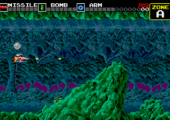
The 2021 physical release of Darius Extra Version for the Sega Mega Drive represents a landmark achievement in the field of retro software engineering and video game preservation. Developed by the acclaimed porting specialists at M2 and published through a collaboration involving Taito, Columbus Circle, and Strictly Limited Games, this release serves as an expansive evolution of the software first introduced on the Mega Drive Mini in 2019. While the 2019 version was celebrated as a technical "timeline correction"—providing the Sega 16-bit hardware with a port it lacked during its primary commercial lifespan—the 2021 cartridge edition moves beyond mere emulation or direct porting. It introduces a comprehensive suite of mechanical refinements, graphical optimizations, and audio restorations that address decades-old balance issues inherent in the original arcade revisions.
Historical Context and the Evolution of Darius on Sega Hardware
To understand the significance of the Darius Extra Version, one must examine the historical gap in the franchise’s availability on Sega platforms. Originally released by Taito in 1986, the arcade version of Darius was a marvel of engineering, utilizing a unique three-screen panoramic display and a seat-shaking "Body Sonic" sound system. While the PC Engine received several high-quality ports, including Super Darius and Darius Plus, the Sega Mega Drive was notably bypassed during the height of the 16-bit era.
The initiative to rectify this omission began in earnest with the development of the Mega Drive Mini. Developer Hidecade initially produced a fan-driven proof-of-concept that caught the attention of Sega and Taito, leading to its official inclusion in the micro-console’s library. However, the 2021 Darius Extra Version represents M2’s second, more intensive pass at the source code. This iteration focuses on the "Extra" revision of the arcade game, a version historically known for its high difficulty and polarizing mechanical changes. By enlisting the expertise of arcade "superplayers" such as KZS, known for high-level clears at the Takadanobaba Mikado Arcade Center, M2 sought to create a definitive version that balances arcade authenticity with modern playability.
Comprehensive Analysis of the Three Arcade Revisions
The Darius Extra Version cartridge includes three distinct versions of the original arcade game, each offering a different mechanical experience and difficulty curve. These revisions—Old, New, and Extra—have been meticulously tuned for single-screen gameplay, a task that required reconfiguring the original 48:9 aspect ratio of the three-screen arcade cabinet into the standard 4:3 ratio of the Mega Drive.
The Old and New Revisions
The "Old" version reflects the initial 1986 arcade release, characterized by a steep difficulty curve and specific boss behaviors that players could occasionally exploit. The "New" version followed shortly after, introducing bug fixes and adjusting boss patterns to ensure a fairer experience. In the 2021 cartridge release, these modes are presented as "Proco" (Normal) and "Tiat" (Easy). A significant quality-of-life improvement in the Tiat mode is the removal of the "power-down on death" mechanic, allowing casual players to maintain their weapon progress after losing a life. However, to maintain competitive integrity, clears achieved in Tiat mode are excluded from the game’s local high-score tables.
The Controversial Extra Revision
The "Extra" version remains the centerpiece of this release. In the arcades, Taito designed the Extra revision to increase "coin drop" by making the game significantly more punishing. Changes included the limitation of gold screen-clearing capsules and the introduction of "red roe"—tracking projectiles that aggressively pursue the player’s ship, the Silver Hawk, before boss encounters.
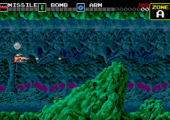
M2’s 2021 intervention has specifically targeted the most "unfair" elements of the Extra revision. For example, Zone M, a notoriously difficult asteroid field, has seen its enemy formations reduced to prevent unavoidable deaths caused by the overlapping of environmental hazards and airborne enemies. Similarly, underwater stages that previously featured turrets firing impassable "walls" of bullets have been re-tuned, allowing players to weave through patterns using skill rather than relying on shield durability.
Technical Enhancements and Hardware Optimization
The transition from the Mega Drive Mini’s emulated environment to a physical cartridge necessitated a suite of technical refinements to ensure the game performed optimally on original 1980s hardware. M2 addressed several "edge-case" bugs and graphical glitches that were present in the 2019 version when run on actual consoles.
Visual Fidelity and Sprite Management
One of the most impressive technical feats of the Darius Extra Version is its handling of the Sega Mega Drive’s Video Display Processor (VDP). The Extra revision requires a higher density of on-screen sprites and increased CPU cycles. On original arcade hardware, these demands often resulted in frame rate drops. M2 has optimized the Mega Drive code to maintain a consistent frame rate, even during intense encounters with massive bosses like Green Coronatus. The game utilizes unorthodox VRAM management to allow the large, multi-jointed aquatic bosses to undulate smoothly, mimicking the original arcade’s complex sprite manipulations. Furthermore, the 2021 version eliminates visible Color RAM (CRAM) dots and sprite flicker that occasionally plagued the earlier build.
Audio Restoration and the WING☆ FM Mix
Audio preservation was a primary focus for the physical release. M2 commissioned sound artist WING☆, a collaborator of legendary composer Yuzo Koshiro, to rebuild the game’s Frequency Modulation (FM) mix. The original Mega Drive Mini release utilized lower-quality Pulse Code Modulation (PCM) samples for sound effects, which resulted in a "muffled" quality for iconic cues like the "WARNING" siren.
The 2021 cartridge recreates these sound effects natively on the YM2612 FM chip and the DCSG (Digital Complex Sound Generator). This results in higher fidelity and greater stereo separation, bringing the home experience closer to the high-end Zuntata-produced arcade original. Key tracks such as "Captain Neo" and "Chaos" now feature the deep low-end frequencies that defined the Darius soundscape. Additionally, the cartridge restores the arcade’s unique boss explosion sequence, characterized by a series of rolling, off-screen detonations that provide a more visceral sense of impact.
Mechanical Depth and Replayability
Beyond technical polish, the Darius Extra Version introduces several features that expand the game’s longevity. The branching map system, a hallmark of the series, allows players to choose their path through 26 different zones.
The 26-Boss Arrangement
In the original arcade release, ROM space constraints forced Taito to reuse 11 boss designs across the 26 zones. The 2021 cartridge offers players a choice: the "Arcade Bosses" mode, which maintains the original 11-boss rotation, or the "26 Bosses" mode. The latter ensures that every single zone on the map features a unique boss encounter. This mode incorporates bosses originally exclusive to the PC Engine version, such as Steel Spine, but re-tunes their patterns to align with the more aggressive AI found in later Darius sequels.
Scoring and Competitive Play
The scoring system has been overhauled to reward high-level play. The "Remained Player Bonus" grants one million points for every ship remaining in the player’s stock upon completing the game, incentivizing "no-miss" runs. Boss fights also feature a risk-reward mechanic: destroying individual parts of a boss, such as fins or claws, awards 30,000 points per section. This encourages players to stay in the fight longer to maximize their score rather than destroying the boss as quickly as possible.
To cater to the competitive community, M2 included a hidden "Arcade Mode." Activated via a button sequence at the title screen, this mode enforces a strict ruleset:
- No pausing or soft resets.
- Autofire limited to 10 Hz.
- Only the "Proco" (Normal) difficulty and the original 11-boss structure are available.
- Dedicated ranking tables separate from the standard game modes.
Market Impact and the Future of Retro Development
The release of Darius Extra Version is a significant event for the boutique physical media market. By partnering with Columbus Circle in Japan and Strictly Limited Games in the West, Taito ensured that this "lost" piece of Sega history reached a global audience of collectors and enthusiasts.
The success of this project demonstrates a growing market for "new" legacy software—games developed with modern tools and expertise but designed to run on decades-old hardware. M2’s approach sets a high standard for such releases, prioritizing historical accuracy and technical excellence over simple nostalgia. For the Sega Mega Drive community, the cartridge represents the ultimate version of a foundational shooter, finally bridging the gap between the 1986 arcade experience and the 16-bit home console.
Summary of Key Features and Enhancements
| Feature | Description |
|---|---|
| Revisions Included | Old, New, and Extra arcade versions. |
| Boss Modes | Choice between the original 11-boss arcade cycle or a unique boss for all 26 zones. |
| Sound Design | New FM mix by WING☆ using the YM2612; restored "BOOM" explosion sequences. |
| Performance | Optimized sprite handling and reduced slowdown compared to arcade hardware. |
| Customization | Independent autofire settings (10Hz to 30Hz) for ABC and XYZ button rows. |
| Hidden Features | Dedicated Arcade Mode and a looping Sound Test menu. |
Darius Extra Version stands as a testament to the enduring legacy of Taito’s aquatic-themed shooter and the technical prowess of M2. It is not merely a port, but a curated celebration of the franchise’s origins, refined for a new generation of hardware enthusiasts. Through its rigorous balancing and technical restoration, it secures its place as one of the most significant modern additions to the Sega Mega Drive library.