Jia Lissa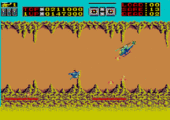
The release of Choplifter on the Sega Master System in 1986 marked a significant milestone in the evolution of the "rescue-based" shoot-’em-up (shmup) genre. Originally conceptualized and developed by Dan Gorlin for the Apple II in 1982, the title underwent a transformative journey from a home computer game to a high-octane arcade experience, eventually returning to home consoles under the stewardship of Sega Enterprises. The Master System version, which arrived during the height of the 8-bit era, was not merely a direct port of the Apple II original but was largely based on the 1985 arcade version programmed by the renowned Rikiya Nakagawa. This version introduced several mechanical refinements and environmental expansions that redefined the player’s objectives and the technical expectations for the hardware of the time.
Historical Context and Development Chronology
To understand the impact of the Master System port, one must examine the timeline of Choplifter’s development across the early 1980s. Dan Gorlin’s original 1982 release for the Apple II, published by Brøderbund, was a pioneer in non-linear gameplay, tasking players with more than just the destruction of enemy assets. By 1985, Sega Enterprises USA recognized the potential of the IP and released an arcade version as a conversion kit alongside the seminal racing title Hang-On.
The arcade iteration was led by Rikiya Nakagawa, a developer whose later portfolio would include classics such as Alien Syndrome and Thunder Blade. Nakagawa’s team made critical adjustments to the game’s core loop. While the Apple II version required the rescue of 64 hostages across a single, sprawling map, the arcade version increased the complexity by introducing distinct stages and reducing the number of hostages needed per rescue trip to increase the frequency of high-stakes landings. The 1986 Master System port aimed to replicate this arcade intensity, serving as a flagship title that demonstrated the console’s superior color palette and processing power compared to its contemporary rivals.
Core Gameplay Mechanics and Tactical Objectives
The premise of Choplifter involves the player piloting a sophisticated rescue helicopter into hostile territory to retrieve prisoners of war. Unlike traditional horizontal scrollers where the screen moves at a fixed pace, Choplifter allows for bidirectional flight. The player must navigate through six stages—comprised of three distinct environments that loop twice with increased difficulty—to meet a specific rescue quota.
The rescue process is a multi-stage tactical operation. Players must first locate the barracks or enclosures where hostages are held and use gunfire to breach the structures. Once the hostages emerge, the pilot must perform a delicate landing. The physics engine of the Master System version requires precise throttle control; landing too quickly or directly on top of the hostages results in friendly fire casualties, a mechanic that adds a layer of psychological tension rarely seen in mid-80s action games.
Once the helicopter is on the ground, up to eight hostages can board at a time. During this window, the aircraft is a stationary target for enemy tanks, jet fighters, and anti-aircraft fire. After the capacity is reached, the player must navigate back to the starting base, unload the survivors, and return to the front lines. The game requires a total of 40 successful rescues to advance to the subsequent stage. This loop creates a risk-reward dynamic: the further a player pushes into enemy territory to find more hostages, the longer and more dangerous the return flight becomes.
Technical Analysis and Visual Presentation
From a technical standpoint, Choplifter was a showcase for the Sega Master System’s hardware. The console, powered by a Zilog Z80 CPU running at approximately 3.58 MHz, was capable of displaying 32 simultaneous colors from a palette of 64. This was a significant advantage over the Nintendo Entertainment System (NES), and Sega utilized this to create vibrant, multi-layered environments.
The game features impressive parallax scrolling, particularly in the desert and ocean stages. This technique provides a sense of depth by moving background elements, such as distant mountains or clouds, at a slower speed than the foreground action. The visual fidelity extended to the character sprites; hostages were not static icons but animated figures that reacted to the helicopter’s presence. In the ocean stage, for instance, hostages are depicted swimming from a sinking submarine toward the rescue craft, a detail that enhanced the cinematic quality of the experience.
The sound design, while limited by the programmable sound generator (PSG) of the era, provided clear audio cues for enemy approach and successful rescues. The absence of a continuous background music track in some versions was replaced by the rhythmic drone of the helicopter blades, which served to heighten the atmospheric tension of the missions.
Environmental Diversity and Level Design
The Master System version expanded the original game’s scope by introducing three primary environments:
- The Desert: A direct homage to the original Apple II setting, featuring open plains, tanks, and fighter jets. This stage serves as the introductory level, teaching players the basics of landing and maneuvering.
- The Ocean: A high-stakes maritime environment where players must rescue hostages from naval vessels and submarines. This stage introduces new hazards, such as homing missiles and the requirement to hover precisely over moving platforms.
- The Cave: Widely considered the most difficult portion of the game, the cave environment forces players into cramped, claustrophobic corridors. The ceiling is lined with stalactites that can destroy the helicopter on contact, and the limited vertical space makes evading enemy fire significantly more challenging.
The "loop" system utilized in Choplifter follows a common arcade tradition of the 1980s. After completing the first three stages, the player restarts the cycle with increased enemy aggression and faster projectile speeds. The fourth stage (the second desert mission) features a "night transition," where the color palette shifts to darker hues, simulating a midnight raid. This was a sophisticated visual trick for 1986, providing variety without requiring the storage of entirely new tilemaps on the cartridge.
Secrets, Easter Eggs, and Cultural References
Sega’s development team included several hidden features that have become legendary among retro gaming enthusiasts. If a player manages to destroy 16 rockets in a single stage, special sprites appear in the background. These include Superman flying across the screen and the character E.T. from the Steven Spielberg film. These inclusions were indicative of the era’s "hidden secret" culture, designed to encourage replayability and word-of-mouth discussion among players.
Additionally, the game’s title screen has long been a subject of analysis. It depicts the helicopter firing upon the very hostages it is meant to save. Industry historians suggest this may have been a subtle nod to the "friendly fire" mechanics of the game or perhaps a depiction of the intense Stage 3 cave environment where crossfire is unavoidable.
Critical Analysis and Market Impact
Upon its release, Choplifter was praised for its balance of action and strategy. However, contemporary reviews also noted its steep difficulty curve. The "quarter-munching" philosophy of the arcade original was preserved in the home port, particularly in the cave stages where environmental hazards often felt unforgiving. The lack of traditional "boss" encounters was another point of discussion; while most shmups of the era ended stages with a giant enemy, Choplifter relied on the mounting pressure of survival and the logistical challenge of the rescue mission to provide a climax.
The brevity of the game—capable of being completed in under 20 minutes by an expert player—was offset by its high replay value. In 1986, the concept of "mastery" was central to the gaming experience. The lack of a save system or passwords meant that players had to develop muscle memory and memorize enemy patterns through repeated play sessions.
Legacy and Conclusion
Choplifter on the Master System remains a definitive version of the title, often cited as superior to the arcade version due to its tighter controls and better utilization of the home console’s color capabilities. It paved the way for subsequent entries in the franchise, including Choplifter II and Choplifter III on various platforms, and eventually the 2012 reboot, Choplifter HD.
The game’s influence can be seen in numerous modern "rescue" titles, where the objective is shifted away from pure destruction toward the preservation of non-player characters. As a technical achievement, it demonstrated that the Sega Master System was a formidable competitor in the 8-bit market, offering arcade-quality experiences that were, at the time, unparalleled in the home environment. For collectors and historians, Choplifter stands as a testament to a transitional period in gaming history where simple concepts were elevated by sophisticated programming and a deep understanding of player psychology.