Jia Lissa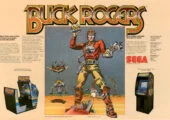
The year 1982 marked a pivotal transition for Sega as it sought to solidify its presence in the burgeoning North American interactive entertainment market. During this period, Sega’s North American arcade division, previously known as Sega/Gremlin, underwent a strategic rebranding to become Sega Electronics. This move coincided with a broader corporate shift initiated by Sega’s parent company at the time, the multi-industry conglomerate Gulf + Western. Having integrated Sega into its manufacturing arm in late 1981, Gulf + Western sought to leverage the intellectual property of another of its major subsidiaries, Paramount Pictures. This directive aimed to transform blockbuster cinematic franchises into arcade and home console experiences, leading to the development of several high-profile titles, most notably Star Trek: Strategic Operations Simulator and Buck Rogers: Planet of Zoom.
While the Star Trek adaptation was a ground-up effort to simulate the tactical space combat seen in the motion pictures, Buck Rogers: Planet of Zoom represented a different tactical approach to software development. Rather than creating a bespoke engine for the 1920s-era space hero, Sega elected to rebrand an existing Japanese project titled Zoom 909. This decision was driven by the necessity for rapid market entry and the recognition that the Buck Rogers name carried significant brand equity in the United States, following a successful 1979 film revival and a television series that concluded in 1981.
Corporate Strategy and the Paramount Partnership
The collaboration between Sega and Paramount Pictures was a precursor to the modern "media mix" strategy. In the early 1980s, the video game industry was experiencing exponential growth, and film studios were eager to capture a share of the "quarters" being dropped into arcade cabinets. While competitors like MCA and 20th Century Fox chose to license their properties to third-party developers, Gulf + Western’s ownership of Sega allowed for a vertically integrated approach.
Internal records from the era indicate that more than half a dozen movie-based games were initially planned under this partnership. The slate included titles based on the fantasy film Dragonslayer, the horror franchise Friday the 13th, and the science fiction classic War of the Worlds. However, the complexities of hardware development and the volatile nature of the early arcade market meant that only two of these major projects reached wide distribution. Buck Rogers: Planet of Zoom was the second of these releases, debuting in late 1982.
Industry analysts of the time noted that the choice of Buck Rogers was particularly savvy for the American market. The character, created by Philip Francis Nowlan in 1928, had a multi-generational reach, having appeared in novellas, comic strips, radio serials, and theatrical shorts. By rebranding Zoom 909 as a Buck Rogers title, Sega was able to provide an immediate narrative hook for a game that otherwise shared very little DNA with the source material.
Technical Specifications: The VCO Object System
From a technical standpoint, Buck Rogers: Planet of Zoom served as a critical stepping stone for Sega’s engineering department. The game utilized the Sega VCO (Voltage Controlled Oscillators) Object system, a hardware architecture that focused on sprite scaling to create a pseudo-3D perspective. This system was an evolution of the technology used in Sega’s 1981 racing hit, Turbo.
The VCO hardware allowed for the rapid resizing of 2D sprites, creating the illusion that objects were moving toward or away from the player at high speeds. While this "Super Scaler" technology would eventually reach its zenith in the mid-to-late 1980s with titles like OutRun and After Burner, Planet of Zoom was a pioneering effort in utilizing raster graphics to simulate depth. The hardware was capable of handling dozens of objects on screen simultaneously, including enemy fighters, energy pylons, and environmental obstacles, all while maintaining a frame rate that conveyed a sense of "breakneck" velocity.
The game was offered in multiple configurations, but the "cockpit" cabinet is often cited by historians as the definitive version. This unit featured a specialized control stick and an immersive seating arrangement that complemented the game’s first-person-style perspective (viewed from just behind the ship). The use of an accelerator pedal allowed players to manipulate their speed, a mechanic that was directly tied to the game’s fuel consumption and scoring systems.
Chronology of Gameplay and Narrative Structure
The narrative of Planet of Zoom is minimalist, serving primarily as a framework for the action. The plot involves a celestial body known as the "Planet of Zoom" traversing space and destroying civilizations in its path. Players assume the role of Buck Rogers, piloting a starfighter to infiltrate the planet’s defenses and destroy its "Source Ship."
The gameplay is divided into rounds, each consisting of eight distinct sub-sections. These sections transition seamlessly, creating a continuous flow of combat:
- The Space Trench: Often compared to the trench run in the 1977 film Star Wars, this stage requires players to navigate between narrow walls while avoiding enemy fire.
- The Pylon Fields: A test of maneuvering where the player must weave through rows of energy towers.
- Enemy Interception: Open-space combat focusing on dogfighting with various alien craft.
- The Source Ship Encounter: The final boss of each round, which requires the player to destroy four specific engines to progress.
A critical mechanic in the game is the fuel gauge, represented by a red bar at the top of the screen. This bar acts as both a timer and a health meter; if the player fails to reach the end of a section before the fuel is exhausted, the ship crashes. To mitigate this, players are encouraged to use the "Zoom" (high speed) setting, which consumes fuel more efficiently per unit of distance but significantly increases the difficulty of avoiding obstacles.
Market Reception and Economic Performance
Upon its release in late 1982, Buck Rogers: Planet of Zoom was a visual standout in arcades. In a market dominated by fixed-screen shooters like Galaga or side-scrolling titles like Defender, the pseudo-3D scaling of Sega’s VCO system provided a "wow factor" that drew significant foot traffic.
However, historical data suggests that the game’s longevity was hampered by its scoring mechanics. Unlike many of its contemporaries, the arcade version of Planet of Zoom did not reset the player’s score upon the insertion of additional credits. This allowed players with sufficient capital to "buy" their way to the top of the high-score leaderboard, which many purists felt undermined the competitive integrity of the game. Furthermore, while the game featured eight areas per round, the patterns became highly repetitive after the first few loops.
Despite these criticisms, the game was a commercial success, leading to a wide array of home ports. Sega’s home software division, as well as third-party licensees, brought the title to the Atari 2600, ColecoVision, Commodore 64, and the IBM PC. While these versions lacked the hardware scaling capabilities of the arcade original—often relying on simpler 2D "flicker" effects to simulate depth—the strength of the Buck Rogers brand ensured healthy sales figures across all platforms.
Broader Impact and Industry Implications
The legacy of Buck Rogers: Planet of Zoom is most visible in the subsequent "Golden Age" of Sega arcade development. The lessons learned from the VCO Object system directly informed the development of the "Sega System 16" and the legendary "Y Board" hardware. The sense of speed and the focus on "forward-into-the-screen" movement would become a hallmark of Sega’s identity throughout the 1980s.
Furthermore, the game serves as a landmark in the history of licensed software. It demonstrated that a recognizable IP could be used to enhance the marketability of an existing game engine, a practice that would become standard across the industry. It also highlighted the shift in science fiction aesthetics; the game’s visuals leaned heavily into the "used universe" and high-tech industrial looks popularized by late 70s cinema, moving away from the "pulp" aesthetic of the original 1920s Buck Rogers strips.
In the context of 1982, a year often remembered for the beginning of the North American video game crash, Buck Rogers: Planet of Zoom stood as a testament to the technological ambition of arcade manufacturers. While it may not have captured the tactical depth of its sister title, Star Trek: SOS, it provided a sensory experience that was at the absolute forefront of what was possible with early 80s raster technology.
Today, Planet of Zoom is regarded by collectors and historians as a vital piece of Sega’s lineage. It represents a moment when the worlds of Hollywood and Silicon Valley first began to merge, creating a template for the blockbuster-driven industry that exists today. While the original cockpit cabinets are now rare museum pieces, the game’s influence remains embedded in the DNA of the "rail shooter" genre and the evolution of 3D graphics.