Jia Lissa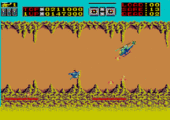
The release of Choplifter for the Sega Master System in 1986 marked a pivotal moment in the evolution of the "rescue-shmup" subgenre, successfully bridging the gap between early home computer complexity and high-octane arcade action. Originally conceptualized and developed by Dan Gorlin for the Apple II in 1982, the title underwent a significant transformation when Sega Enterprises acquired the rights to produce an arcade version in 1985. This arcade iteration, programmed by the influential Rikiya Nakagawa—known for his later contributions to Alien Syndrome and Thunder Blade—served as the primary blueprint for the Sega Master System port. By refining the core mechanics and expanding the environmental variety, Sega transformed a minimalist computer game into a showcase for their 8-bit console hardware, solidifying the title’s legacy in the mid-1980s gaming landscape.
Historical Context and Development Chronology
The trajectory of Choplifter is unique in the history of software development, moving from a home computer environment to the arcade and then back to a home console. In 1982, Dan Gorlin’s original version for the Apple II was praised for its sophisticated physics and its departure from the era’s trend of mindless destruction, focusing instead on the humanitarian goal of rescuing hostages.
By 1985, Sega Enterprises USA identified the title’s potential for the coin-operated market. In October 1985, Sega released the arcade version as a conversion kit alongside the groundbreaking motorcycle racer Hang-On. This version introduced substantial changes to the gameplay loop. Under Nakagawa’s direction, the arcade version reduced the number of hostages per bunker from 16 to eight but increased the number of bunkers and introduced entirely new environments, such as the naval fleet and the subterranean caves.
The 1986 Sega Master System port aimed to replicate this arcade experience within the constraints of home hardware. At the time, Sega was aggressively marketing the Master System (known as the Mark III in Japan) against the Nintendo Entertainment System (NES). Choplifter served as a key software asset, demonstrating the Master System’s superior color palette and technical capabilities in handling multi-directional scrolling and complex sprite interactions.
Technical Specifications and Gameplay Mechanics
The Sega Master System version of Choplifter operates on the Zilog Z80 architecture, utilizing the console’s Video Display Processor (VDP) to deliver a visual experience that surpassed the original 1982 computer version and rivaled the 1985 arcade cabinet. The game features six distinct stages, which are essentially three unique environments—Desert, Ocean, and Cave—looped twice with increased difficulty parameters.
Rescue Dynamics and Pilot Responsibility
The primary objective remains consistent: the player must pilot a rescue helicopter into enemy territory, retrieve hostages from destroyed barracks, and transport them back to the safety of the starting base. The game tracks 64 total hostages across the mission. To advance to the subsequent stage, the player must successfully rescue a minimum of 40 individuals.
The mechanics of the rescue operation are governed by a rudimentary but effective physics system. The helicopter can tilt forward and backward to gain horizontal momentum, and it can rotate 180 degrees to engage enemies in the background or foreground. Landing requires precision; if the pilot descends too quickly or lands directly on top of the hostages, the very people meant for rescue are killed. Furthermore, the helicopter has a limited capacity of 16 passengers per trip, necessitating multiple sorties into increasingly hostile territory.
Enemy AI and Environmental Hazards
As the player progresses, the opposition scales from simple ground-based tanks and anti-aircraft fire to more sophisticated threats. In the desert stages, players encounter high-speed jets and guided missiles. The ocean stage introduces a naval fleet where the player must navigate between destroyers and submarines while retrieving hostages from the water. The final environment, the cave, represents the game’s peak difficulty. Here, the player must contend with narrow corridors, falling stalactites, and mines, all while managing the helicopter’s momentum within confined spaces.
Supporting Data and Hardware Analysis
The Sega Master System’s hardware played a crucial role in the port’s success. While the NES was limited to a total of 52 colors with a maximum of 13 on-screen at once, the Master System supported a 64-color palette, allowing for 31 colors on-screen simultaneously. This technical advantage is evident in Choplifter’s use of color gradients in the sky and the detailed sprites of the hostages and enemy vehicles.
| Feature | Apple II (1982) | Sega Arcade (1985) | Master System (1986) |
|---|---|---|---|
| CPU | MOS 6502 | Zilog Z80 & Intel 8039 | Zilog Z80 |
| Colors | 6 (Limited) | 256 | 32 (on-screen) |
| Hostages per Stage | 64 | 64 | 64 |
| Advancement Requirement | N/A (High Score) | 40 Rescued | 40 Rescued |
| Stages | 1 (Infinite Loop) | 4 | 6 (3 Looped) |
Data from the era indicates that Choplifter was one of the most frequently cited reasons for the Master System’s early adoption in Western markets. The game’s ability to render parallax scrolling—a technique where background layers move slower than foreground layers to create an illusion of depth—was a significant selling point that distinguished Sega’s library from the static backgrounds often found in contemporary NES titles.
Comparative Performance and Critical Reception
Upon its release, Choplifter received high marks for its faithfulness to the arcade experience. Industrial observers noted that while the arcade version utilized more powerful dual-processor hardware, Nakagawa’s refinements to the gameplay logic translated seamlessly to the home console.
One of the most praised aspects of the Master System version was the inclusion of environmental details that enhanced immersion. For instance, in the ocean stage, hostages are depicted swimming toward the helicopter, a visual detail absent in many other ports. Additionally, the inclusion of "Easter eggs," such as the appearances of Superman and E.T. after destroying a specific number of enemy rockets, served as a testament to the developers’ attention to detail and the culture of the mid-80s development scene.
However, contemporary reviews also highlighted the game’s unforgiving difficulty. The "Cave" stage, in particular, was criticized for its cramped design, which left little room for pilot error. The difficulty curve was a direct carry-over from the arcade version’s "quarter-munching" philosophy, designed to limit session length. On a home console where players were not paying per life, this led to a gameplay experience that could be perceived as brief. A skilled player could navigate all six stages in approximately 15 to 20 minutes, a factor that prompted some critics to suggest that more original content should have been added to the home version to increase longevity.
Official Responses and Historical Impact
While Sega Enterprises did not frequently issue formal press releases regarding individual port performance during the mid-80s, the company’s continued investment in the Choplifter franchise signaled its internal success. The game would later see iterations on the Sega Game Gear and inspired subsequent rescue-themed titles like the Strike series (e.g., Desert Strike) by Electronic Arts.
Rikiya Nakagawa’s work on the title is often cited by retro-gaming historians as a masterclass in porting. By focusing on the "feel" of the helicopter’s movement and the tension of the rescue, Nakagawa ensured that the game remained engaging despite the hardware downgrades from the arcade cabinet. The Master System version is often considered the definitive 8-bit home version, outclassing the ports found on the Commodore 64, Atari 7800, and NES in terms of visual fidelity and control responsiveness.
Broader Implications for the Gaming Industry
The success of Choplifter on the Master System underscored the importance of arcade-to-home conversions during the third generation of video game consoles. In the post-1983 crash era, consumers looked for "arcade-quality" experiences at home to justify the cost of new hardware. Sega’s ability to deliver a near-perfect rendition of their arcade hit helped establish the Master System as a serious competitor in the global market.
Furthermore, Choplifter contributed to the refinement of non-linear objectives in action games. By requiring players to prioritize the safety of NPCs (non-player characters) over the destruction of enemies, it introduced a layer of tactical depth that was rare in the early 1980s. The tension of the "return trip"—where the player is weighed down by hostages and must navigate back through enemies they previously bypassed—remains a foundational mechanic in modern mission-based game design.
Today, Choplifter on the Sega Master System is regarded as a hallmark of 8-bit software engineering. Its blend of physics-based movement, resource management (hostage capacity), and environmental variety serves as a blueprint for the rescue-action genre. While its high difficulty and short length reflect the arcade-centric design philosophy of its time, its technical execution remains a benchmark for the capabilities of the Sega Master System hardware. As the industry continues to look back at the 8-bit era, Choplifter stands out not just as a successful port, but as a definitive version of Dan Gorlin’s original vision.