Jia Lissa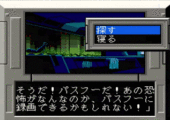
Released on July 31, 1992, Detonator Orgun stands as a pivotal example of the "digital comic" or graphic adventure genre that proliferated during the early years of the CD-ROM era. Developed by Darts and published by Hot-B Co. Ltd., the title was a direct adaptation of the 1991 three-episode Original Video Animation (OVA) of the same name. At the time of its launch, the Sega Mega CD—known as the Sega CD in North America—was marketed as a revolutionary platform capable of delivering "multimedia" experiences that were previously impossible on cartridge-based hardware. Detonator Orgun was designed to capitalize on this promise, leveraging the storage capacity of the CD-ROM format to bring high-quality animation and voice acting into the home gaming environment. However, the game’s strict adherence to its source material and its reliance on traditional adventure game mechanics created a specialized experience that targeted a very specific demographic of Japanese science fiction enthusiasts.
Historical Context and Development Background
The early 1990s represented a "Golden Age" for the Japanese OVA market. Animation studios such as AIC (Anime International Company) and Artmic were producing high-budget, high-concept science fiction series that often featured intricate mechanical designs and mature themes. Detonator Orgun was a product of this environment, directed by Masami Ōbari, a figure renowned for his stylized mecha designs and dynamic action choreography. The series was a spiritual successor to the Gall Force and Bubblegum Crisis lineages, blending themes of alien invasion, human evolution, and sentient weaponry.
Hot-B, the publisher of the Mega CD adaptation, was a veteran in the Japanese gaming industry, known for eclectic titles such as Steel Empire and the Inindo: Way of the Ninja series. In 1992, the transition to optical media was seen as the next frontier for storytelling. Developers were experimenting with how to integrate full-motion video (FMV) and high-fidelity audio into gameplay. Detonator Orgun was part of a wave of titles, alongside Hideo Kojima’s Snatcher and Telenet Japan’s The Space Adventure, that sought to blur the lines between cinema and interactive software. Unlike action-heavy mecha titles of the era, such as Assault Suits Leynos, Detonator Orgun chose a path of narrative immersion, prioritizing plot progression over twitch-based combat.
Narrative Overview and Adaptation Fidelity
The plot of Detonator Orgun is set in the year 2292, focusing on Tomoru Shindo, a university student living in the futuristic metropolis of City No. 5. Tomoru is plagued by recurring dreams of a mechanical warrior and a looming interstellar conflict. The narrative shifts when Orgun, a "Detonator" or elite warrior of the alien race known as the Evoluders, deserts his kind and travels to Earth. Orgun establishes a telepathic link with Tomoru, eventually leading to their fusion, which allows Tomoru to pilot the Orgun armor to defend Earth against the impending Evoluder invasion.
The Mega CD game covers the events of the first two episodes of the OVA in significant detail. It explores the philosophical underpinnings of the Evoluder race—a species that has abandoned organic bodies in favor of cybernetic evolution, losing their humanity in the process. The game’s script remains highly faithful to the original dialogue, utilizing the same voice cast to maintain continuity for fans. This fidelity was a major selling point in 1992, as it allowed players to "play through" the anime they had seen on VHS or LaserDisc. The game concludes with a narrative bridge or "preview" of the third and final OVA episode, effectively acting as a promotional tool for the conclusion of the animated series.
Gameplay Mechanics and Interactive Structure
Detonator Orgun utilizes a menu-driven, point-and-click interface typical of Japanese graphic adventures of the late 80s and early 90s. The player interacts with the world through a series of static and semi-animated screens, selecting commands from a list to advance the story. These commands typically include:
- Look/Examine: Allows the player to gain more information about the current environment or a specific character’s appearance.
- Think: Provides insight into Tomoru’s internal monologue, often serving as a hint system for the player’s next move.
- Talk: Initiates dialogue trees with non-player characters (NPCs) to gather information or trigger plot events.
- Move: Facilitates travel between different locations within City No. 5 or aboard military installations.
The gameplay is characterized by a "slow burn" pace. There are no traditional action sequences where the player manually controls the Orgun armor in combat. Instead, battle scenes are presented as cinematic rewards for making the correct narrative choices. This design philosophy emphasizes the "Adventure" aspect of the genre, requiring players to pay close attention to dialogue and environmental cues. For non-Japanese speakers, this creates a significant barrier to entry, as the game’s progression is entirely dependent on understanding the nuances of the text-heavy interface.
Technical Analysis: Audiovisual Presentation
The technical execution of Detonator Orgun on the Mega CD is a study in the limitations and strengths of 16-bit CD-ROM hardware. The Mega CD was notorious for its limited color palette (64 colors on screen from a palette of 512) and its struggles with video compression.
Visual Performance
The game features numerous FMV cutscenes taken directly from the OVA. While impressive in 1992 for their sheer presence on a home console, these scenes suffer from the Cinepak compression common to the era. The video is displayed in a windowed format to conserve processing power, resulting in noticeable pixelation and a "dithered" appearance. However, the hand-drawn character portraits and background art during the adventure segments are of high quality, successfully capturing the cyberpunk aesthetic of Masami Ōbari’s original vision. The mechanical designs, in particular, retain their intricate detail despite the hardware’s color limitations.
Audio Fidelity and Discrepancies
One of the most notable aspects of the game’s production is its inconsistent use of the CD-ROM’s audio capabilities. The opening cinematic features high-quality Redbook CD audio, including a powerful synth-driven score by Kouji Hayama and crystal-clear voice acting. As the player progresses deeper into the game, however, the audio quality shifts. While the voice acting remains present (a feat for the time), the background music frequently transitions from CD-quality tracks to the Mega Drive’s internal YM2612 FM synthesis chip.
This technical decision was likely made to save disc space or to reduce load times during interactive segments. While the YM2612 is capable of producing iconic "chiptune" sounds, the contrast with the high-fidelity CD audio is jarring. This inconsistency suggests a development cycle that may have been rushed or constrained by the costs of high-capacity audio mastering in the early 90s.
Chronology of Release and Market Context
To understand the impact of Detonator Orgun, one must look at the timeline of the franchise and the hardware:
- January 1991: Release of Detonator Orgun 1: Birth.
- May 1991: Release of Detonator Orgun 2: Pursuit.
- December 1991: Sega Mega CD launches in Japan.
- July 1992: Release of Detonator Orgun for the Mega CD.
- September 1992: Release of Detonator Orgun 3: Final.
The game was released just before the final episode of the OVA hit the market, positioning it as a centerpiece of the franchise’s marketing blitz. In 1992, the Mega CD was struggling to define itself against the Super Famicom. Titles like Detonator Orgun were intended to prove that the Mega CD was the superior choice for "serious" anime fans and older gamers who valued narrative depth over mascot-driven platformers.
Analysis of Implications and Legacy
The release of Detonator Orgun highlighted a specific trend in the Japanese gaming industry: the "media mix" strategy. This approach sought to synchronize the release of toys, anime, and video games to maximize brand exposure. While successful as a marketing exercise, the game itself illustrates the pitfalls of early "interactive movies." By prioritizing fidelity to the source material over original gameplay mechanics, the developers created a product that functioned more as a collectible for existing fans than a standalone gaming experience.
The game’s lack of an international release further cemented its status as a niche artifact. During the 1990s, Sega of America and Sega of Europe were hesitant to localize text-heavy Japanese adventures, fearing they would not appeal to Western audiences accustomed to faster-paced action games. This left titles like Detonator Orgun as "lost" chapters of the Sega CD library for international collectors.
In retrospect, Detonator Orgun serves as a technical time capsule. It represents the industry’s first tentative steps toward cinematic storytelling, a path that would eventually lead to the sophisticated narrative-driven games of the modern era. While its production values may seem lackluster by contemporary standards, its attempt to integrate full-cast voice acting and animated cinematics into a home console game was a significant milestone in the evolution of the medium. For fans of 90s cyberpunk and Masami Ōbari’s aesthetic, it remains a fascinating, if flawed, exploration of the intersection between animation and interactivity.