Farhan hamdan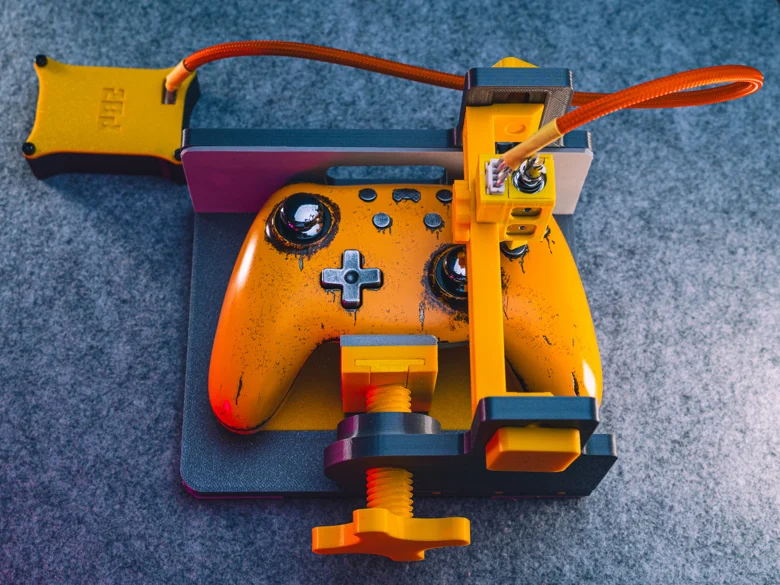
The team behind the renowned lag testing platform Gamepadla has introduced the Prometheus 82, an innovative device designed to revolutionize how gamers and hardware enthusiasts measure input latency. This new kit, currently in beta and available for $225, represents a significant leap forward by combining a sophisticated lag testing circuit with a precisely engineered 3D-printed brace and solenoid system. Its primary appeal lies in its ability to measure both button and stick latency without requiring any invasive controller disassembly, a common and often daunting prerequisite for traditional latency testing methods.
The Prometheus 82, alongside the Gamepadla platform, measures the total controller latency, which encompasses both the controller’s inherent processing delay and the latency introduced by the personal computer setup. This approach provides users with a highly accurate, real-world measurement reflective of the actual latency experienced on their individual gaming systems. While this methodology offers invaluable insight for optimizing personal gaming environments, it distinguishes itself from isolated controller lag tests that solely focus on the hardware’s intrinsic delay, a distinction critical for professional reviewers and hardware manufacturers.
The Evolution of Latency Testing in Gaming
The pursuit of minimal input latency has become an increasingly critical factor in modern gaming, particularly within competitive esports, fighting games, and rhythm-based titles where milliseconds can dictate victory or defeat. Historically, measuring controller latency was a cumbersome and often imprecise endeavor. Early methods involved crude techniques like high-speed cameras or frame-counting, which, while offering some insights, lacked the granularity and repeatability required for rigorous analysis.
The advent of specialized hardware and software solutions marked a turning point. Platforms like Gamepadla emerged to provide more systematic and accurate measurement tools. These initial iterations often required users to physically modify controllers, soldering wires to button contacts or analog stick potentiometers to tap directly into the electrical signals. While effective, this process was prohibitive for many users, demanding technical skill, specialized tools, and a willingness to potentially damage expensive hardware.
The development of the Prometheus 82 can be seen as a direct response to these challenges. Leveraging years of experience with the Gamepadla platform, the team aimed to democratize latency testing by removing the most significant barrier to entry: controller disassembly. The project’s journey from concept to a tangible beta product underscores a commitment to making advanced performance analysis accessible to a broader audience, from casual gamers curious about their setup’s responsiveness to dedicated enthusiasts and professional hardware testers seeking comprehensive data. The continuous updates available via the team’s Reddit presence (u/JohnnyPunch) indicate an iterative development process, engaging with community feedback to refine the device’s capabilities and user experience.
Prometheus 82: Design, Functionality, and Precision
The Prometheus 82 system is a testament to clever engineering, integrating mechanical precision with sophisticated electrical and software components. At its core, the device consists of two main parts: a custom-designed lag testing circuit and a 3D-printed brace coupled with a solenoid kit.
The 3D-printed brace is designed to securely mount a wide variety of game controllers, ensuring stability and consistent positioning during testing. This ergonomic design is crucial for repeatable measurements. The solenoid kit, which is carefully aligned to either a button or an analog stick, acts as a robotic finger, providing a precise, consistent, and repeatable input. Unlike human input, which can vary in force, speed, and contact time, the solenoid actuates with uniform characteristics, eliminating a significant source of measurement variability. The "reverse sensor" aspect, as hinted by the video title, suggests a mechanism where the sensor detects the physical activation from the solenoid, triggering the timing sequence for latency measurement.
Once the controller is mounted and the solenoid is aligned, the system connects to a PC. The accompanying software orchestrates the entire testing process. It initiates the solenoid’s activation, precisely measuring the time elapsed from the moment the button or stick is physically pressed by the solenoid until that input is registered by the PC’s operating system. A key feature of the Prometheus 82’s software is its automatic compensation for factors such as pulse duration and contact delay. These are tiny, often overlooked variables in traditional testing that can introduce inaccuracies. By accounting for them, the Prometheus 82 aims to provide a highly refined and accurate latency measurement.
The developers assert that this non-invasive method yields results within a millisecond of the accuracy achieved by direct soldering to controller contacts. This claim is significant because it suggests that the Prometheus 82 offers professional-grade accuracy without the associated risks or technical demands, making it a powerful tool for anyone serious about understanding their input lag. The software then processes the raw data to provide a comprehensive statistical overview, including minimum, maximum, and average latency measurements, offering a clear picture of performance consistency.
The Critical Distinction: Total System Latency vs. Isolated Controller Latency
Understanding the nuances between "total system latency" and "isolated controller latency" is paramount for interpreting the data generated by devices like the Prometheus 82. This distinction forms the core of the discussion surrounding the device’s applicability for different user groups.
Isolated Controller Latency refers to the pure, inherent delay within the controller hardware itself. This includes the time it takes for a physical input (button press, stick movement) to be processed by the controller’s internal circuitry, converted into a digital signal, and transmitted. Tools designed for isolated testing, such as certain MiSTer lag testing kits, aim to remove all external variables, providing a pristine measurement of the controller’s raw performance. For instance, testing an arcade controller with a MiSTer often yields highly consistent results, such as a min/max/average of 0.3 / 3.3 / 1.3 milliseconds. These numbers tend to be remarkably stable across multiple tests and over extended periods, as they are unburdened by the complexities of an operating system. This consistency makes isolated tests ideal for comparing the fundamental hardware performance of different controllers or for quality control during manufacturing.

Total System Latency, which the Prometheus 82 measures, encompasses the isolated controller latency plus all subsequent delays introduced by the user’s computing environment. This includes the USB polling rate, operating system overhead, driver processing, background applications, and even the specific hardware configuration of the PC (CPU, motherboard, BIOS). While the Prometheus 82 accurately captures this entire chain, it means that the resulting latency figures are specific to that particular PC setup at that particular moment.
The article highlights this variability with a compelling example: an arcade controller consistently showing 0.3-1.3ms isolated latency might register 1.59 / 9.61 / 5.42ms, 2.34 / 8.63 / 5.45ms, and 1.6 / 9.68 / 5.52ms in successive Gamepadla tests on a PC. This variability, often around two milliseconds higher than isolated tests and fluctuating by up to a millisecond, clearly demonstrates the impact of the Windows operating system and other PC-specific factors. Therefore, while the Prometheus 82 provides an incredibly valuable metric for gamers optimizing their personal setups – showing precisely what they can expect in real-world scenarios – it’s crucial for professional reviewers and hardware manufacturers to acknowledge that these numbers represent a combined system performance, not solely the controller’s intrinsic lag. Without further calibration, reporting these figures as "controller lag" alone could be misleading.
Addressing the Challenge: Achieving Isolated Measurements with Prometheus 82
Given the critical distinction, the article delves into potential methodologies for professional testers to derive more isolated controller latency figures using the Prometheus 82, or at least to better understand the system’s contribution to the total latency.
One proposed solution involves establishing a dedicated PC with strict environmental control. This would entail setting up a machine solely for latency testing, minimizing the operating system’s footprint, disabling all unnecessary background processes, and ensuring consistent driver versions. The process would begin by benchmarking a known "golden" controller, one whose isolated latency has been rigorously verified using a dedicated isolated testing kit (like the MiSTer kit). This known controller would be tested exhaustively across all connection types (wired USB, Bluetooth, wireless dongle) on the dedicated PC using Prometheus 82, with thousands of inputs recorded. By comparing these results to the controller’s known isolated latency, one could, in theory, calculate a consistent "system overhead" specific to that dedicated PC. However, even with such stringent controls, slight variations due to OS optimizations, driver updates, or even minor hardware differences could still introduce a degree of variability.
Another innovative concept suggested is the development of a "loopback tester" device. This hypothetical second device, perhaps another Arduino-based unit, would connect to the PC and then to the Gamepadla/Prometheus 82 hardware. Its purpose would be to measure the PC’s latency directly and independently. By running thousands of loopback tests, one could establish a baseline for the PC’s processing delay. Subsequently, when a controller is tested with Prometheus 82 on the same USB port (or via the same Bluetooth adapter), the measured system latency could potentially be subtracted from the total reading to yield a more refined "after system lag" calculation. The viability of this approach hinges on the PC’s latency being sufficiently consistent to allow for accurate subtraction, which remains a significant variable.
A more radical alternative mentioned is the creation of a Linux boot USB stick image. By booting the testing PC from a minimalist Linux distribution, one could potentially bypass much of the variability inherent in a full-featured Windows installation. Linux generally offers greater control over system processes and can be configured for extremely low latency. However, this approach introduces its own set of complexities. It requires more technical effort to set up and maintain, and crucially, even a minimalist Linux environment cannot entirely negate hardware-specific variances stemming from different motherboards, CPUs, and BIOS configurations. Every component in the signal chain contributes, and isolating each variable precisely is a monumental task.
Implications and Broader Impact
Despite the complexities of isolating controller lag, the Prometheus 82 stands as a monumental achievement with significant implications across the gaming ecosystem.
For Competitive Gamers and Enthusiasts: The Prometheus 82 offers an unprecedented opportunity to truly understand and optimize their personal gaming setups. For players where every millisecond counts, knowing the total input lag of their specific controller, PC, and OS configuration allows for informed decisions regarding hardware choices, driver updates, and system optimization. It empowers them to identify bottlenecks and fine-tune their environment for peak performance, potentially giving them a competitive edge.
For Reviewers and Gaming Journalists: The device simplifies the initial data collection process for controller reviews, allowing for rapid and non-destructive testing across a wide range of devices. However, it also places a greater responsibility on them to clearly articulate their testing methodology and the context of their latency figures. Professional reviews would benefit from either performing the rigorous calibration steps outlined above or by explicitly stating that their reported numbers represent total system latency on a specific test bench, rather than isolated controller lag. This transparency is crucial for maintaining journalistic integrity and providing accurate information to consumers.
For Hardware Manufacturers and Developers: The Prometheus 82 could become an invaluable tool for research and development. Manufacturers of controllers and controller adapters can use it for rapid prototyping, A/B testing different designs, firmwares, or wireless protocols. Its non-invasive nature means they can iterate quickly without the overhead of disassembling and reassembling prototypes. For quality assurance, it provides a consistent, repeatable method to ensure that production units meet specific latency targets, enhancing product quality and consistency.
The Future of Latency Testing: The Prometheus 82, even in its beta stage, represents a significant step towards more accessible and accurate latency testing. The ongoing dialogue within the community and the developers’ willingness to iterate (as evidenced by the Reddit updates and the interview with John & Anna) suggest a promising future. Future versions might incorporate integrated loopback testing, more refined software algorithms to estimate isolated lag, or even standardized testing environments to reduce system variability.
In conclusion, the Prometheus 82 is an "awesome evolution" of the Gamepadla platform, bringing sophisticated lag testing within reach of a broader audience. Its ability to measure total system latency non-invasively is a game-changer for individual gamers seeking to optimize their performance. While professional reviewers and manufacturers must navigate the nuances of distinguishing between total system and isolated controller lag, the device provides a powerful foundation for understanding and improving the responsiveness of gaming inputs. Its impact will undoubtedly resonate throughout the gaming community, fostering a deeper understanding of input lag and driving innovation in controller design and system optimization.