Farhan hamdan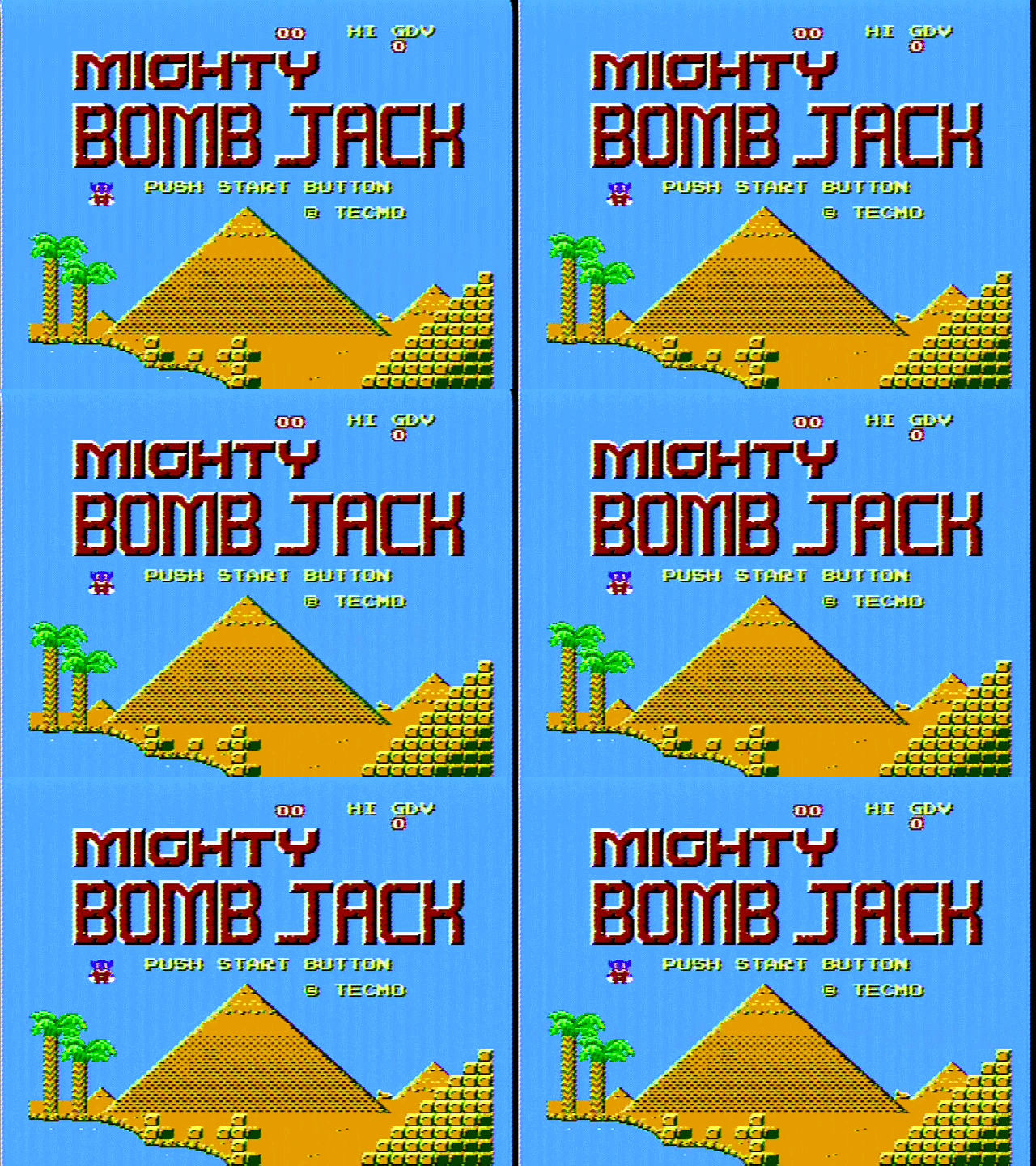
A recent comprehensive analysis by Nicole Express has shed critical light on a long-observed, yet technically opaque, visual anomaly present in the composite video output of North American (NTSC) Nintendo Entertainment Systems: the persistent "wobbly" effect. This revelation, detailed in a technical blog post, unravels a complex interplay of internal clock timings and video signal generation, offering an unprecedented understanding of the NES’s unique hardware architecture and its subtle visual quirks. The findings reveal that the seemingly minor visual instability is not a defect but a direct consequence of the console’s native composite video generation, rooted in a deviation from standard NTSC colorburst synchronization protocols.
Understanding the "Wobble": A Deep Dive into NES Composite Video
The core of Nicole Express’s discovery lies in the precise manner the NES’s Picture Processing Unit (PPU) generates its composite video signal. Unlike many later consoles that produce a clean RGB signal and then convert it to composite, the NES was designed to output composite video directly. This fundamental design choice necessitated intricate engineering compromises to achieve a color signal within the constraints of 8-bit hardware and a highly competitive consumer market.
According to the analysis, the NTSC NES deviates from the standard colorburst synchronization. In a conventional NTSC signal, the colorburst, which serves as a crucial timing reference for color decoding, is designed to invert its phase every two horizontal lines. This alternating phase helps to average out and cancel certain artifacts, contributing to a stable color image. However, the NES PPU, due to its specific internal clock divisions and the mathematical relationship between its master crystal oscillator, the PPU clock speed, and the dot clock, ends up synchronizing its colorburst every three lines. This 3-line synchronization pattern, rather than the standard 2-line alternation, forces the system to alternate how it draws consecutive frames to maintain any semblance of color stability. This frame-to-frame alternation in color phase manifests visually as the characteristic "wobble," often described as a subtle horizontal shimmering or a mild "horizontal interlacing" effect, where the image appears to shift slightly between frames.
The technical intricacies are profound. The NES’s master crystal oscillator operates at approximately 21.47727 MHz for NTSC regions. This frequency is exactly four times the NTSC color subcarrier frequency of 3.579545 MHz multiplied by six. The PPU then derives its dot clock (the rate at which individual pixels, or "dots," are drawn) from this master clock. For the NES, this dot clock is approximately 5.37 MHz. The challenge arises in precisely aligning this dot clock with the NTSC color subcarrier frequency and the horizontal and vertical scan rates to produce a stable color signal. Because the NES generates composite video natively, it must inherently integrate these timing compensations into its fundamental design. This requires an almost mathematically perfect alignment of these frequencies to avoid even more severe visual anomalies. The ingenious, albeit imperfect, solution adopted by Nintendo’s engineers was the 3-line colorburst synchronization, a clever workaround that minimized visible artifacts while keeping hardware costs down.
Historical Context: The Genesis of Video Standards and the NES Era
To fully appreciate the significance of this discovery, it is essential to contextualize it within the history of video technology and the era of the Nintendo Entertainment System.
The NTSC (National Television System Committee) standard itself was established in the United States in the early 1950s, primarily to facilitate the transition from black-and-white to color television while maintaining backward compatibility. This standard, which defines parameters such as frame rate (29.97 frames per second), line count (525 lines, 480i visible), and the critical color subcarrier frequency (3.579545 MHz), became the dominant broadcasting and video format in North America, Japan, and several other regions. Its design incorporated ingenious methods for encoding color information onto a luminance (brightness) signal, primarily through phase and amplitude modulation of the color subcarrier relative to a transmitted colorburst reference.
During the early years of video gaming, particularly in the 1970s and early 1980s, video output from home consoles was predominantly handled via RF (Radio Frequency) modulators. These devices converted the console’s video signal into a broadcast television channel signal (typically Channel 3 or 4), allowing it to be displayed on standard televisions via the antenna input. While convenient, RF modulation resulted in significantly degraded image quality, often masking subtle video artifacts that would be more apparent with a direct composite video connection.
The Nintendo Entertainment System, launched in North America in 1985, marked a pivotal moment in gaming history. Its robust hardware, innovative game design, and aggressive marketing strategy revitalized the collapsing video game market. The NES’s Picture Processing Unit (PPU), the custom chip responsible for generating the video signal, was a marvel of 8-bit engineering. It managed tile-based graphics, sprites, and scrolling backgrounds, all while generating a video signal that could be output via RF or, increasingly, directly through composite video RCA jacks. The choice to integrate native composite video generation into the PPU was a cost-effective decision, avoiding the need for additional, more expensive RGB-to-composite encoder chips common in later systems like the Super Nintendo Entertainment System (SNES) or Sega Genesis. This design philosophy, while brilliant for its time, embedded the technical quirks that Nicole Express has now so clearly articulated. At the time of the NES’s release, the "wobble" was either unnoticed due to RF connections or simply accepted as a minor characteristic of consumer electronics video output, particularly on the lower-resolution CRT televisions of the era, which often masked such subtle imperfections.
The Role of Nicole Express and the Retro Gaming Community

The comprehensive explanation of the NES "wobble" by Nicole Express (whose blog post was initially published on July 24, 2026, according to the source material) is a testament to the meticulous dedication of the modern retro gaming and hardware preservation community. Decades after the NES’s initial release, enthusiasts armed with advanced oscilloscopes, logic analyzers, and deep theoretical knowledge continue to scrutinize and document the intricate workings of vintage hardware.
This level of modern scrutiny is driven by several factors. The widespread availability of high-resolution displays (HDTVs, 4K monitors) and sophisticated video capture equipment has made previously imperceptible artifacts glaringly obvious. Furthermore, the advent of highly accurate emulators and the proliferation of hardware modification projects (such as RGB mods for the NES) have spurred a demand for a complete and precise understanding of original hardware behavior. The retro gaming community, often spearheaded by individuals like Nicole Express and platforms like RetroRGB (which highlighted this discovery), operates as a collective research and development hub. These independent researchers delve into datasheets, reverse-engineer proprietary chips, and conduct extensive empirical testing to demystify technologies that were once considered black boxes. Nicole Express’s work exemplifies this spirit, transforming a vague, anecdotal observation into a scientifically validated explanation rooted in fundamental electrical engineering and video signal theory. This type of analysis is crucial for ensuring the accurate preservation of gaming history, both in digital emulation and through physical hardware restoration.
Implications for Preservation and Emulation
The findings regarding the NES’s composite video "wobble" carry significant implications for the fields of video game preservation, hardware emulation, and retro console modification.
For emulation, achieving pixel-perfect accuracy has always been the holy grail. Emulators strive not just to run games but to replicate the exact visual and audio output of the original hardware, including its quirks and limitations. Understanding the 3-line colorburst synchronization and its resulting "wobble" allows emulator developers to implement this specific behavior accurately. Without this knowledge, emulators might produce a "cleaner" but ultimately less authentic composite signal, diverging from the original console’s intended (or inherent) output. This insight helps bridge the gap between abstract code and the tangible experience of playing on original hardware. It ensures that future generations can experience games as they truly appeared on period-appropriate displays, complete with their unique characteristics.
In the realm of hardware modification and restoration, this technical explanation provides critical context. Enthusiasts who perform RGB modifications on NES consoles, for example, aim to bypass the native composite output entirely to achieve a superior, cleaner RGB signal. Knowing the source of the "wobble" helps these modders understand what they are bypassing and why the native composite output behaves as it does. For those restoring original NES hardware, distinguishing between a normal, inherent "wobble" and actual hardware faults becomes easier. This knowledge is invaluable for diagnostics and for maintaining the integrity of vintage consoles. It allows for informed decisions regarding whether a console’s video output is functioning as designed or if it requires repair.
Furthermore, this discovery contributes to a broader appreciation for the aesthetics of imperfection in retro gaming. Modern gaming often prioritizes pristine, artifact-free visuals. However, the unique visual signatures of older hardware, like the NES’s "wobble," are integral to their charm and identity. These subtle imperfections are part of the historical texture of these systems, distinguishing them from contemporary hardware. Understanding their technical origins deepens our appreciation for the engineering ingenuity required to create compelling experiences within severe technical constraints. The "wobble" is not merely a flaw; it is a historical artifact, a testament to the clever compromises made by pioneering engineers.
Expert Perspectives and Community Dialogue
While direct statements from original Nintendo engineers regarding this specific composite video quirk are rare and difficult to obtain decades later, the community’s consensus infers that such design choices were pragmatic engineering solutions. Developing the NES involved balancing performance, reliability, and critically, manufacturing cost. Integrating a full-spec NTSC composite encoder would have added complexity and expense to the PPU, potentially making the console less accessible to its target market. The adopted 3-line synchronization, while producing a subtle artifact, was likely deemed an acceptable compromise given the prevalent display technologies and the console’s overall performance.
The ongoing dialogue within the retro gaming and hardware communities continuously refines our understanding of these systems. Experts from diverse backgrounds—electrical engineers, software developers, historians, and dedicated hobbyists—collaborate to document, analyze, and disseminate information. Nicole Express’s explanation, shared through platforms like RetroRGB, exemplifies this collaborative spirit. It encourages further investigation into other consoles and video standards, pushing the boundaries of collective knowledge. These communities are not just preserving games; they are meticulously cataloging the very DNA of early digital entertainment, ensuring that the foundational technologies are understood at their deepest levels. This collective effort ensures that the legacy of consoles like the NES is not just remembered, but thoroughly comprehended, providing invaluable insights into the history of technology and interactive media.
In conclusion, Nicole Express’s detailed analysis of the NTSC NES’s "wobbly" composite video output represents a significant contribution to the collective knowledge of retro gaming hardware. By dissecting the intricate timing mechanisms of the NES PPU and its interaction with NTSC video standards, the mystery behind this long-observed visual anomaly has finally been solved. This revelation underscores the profound depth of engineering ingenuity present in vintage hardware and highlights the ongoing, invaluable efforts of the retro gaming community in preserving and understanding our digital heritage with unparalleled precision. The "wobble," once a puzzling visual quirk, is now understood as an elegant, albeit imperfect, solution born from the technological and economic constraints of its era.