
 Jia Lissa
In a comprehensive dialogue published in the August 15, 1980, edition of Game Machine, Hayao Nakayama, the Executive Vice President and Representative Director of Sega Enterprises, Ltd., provided a detailed roadmap of the company’s strategic direction during a pivotal era for the global amusement industry. As the "Golden Age of Arcades" reaches its zenith, Sega is positioning itself as a hybridized powerhouse, leveraging its relationship with the American conglomerate Gulf & Western (G&W) to bridge the gap between Japanese manufacturing prowess and American market innovation. Nakayama’s insights reveal a company transitioning from its roots in electro-mechanical machines toward a future dominated by microprocessor-driven "TV games," while navigating the complex legal waters of international copyright and the logistical challenges of a dual manufacturer-operator business model.
The Corporate Architecture: Sega and the Gulf & Western Connection
The current organizational structure of Sega is a sophisticated web of international interests that began in 1974 when Sega Enterprises, Ltd., headquartered in Tokyo and led by President David Rosen, was acquired by the Gulf & Western Corporation. Based in New York and led by Charles Bluhdorn, G&W is a massive conglomerate that ranked 52nd in the United States in 1980, boasting annual sales of $5.3 billion and a net income of $230 million. While G&W is often associated with its ownership of Paramount Pictures, Nakayama clarified that its core interests lie in manufacturing, energy, and automotive sectors—including the recent development of a high-efficiency "dream battery" for vehicles.
Technically, Sega of Japan functions as a "grandchild company" within this hierarchy. Following its acquisition, Sega was listed on the U.S. stock market, leading to the formation of Sega Enterprises, Inc. (Sega of America). Sega of America serves as the parent company to Sega of Japan. This structure allowed for strategic acquisitions, most notably the 1976 purchase of San Diego-based Gremlin Industries and the 1979 acquisition of Esco Trading in Japan. This cross-continental footprint allows Sega to coordinate research and development (R&D) between its Japanese and American wings, ensuring that products are tailored to the specific demands of their respective markets.
Financial Performance and Operational Scale
The fiscal year ending in April 1979 marked a period of robust growth for Sega’s Japanese operations. The company reported annual sales of 24 billion yen (approximately $106 million USD in 1980 figures) with a declared income of 5.37 billion yen. This financial success is supported by a massive domestic infrastructure comprising 1,200 employees, three major branch offices in Sapporo, Osaka, and Fukuoka, and a network of 89 operational offices.

Sega occupies a unique and sometimes controversial position in the Japanese market as both a manufacturer and an operator of game centers. Nakayama acknowledged the inherent tension in this dual role but argued that it is a byproduct of the industry’s evolution in Japan, where most major manufacturers began as operators. He emphasized that Sega’s "operator mindset" allows it to better understand the needs of its clients, though the company’s primary identity remains that of a manufacturer. By managing a large number of locations, Sega aims to achieve economies of scale and maintain long-term business sustainability, balancing consistent revenue with attentive service.
The Strategic Pivot to TV Games
A central theme of Nakayama’s policy is the aggressive shift toward video-based entertainment. Sega intends to dedicate 70% to 80% of its resources to the development of "TV games," a move aligned with the global trend away from purely mechanical or electro-mechanical amusements. Nakayama argued that the novelty and entertainment value afforded by digital screens are the primary drivers of the industry’s current boom.
While Sega continues to produce pinball machines (through partnerships with Williams and Stern) and medal games, these are increasingly viewed as secondary to the video game market. The company is currently engaged in a process of "inventory optimization," where underperforming medal games like Blackjack and Faro II are being refurbished and improved to eliminate waste and provide operators with lower-cost alternatives.
Market Discrepancies and the Cabinet Debate
The interview highlighted a fascinating divergence between the Japanese and Western markets regarding game preferences and hardware formats. In Japan, the "tabletop" or "cocktail" cabinet has become the dominant format for TV games, largely due to the spatial constraints of Japanese game centers and their integration into coffee shops and small venues. Conversely, the "upright" cabinet remains the standard in the United States and Europe.
Nakayama noted that while Sega must follow the tabletop trend in Japan for the time being, the company has not abandoned the upright format. He pointed out that upright cabinets offer higher "added value" through their physical presence and artwork, whereas tabletop games rely almost entirely on the screen for appeal.

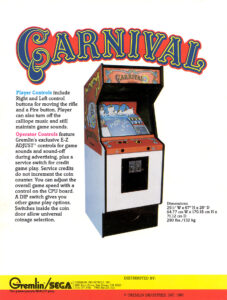
Furthermore, Nakayama addressed the "Idea Exchange Seminar" (IES) recently held by Gremlin, which focused on the need for a shift in mindset regarding game design. He cited the game Mini Monaco as a prime example: a flop in Japan, it became a massive hit in the U.S. and Europe because its small footprint appealed to location owners seeking spatial efficiency. Similarly, the game Carnival—the first to feature a bonus round—received a lukewarm reception in Japan but outperformed major titles like Missile Command in the American market.
Intellectual Property and the War on Counterfeiting
One of the most pressing issues facing Sega in 1980 is the rampant "copying" or "cloning" of popular video games. During the initial Space Invaders boom, a shortage of supply led many operators to turn to counterfeit boards. At that time, Japanese law offered little protection for software. However, Nakayama signaled a major shift in Sega’s legal strategy.
The company is now utilizing trademarks and unfair competition prevention laws to target copycats. Nakayama highlighted a landmark case in the United States where Sega/Gremlin successfully sued Exidy over the game Head-On, forcing the latter to admit fault. This legal victory has empowered Sega to take similar actions in Japan. Nakayama warned that while developing uncopyable hardware is a priority, the increased R&D costs associated with security will ultimately be passed on to the operators. He urged the industry to respect originality, arguing that "easy copying" leads to a decline in product quality and excessive competition that harms everyone in the long run.
Distribution and Future Outlook
To manage an increasingly diverse and expansive market, Sega is reinforcing its regional distribution network. By training and positioning major local companies as authorized distributors, Sega aims to provide more "detailed" sales strategies that a centralized Tokyo office cannot manage alone. This decentralized approach is intended to ensure that Sega’s products reach every corner of the Japanese archipelago with proper support and maintenance.
As the interview concluded, Nakayama expressed a vision of a more professional and unified industry. He commended trade publications like Game Machine for their role in leading the industry toward positive growth. His remarks suggest a leader who is acutely aware of Sega’s role as a bridge between the burgeoning digital cultures of the East and West.
Analysis of Implications
Nakayama’s 1980 business policy reflects a turning point not just for Sega, but for the entire entertainment landscape. By aligning so closely with Gulf & Western, Sega secured the capital and the American R&D foothold necessary to survive the "Video Game Crash" that would soon hit the U.S. market in 1983. The focus on TV games over mechanical games proved prescient, as the 1980s would see the near-total eclipse of electro-mechanical amusements by digital technology.
Furthermore, the legal stance taken by Nakayama regarding Head-On and the copyright of "TV games" laid the groundwork for the modern intellectual property framework of the gaming industry. By treating game code and visual presentation as protectable assets, Sega helped transform video games from ephemeral arcade novelties into a multi-billion dollar software industry.
As Sega moves into the new decade, its dual identity as a Japanese manufacturer with American corporate backing provides it with a unique advantage. The synergy between Sega in Tokyo and Gremlin in San Diego represents an early model of the globalized development cycle that defines the modern tech industry. For now, however, Nakayama’s focus remains on the immediate horizon: securing the arcade market through innovation, legal enforcement, and a deep understanding of the evolving "TV game" phenomenon.








