Chalid Lutfie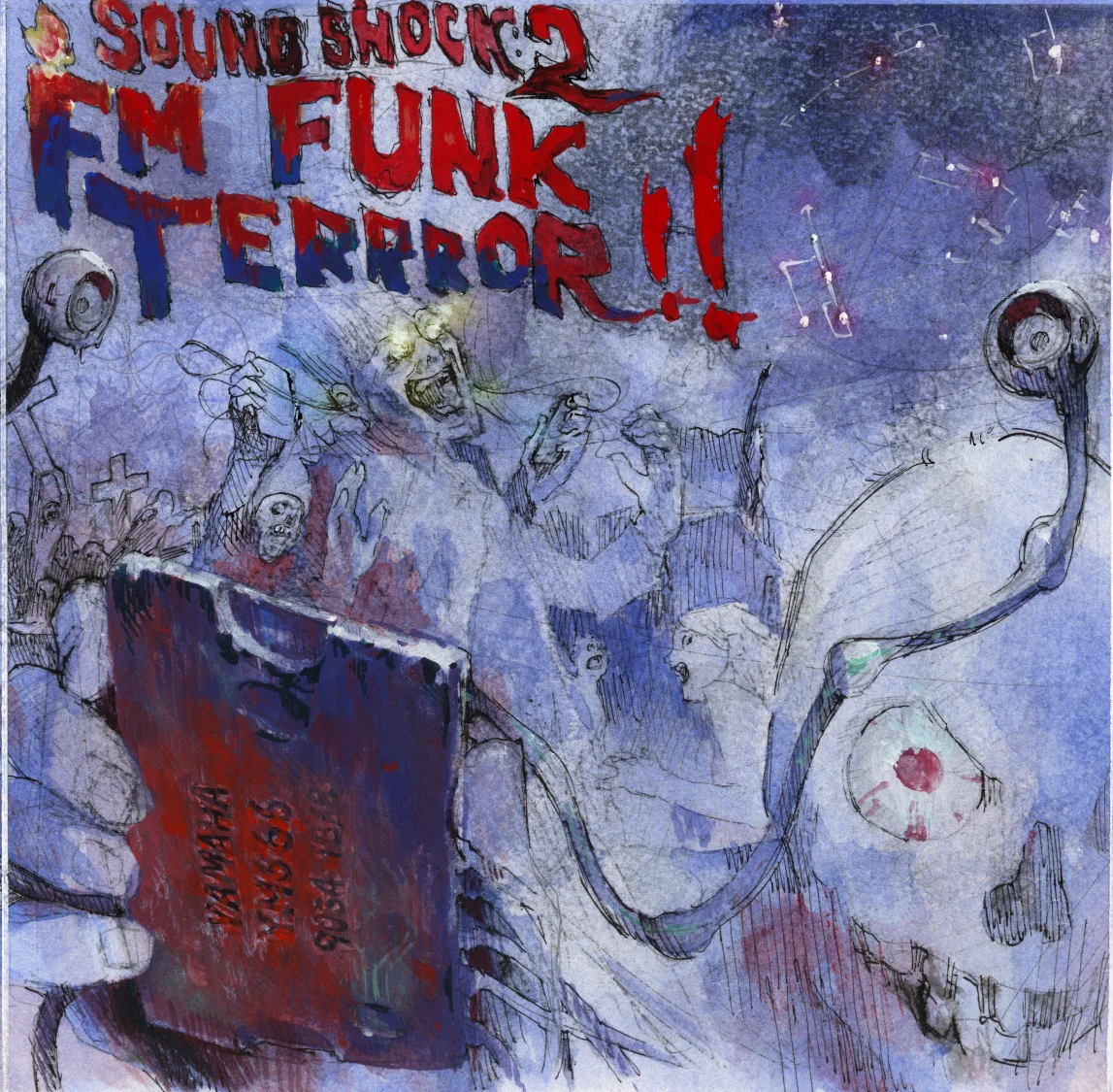
The SOUNDSHOCK music series, a seminal collection dedicated to the exploration and celebration of Frequency Modulation (FM) synthesis, has officially reached its creative conclusion, marking the end of an era for enthusiasts of vintage hardware-driven composition. Central to the identity of this trilogy is the hand-painted artwork of Tsuyoshi Shimokura, whose visual contributions provided a narrative and aesthetic framework for the music curated by the producer known as Zinger. As the series draws to a close, a retrospective analysis of the creative process reveals a deep intersection between 1980s arcade culture, Buddhist philosophy, and the technical intricacies of sound engineering. This collaboration between Zinger and Shimokura serves as a primary example of how independent music projects can leverage high-concept visual storytelling to elevate niche technical genres into broader artistic statements.
The Genesis of a Collaborative Vision
The partnership between Zinger and Shimokura began through the mediation of a mutual contact, hex125, during the production phase of the first installment, SOUNDSHOCK: FM FUNK MADDNESS!!. While Shimokura was initially approached to contribute a musical composition to the album, Zinger discovered a portfolio of the artist’s visual work that showcased a distinct professional background in manga and a profound affinity for computer history. This dual expertise—combining technical literacy with illustrative mastery—made Shimokura the ideal candidate to define the series’ visual language.
Shimokura’s background as a professional artist allowed him to translate the abstract qualities of FM synthesis—often characterized by its metallic, sharp, and complex textures—into tangible imagery. His work for the series is notable for its refusal to use modern digital shortcuts, opting instead for hand-painted techniques that mirror the "hand-crafted" nature of programming FM sound chips.
FM FUNK MADDNESS!!: The Mechanical Heroism of Synthesis
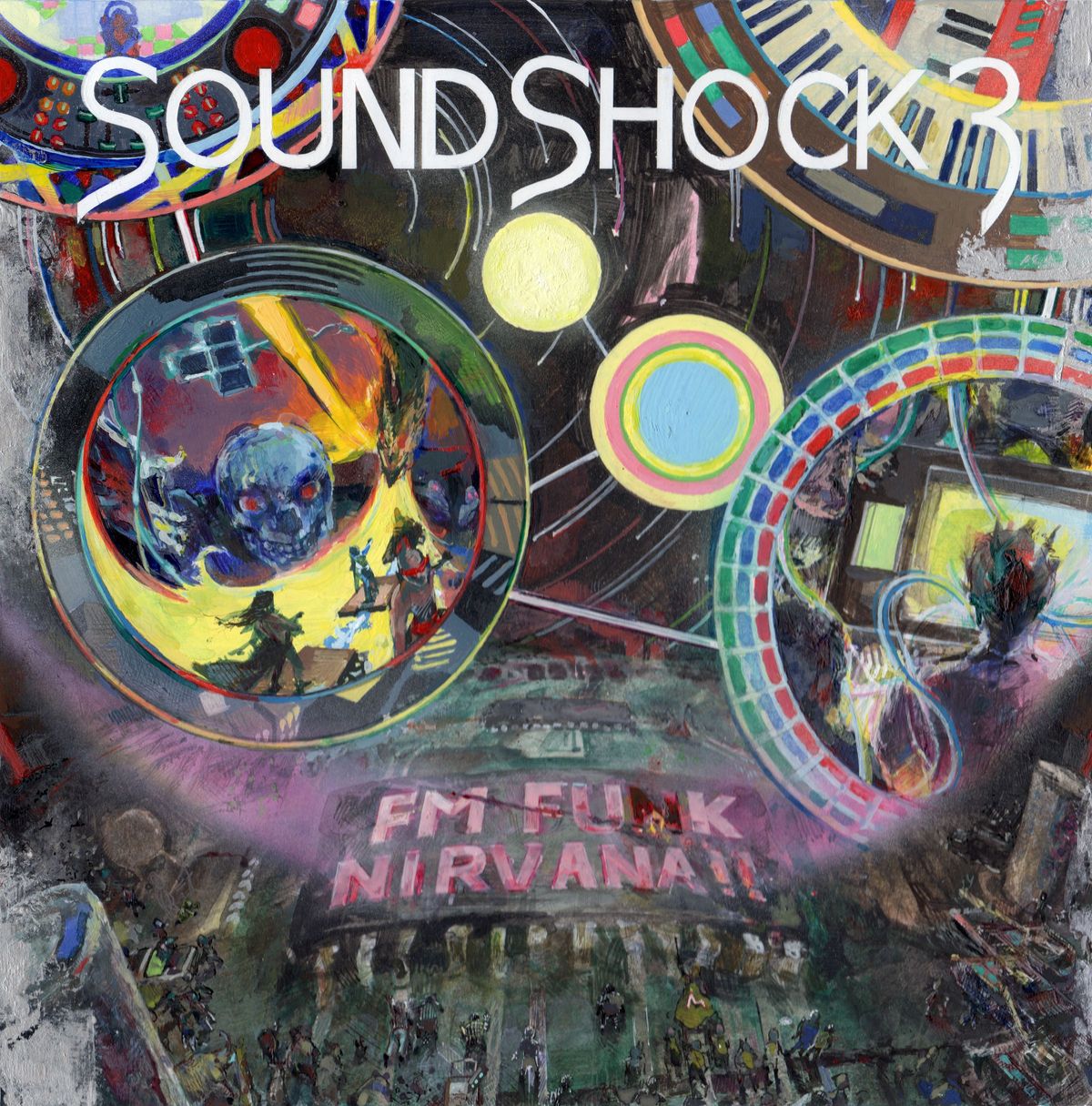
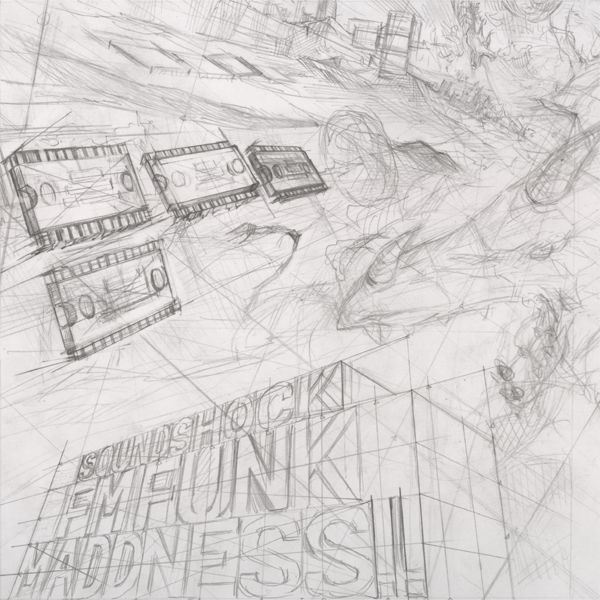
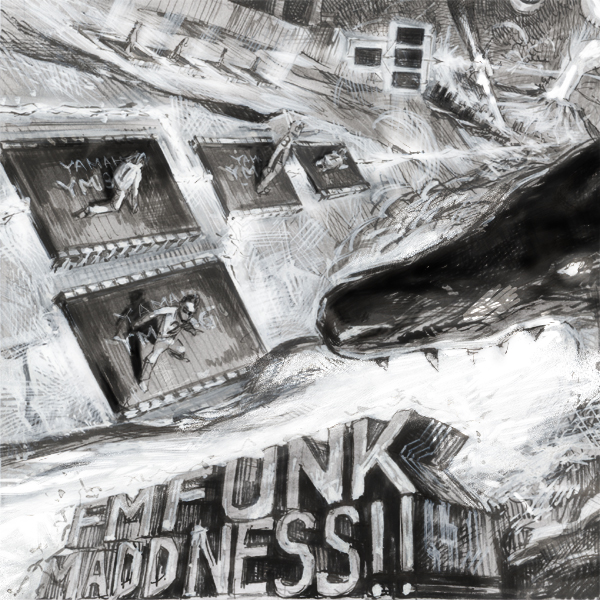
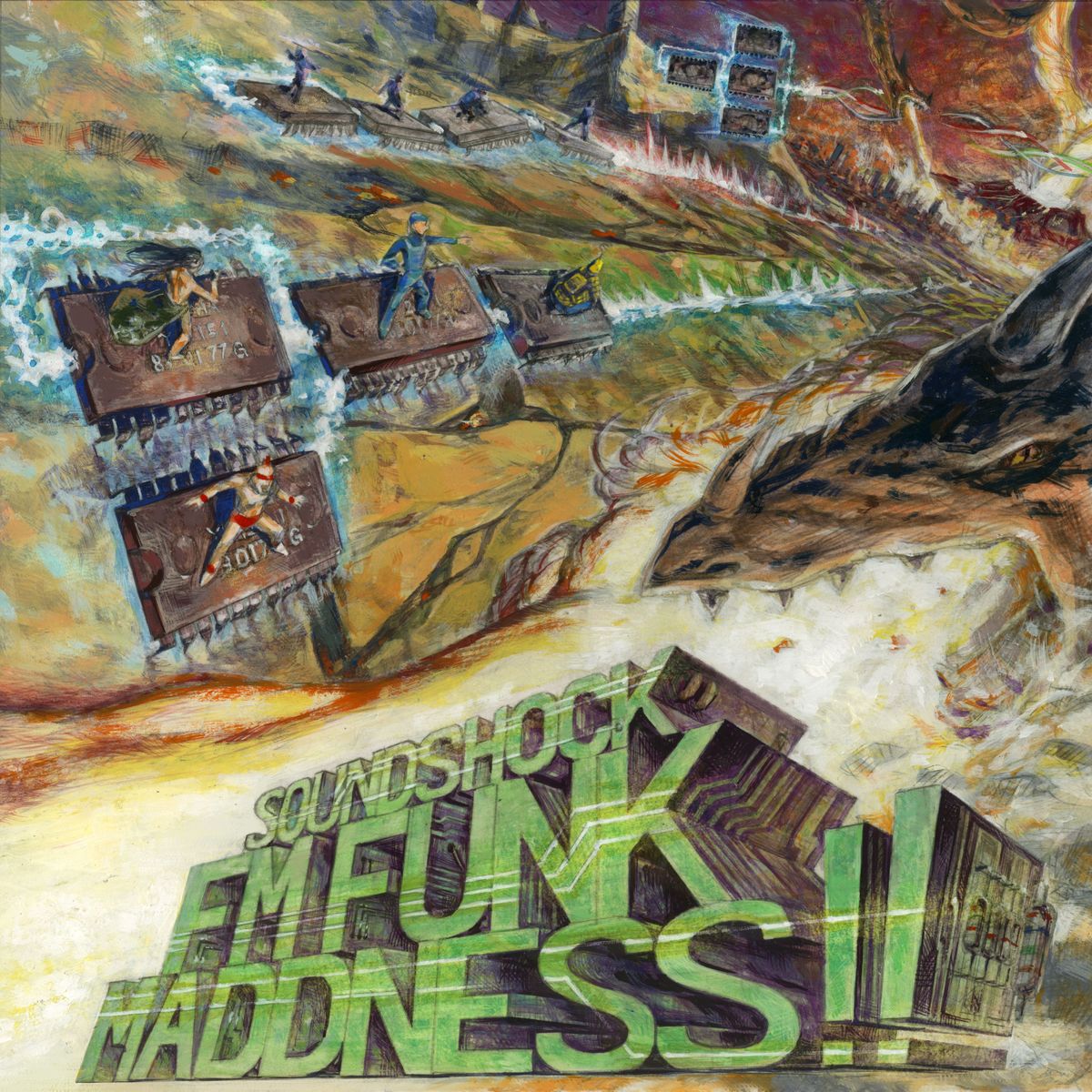
The first volume, FM FUNK MADDNESS!!, established the series’ commitment to high-energy, "over-the-top" aesthetics. In developing the cover art, Zinger and Shimokura drew inspiration from the promotional materials of the late 1980s Japanese arcade scene, specifically referencing the flyers for Taito Corporation’s Metal Black and Darius II. These games were known not only for their gameplay but for their sophisticated use of the Yamaha YM2151 (OPM) sound chip, which provided the "FM Funk" sound the album sought to emulate.
Shimokura’s conceptual sketches for the first volume depicted a world where musicians and their hardware were one. The narrative premise involved "heroes" utilizing the power of FM sound to repel monstrous entities. A key detail in the final artwork is the anthropomorphized FM chips, which were designed with legs resembling caterpillar tracks. Furthermore, Shimokura integrated technical "algorithm charts"—visual representations of how operators are connected within an FM patch—directly into the character designs. This synthesis of technical documentation and fantasy illustration created a unique visual shorthand for the chiptune community, signaling that the project was as much a technical tribute as it was a musical one.
FM FUNK TERRROR!!: The Horror of the Frequency
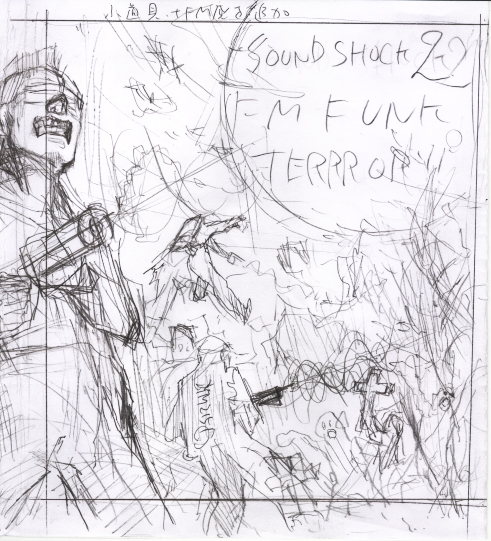
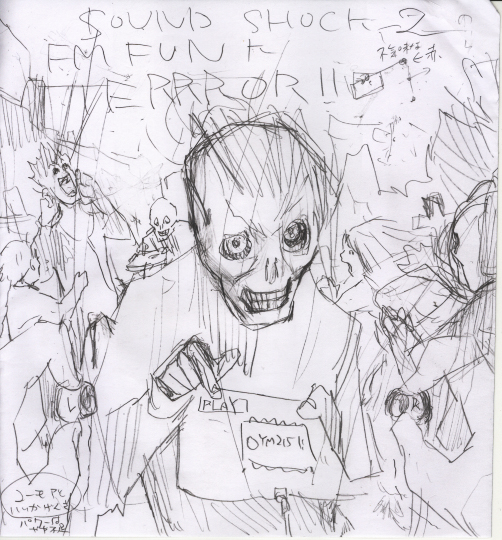
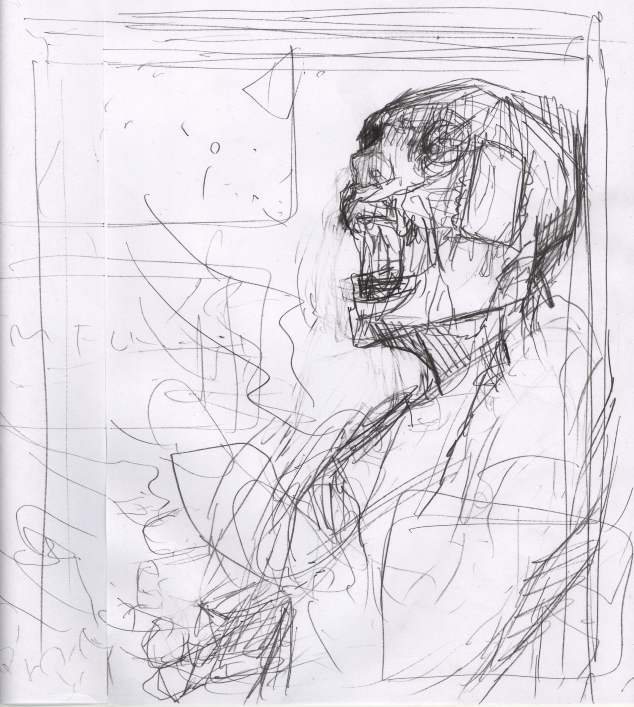
The second installment, SOUNDSHOCK 2: FM FUNK TERRROR!!, shifted the aesthetic focus toward the horror genre. Zinger provided Shimokura with a curated selection of 1980s horror posters and flyers, ranging from mainstream Western classics like A Nightmare on Elm Street and The Evil Dead to the visceral imagery of Namco’s Splatterhouse series.
The resulting artwork was a complex, detail-oriented homage to "video nasties" and retro-gaming horror. Shimokura’s creativity manifested in the inclusion of a "ghoul" character wielding a device labeled "YM666," a fictional, demonic play on the Yamaha YM series of sound chips. The device was styled after a gravestone and functioned as a portable music player, symbolizing the "infectious" nature of the FM sound.
In this phase of the series, the lore expanded significantly. Shimokura authored a short narrative to accompany the art, suggesting that on April 5, as "Algorithm constellations" aligned, a supernatural force of FM-obsessed zombies would descend upon humanity. The victims of this "terror" would find their brains "shocked" by the frequencies, leading to a spiritual awakening. This thematic progression from the mechanical heroism of the first album to the transformative horror of the second set the stage for the series’ final evolution.
FM FUNK NIRVANA!!: The Spiritual Apotheosis
The conclusion of the trilogy, SOUNDSHOCK 3: FM FUNK NIRVANA!!, represents the most ambitious thematic leap in the series. The title itself was born from community interaction, inspired by a YouTube comment that Zinger felt captured the "maxed out" trajectory of the project. While the previous titles utilized intentional misspellings—MADDNESS and TERRROR—to convey increased intensity, the word "Nirvana" was left in its standard form. Zinger reasoned that the concept of Nirvana already represents a state of ultimate perfection and could not be further amplified by stylistic distortion.
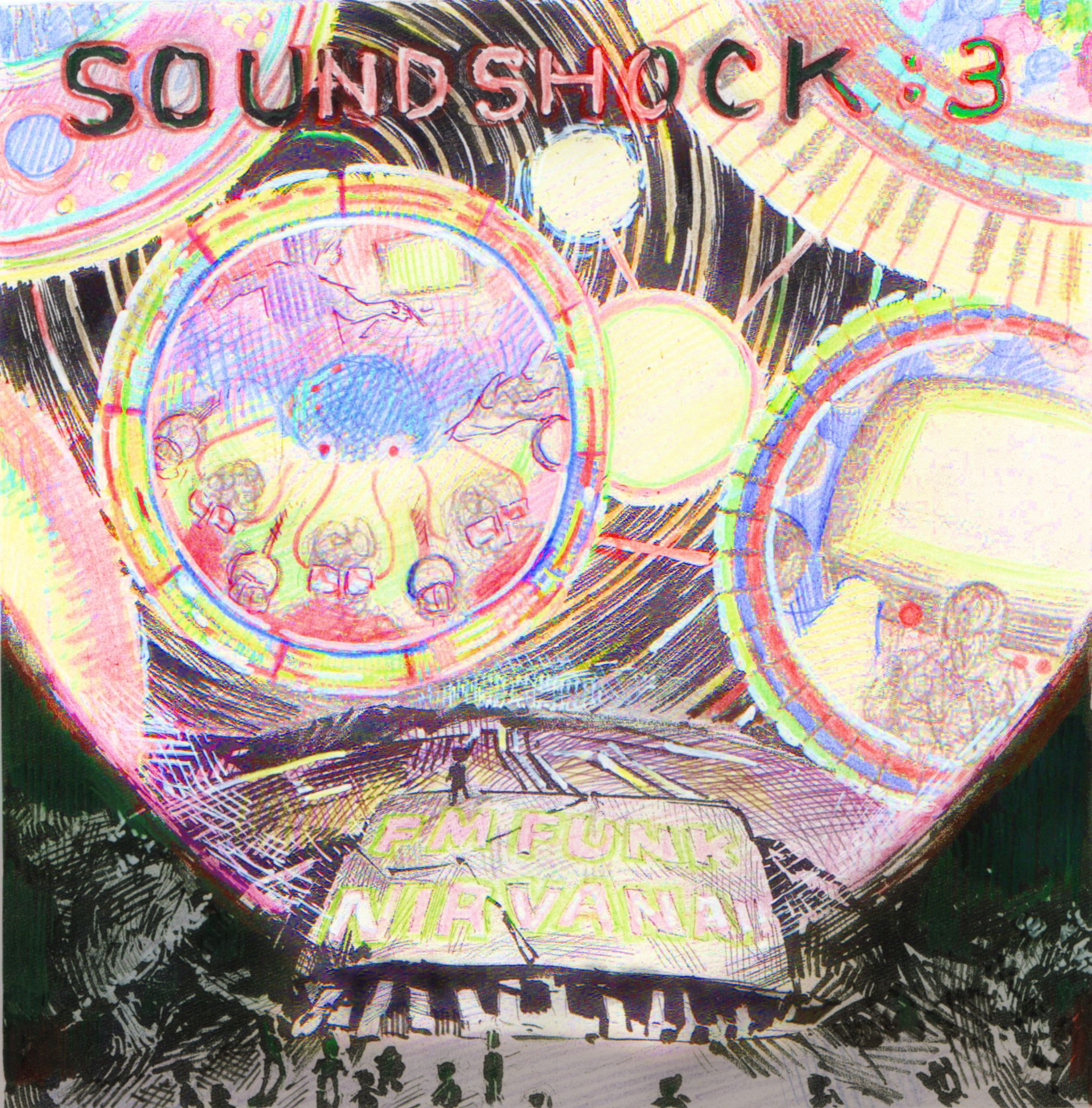
For the visual representation of NIRVANA!!, Shimokura moved away from direct pop-culture references, though he did consult the soundtrack artwork of Darius Gaiden for atmospheric cues. Instead, he delved into Buddhist iconography, specifically the concept of the "Mandala." In spiritual traditions, a mandala serves as a tool for focusing attention and establishing sacred space.
Shimokura’s final cover depicts a vast universe where the upper portion is filled with spheres containing different "elements," forming a celestial map. At the base of the image, a mass of worshippers gathers before a monumental FM chip mounted on a circuit board. This imagery elevates the hardware from a mere tool of production to an object of divine worship. The artist’s intent was to portray the FM chip as a "spiritual guiding tool," suggesting that the music produced by these chips provides a path to enlightenment for the "disciples" of the genre.
Chronology of the SOUNDSHOCK Series
The development of the SOUNDSHOCK series followed a distinct timeline that mirrored the evolution of the independent music scene’s relationship with retro hardware:
- Initial Contact (Circa 2010-2011): Zinger and Shimokura establish a connection via the artist hex125.
- Volume 1 Release (FM FUNK MADDNESS!!): The debut establishes the "FM Funk" branding and the mechanical-manga art style.
- Volume 2 Release (FM FUNK TERRROR!!): The series adopts a darker, narrative-driven horror aesthetic, expanding the lore of the "Algorithm constellations."
- Final Development (2016-2017): The conceptualization of NIRVANA!! begins, shifting the focus toward spiritual finality and the conclusion of the series.
- Series Conclusion (April 15, 2017): The final retrospective is published, featuring Shimokura’s closing message to the fanbase.
Technical Context: The Role of FM Synthesis
To understand the significance of the SOUNDSHOCK series, one must consider the technical background of FM synthesis. Popularized in the 1980s by Yamaha, FM synthesis uses one waveform (a modulator) to change the frequency of another waveform (a carrier). This process creates complex, harmonically rich sounds that were instrumental in the "golden age" of arcade and home console gaming.
The chips referenced in Shimokura’s art, such as the YM2151 (used in Sega’s Hang-On and various arcade boards) and the YM2612 (the heart of the Sega Genesis/Mega Drive), are celebrated for their "crunchy" bass and distinctive metallic leads. The SOUNDSHOCK series functioned as a modern showcase for composers who continue to work within the constraints of this legacy hardware, proving that these decades-old chips remain viable instruments for contemporary funk and electronic music.
Analysis of Implications and Artistic Legacy
The conclusion of the SOUNDSHOCK series carries significant weight within the "doujin" (independent) music community in Japan and the global chiptune scene. Shimokura’s final message to fans emphasizes that the end of the series is "not a sad thing." He posits that the work serves as a "seed" for future artists—"future stars that have yet to be born."
This perspective reflects a broader cultural cycle in the niche music world, where the "progeny" of one era become the "forerunners" of the next. By framing the series as a spiritual offshoot of the original game music pioneers, Shimokura and Zinger have positioned SOUNDSHOCK as a bridge between the historical innovators of the 1980s and the next generation of digital composers.
The series also highlights the enduring value of physical, hand-painted art in an increasingly digital landscape. In an era where album covers are often viewed as small thumbnails on streaming platforms, Shimokura’s commitment to intricate, high-concept oil and acrylic-style illustrations provided the SOUNDSHOCK series with a physical presence that commanded respect.
Official Responses and Community Impact
While the series was a grassroots effort, it garnered significant respect from industry veterans and fans of the "VGM" (Video Game Music) community. The collaboration was characterized by a high degree of mutual respect between the curator and the artist, as evidenced by Zinger’s public gratitude for Shimokura’s talent and their shared explorations of Osaka’s independent game centers.
For the listeners, the series provided more than just a collection of tracks; it offered a cohesive world-building experience. The "Algorithm" lore and the recurring motifs of the FM chips created a sense of identity for a genre that is often relegated to the background of gaming. As the project concludes, the impact of SOUNDSHOCK is expected to persist through the "spiritual offshoots" Shimokura described—new artists who will continue to find inspiration in the "madness, terror, and nirvana" of the FM sound.