Cecilia Chamidah Nur
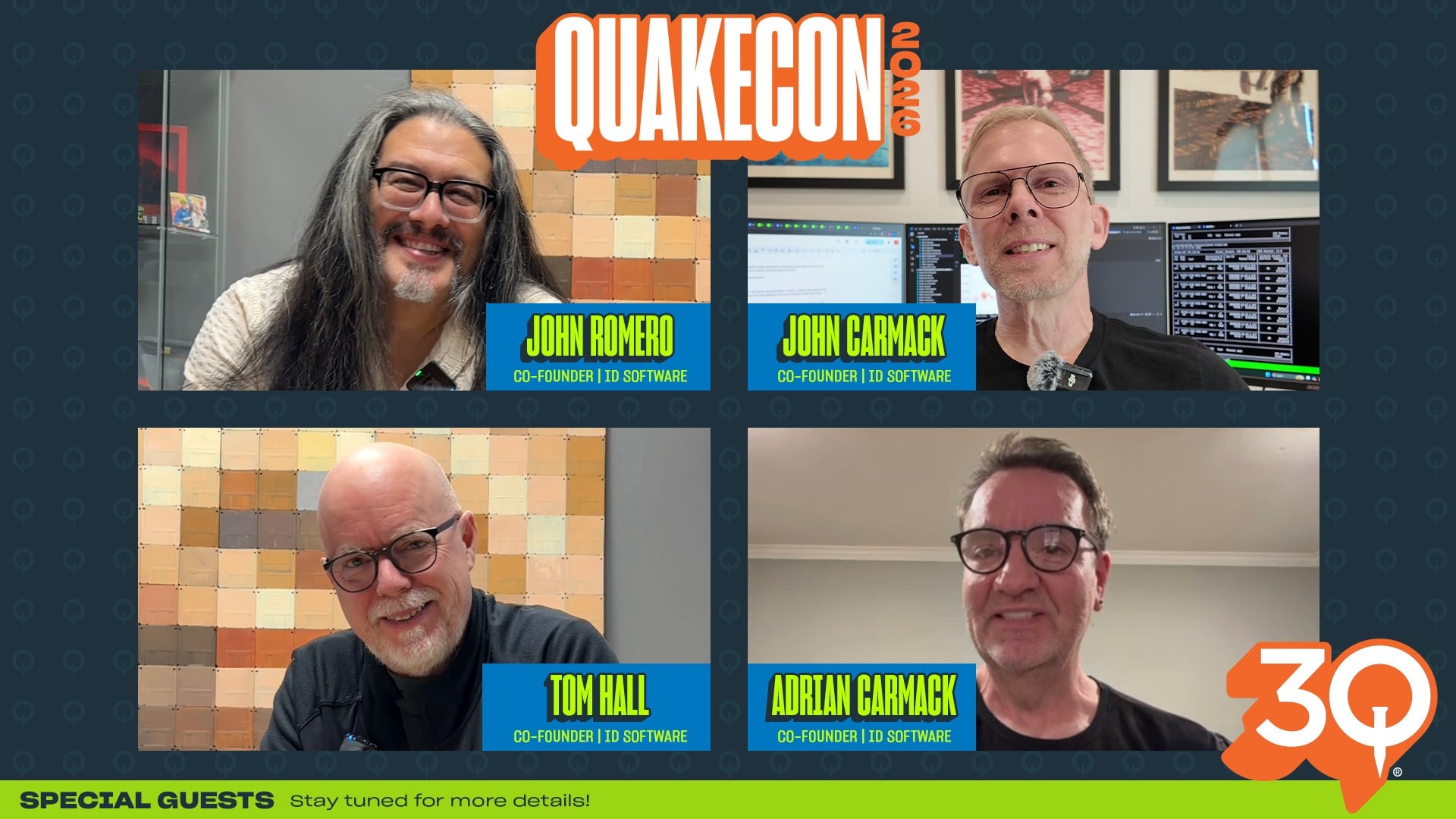
QuakeCon 2026 is set to be a landmark event for id Software, marking not only the 30th anniversary of its revolutionary first-person shooter, Quake, and the inaugural QuakeCon, but also the 35th anniversary of the company’s own founding in February 1991. In a historic announcement made during a DOOM: The Dark Ages One Year Anniversary Stream, id Software revealed that all four of its original co-founders – John Romero, John Carmack, Adrian Carmack, and Tom Hall – will be in attendance. This unprecedented reunion, scheduled for August 6th to 9th, 2026, at the Gaylord Texan Resort & Convention Center in Grapevine, Texas, signifies the first time the quartet has gathered together since 1993, promising a momentous occasion for fans and industry observers alike.
The Genesis of a Gaming Empire
id Software was founded in February 1991 by four visionary programmers and artists: John Romero, John Carmack, Adrian Carmack (no relation to John Carmack), and Tom Hall. Their early collaborations, often characterized by an intense work ethic and pioneering technical innovation, quickly established them as key players in the burgeoning PC gaming scene. Operating initially out of Shreveport, Louisiana, the team rapidly gained notoriety for their groundbreaking shareware titles. Their early hits, such as the Commander Keen series (1990-1991), demonstrated a mastery of PC hardware limitations, pushing boundaries with smooth scrolling and vibrant graphics previously thought impossible on IBM-compatible machines. These early successes paved the way for their subsequent, genre-defining creations.
The company’s ethos, heavily influenced by John Carmack’s relentless pursuit of graphical and engine technology, and John Romero’s flair for level design and gameplay, created a fertile ground for innovation. Adrian Carmack contributed significantly as a lead artist, defining the distinct visual style of id’s early games, while Tom Hall, with his creative design philosophy, shaped many of the narrative and gameplay concepts. This unique blend of technical prowess and creative vision was the foundation upon which id Software built its legacy.
The DOOM Revolution and Early Departures
The true turning point for id Software came with the release of Wolfenstein 3D in 1992, a game widely credited with popularizing the first-person shooter genre. However, it was DOOM, launched in December 1993, that cemented id Software’s place in gaming history. DOOM was a technological marvel, featuring a pseudo-3D engine that offered unprecedented graphical fidelity, lighting effects, and a visceral gameplay experience. Its cultural impact was immense, igniting a global phenomenon that transcended the gaming community. It introduced widespread online multiplayer via modem and LAN, popularized the concept of user-generated content through its modding capabilities, and sparked debates about violence in video games, propelling id Software into the mainstream consciousness.
Despite the monumental success of DOOM, the development period was not without internal strife. Creative differences, particularly between Tom Hall and the other founders regarding the game’s direction and tone, ultimately led to Hall’s departure in August 1993, just months before DOOM‘s release. John Romero, in his memoir Doom Guy: A Life in First Person, describes this period as "the one truly negative chapter" of DOOM‘s development. Hall, advocating for a more story-driven, comedic approach, found himself at odds with the team’s preference for raw, action-oriented gameplay. His resignation marked the first crack in the original quartet, setting a precedent for future founder separations. Following his exit, Hall joined Apogee Software, where he contributed to Rise of the Triad, a spiritual successor to Wolfenstein 3D, before co-founding Ion Storm with Romero years later.
Quake: A New Dimension and Further Divisions
The trajectory of id Software continued upward with the development of Quake. Released in 1996, Quake represented another monumental leap forward for the company and the gaming industry as a whole. It was one of the first commercially successful games to feature a true 3D engine, allowing for fully polygonal environments and characters. This technological breakthrough enabled unprecedented levels of immersion and dynamic gameplay. Quake‘s innovative client-server networking model and the introduction of QuakeWorld significantly enhanced online multiplayer, laying the groundwork for modern esports. The game quickly became a staple of competitive gaming, fostering a vibrant community of professional players and modders. Its influence can be seen in countless subsequent FPS titles, establishing benchmarks for graphics, multiplayer design, and competitive play that are still referenced today.
However, the intense development cycle of Quake mirrored the internal tensions that had characterized DOOM‘s creation. John Romero, known for his ambitious designs and energetic personality, found himself increasingly at odds with John Carmack’s more focused, technology-driven approach. The creative friction, combined with differing visions for the company’s future, culminated in Romero’s departure in 1996, shortly after Quake‘s release. This was another significant fracturing of the original founding team, leading Romero to establish Ion Storm, a studio that would produce titles like Daikatana and Deus Ex. The departure of two key creative forces within three years significantly altered the dynamic of id Software, though the company continued its trajectory of technical excellence under John Carmack’s leadership.
Divergent Paths: The Co-Founders’ Post-id Careers
The years following their respective departures saw the co-founders embark on varied and impactful careers, each leaving an indelible mark on the gaming industry.
Tom Hall’s Journey: After leaving id Software, Tom Hall’s career reflected his enduring passion for creative game design. At Apogee Software (later 3D Realms), he was instrumental in projects like Rise of the Triad, a game that, despite its Wolfenstein 3D roots, developed its own cult following for its over-the-top action and unique design choices. His reunion with John Romero at Ion Storm in 1996 saw him contribute to the design of Anachronox, an innovative RPG praised for its storytelling and art direction, though it struggled commercially. Hall later worked on a variety of projects across different studios, including Monkeystone Games (co-founded with Romero and Stevie Case), contributing to mobile and casual games, demonstrating his adaptability across different gaming landscapes. His career has consistently highlighted his commitment to engaging gameplay and unique narrative experiences.
John Romero’s Continued Impact: Following his high-profile exit from id Software, John Romero became one of the most recognizable figures in game development. Ion Storm, which he co-founded, aimed to "design, build, and sell games," but experienced a tumultuous history. While Daikatana became a notorious commercial failure, the studio also produced critically acclaimed titles like Deus Ex. Romero later formed Monkeystone Games and, more recently, Romero Games with his wife Brenda Romero. His more recent work includes SIGIL, an unofficial spiritual successor to DOOM, released for free in 2019, and SIGIL II in 2023, both of which were lauded by fans for capturing the essence of classic DOOM gameplay. These projects underscored his enduring connection to the genres he helped define and his continued relevance in the indie development scene. He also revisited collaboration with Adrian Carmack on the unfulfilled Kickstarter project Blackroom in 2016, described as a "return to fast, violent and masterful play on the PC."
Adrian Carmack’s Transition: Adrian Carmack, the artistic backbone of id Software’s early visual identity, remained with the company until 2005. His departure was contentious, reportedly stemming from a dispute over his shares, leading to a lawsuit. Post-id, Adrian Carmack largely stepped away from the direct spotlight of game development. In 2014, he was announced as the new owner of the luxurious Heritage Golf & Spa Resort in Killenard, County Laois, Ireland, signaling a significant shift in his professional focus towards hospitality and real estate. However, his brief re-engagement with John Romero on the Blackroom Kickstarter project in 2016 indicated that his interest in the gaming world had not entirely waned, offering a glimpse into a potential return, albeit one that did not fully materialize.
John Carmack’s Technological Pursuit: John Carmack, often hailed as one of the most influential programmers in video game history, remained at id Software the longest among the founders, continuing to push the boundaries of 3D graphics and engine technology with games like Quake III Arena, DOOM 3, and Rage. His relentless pursuit of technological innovation was the driving force behind many of id’s groundbreaking achievements. In 2013, he made a significant career move, resigning from id Software to become the Chief Technology Officer (CTO) of Oculus VR, a pioneering company in virtual reality. His work at Oculus, and later at Facebook (now Meta) as Consulting CTO for VR, was pivotal in advancing VR hardware and software. More recently, he founded Keen Technologies, focusing on artificial general intelligence (AGI), showcasing his continued commitment to tackling complex technological challenges beyond the realm of traditional gaming. Carmack’s trajectory exemplifies a career dedicated to pure technical innovation, always looking towards the next frontier.
QuakeCon: A Community Cornerstone
QuakeCon itself has a rich history, evolving from a small, grassroots LAN party organized by fans in 1996 into an official, annual event sponsored by id Software and Bethesda Softworks. It rapidly grew into one of the longest-running fan conventions in the gaming industry, known for its massive Bring-Your-Own-Computer (BYOC) LAN area, developer panels, esports tournaments, and exclusive game reveals. QuakeCon has served as a vital nexus for the id Software community, a place where fans can connect, compete, and celebrate the legacy of games like Quake, DOOM, and Wolfenstein. Its continued success over nearly three decades underscores the enduring appeal of id Software’s titles and the strength of its dedicated fanbase. The 2026 event, marking its own significant anniversary alongside Quake‘s, promises to be particularly special, drawing on this deep well of community spirit and historical significance.
A Historic Reconciliation: The Road to QuakeCon 2026
The announcement of all four co-founders reuniting at QuakeCon 2026 is particularly poignant given the well-documented history of creative differences and personal tensions that characterized their time at id Software and led to their subsequent separations. The narrative of their complex relationships, particularly between John Carmack and John Romero, has been extensively explored in works such as David Kushner’s 2003 book, Masters of Doom. This book detailed the intense collaboration and eventual friction that shaped their creative partnership and the company’s output.
In recent years, both John Carmack and John Romero have publicly acknowledged and sought to downplay past animosities, often expressing regret that they were "twentysomethings" at the time, lacking the maturity to navigate such intense creative pressures more effectively. Their reconciliation has been a gradual process, highlighted by significant moments like their reunion for DOOM‘s 30th-anniversary stream in 2023, where they shared insights and anecdotes alongside writer David L. Craddock, visibly demonstrating that they had "buried the hatchet."
The impending QuakeCon reunion, encompassing all four original founders, elevates this reconciliation to an unprecedented level. As John Romero stated on Twitter/X, "It’s the first time all four of us have been together since 1993, and the first time we’ve all been to QuakeCon." This statement underscores the historical magnitude of the event. Bethesda’s senior community lead, Joshua Boyle, has hinted at "activities" and "fun things" being planned for the quartet, fueling speculation among fans about potential panel discussions, retrospective interviews, or even collaborative appearances that could provide unique insights into the early days of id Software and the development of their iconic games.
Anticipation and Implications for the Gaming World
The reunion of id Software’s original co-founders at QuakeCon 2026 is expected to generate immense excitement and media attention, extending far beyond the immediate fan base. For long-time enthusiasts, it represents a once-in-a-lifetime opportunity to witness the architects of modern gaming come together, potentially sharing untold stories and perspectives on their revolutionary contributions. Industry analysts anticipate a significant surge in attendance for QuakeCon 2026, driven by the unique allure of this historic gathering.
The implications of this reunion are multifaceted. Firstly, it serves as a powerful testament to the enduring legacy of id Software and its foundational impact on the video game industry. The technologies and design philosophies pioneered by these individuals not only defined genres but also set standards for game development that continue to influence creators today. Their work laid the groundwork for the modern first-person shooter, competitive online gaming, and the entire shareware distribution model that revolutionized independent game development.
Secondly, the event offers a unique opportunity for historical reflection and preservation. A panel discussion featuring all four founders, for instance, could provide invaluable first-hand accounts of the creative processes, technical challenges, and personal dynamics that shaped some of the most important games ever made. Such discussions would not only entertain but also serve as crucial educational resources for future generations of game developers and historians. The potential for new insights into the development of DOOM and Quake, in particular, is immense, given the anniversaries being celebrated.
Finally, the reunion symbolizes a broader sense of reconciliation and maturation within the gaming industry. It demonstrates that even intense creative conflicts can eventually give way to mutual respect and shared celebration of a collective legacy. For many, it will be a heartwarming moment, seeing the "gang of four" reunited, reminding everyone of the passion and innovation that forged a gaming empire.
General admission tickets for QuakeCon 2026 are currently on sale, offering fans the chance to be part of this truly historic celebration. The convergence of multiple significant anniversaries with the unprecedented reunion of id Software’s founding fathers positions QuakeCon 2026 as an unmissable event that will undoubtedly resonate throughout the gaming world for years to come.
Please note that some external links on this page are affiliate links, which means if you click them and make a purchase we may receive a small percentage of the sale. Please read our FTC Disclosure for more information.