Chalid Lutfie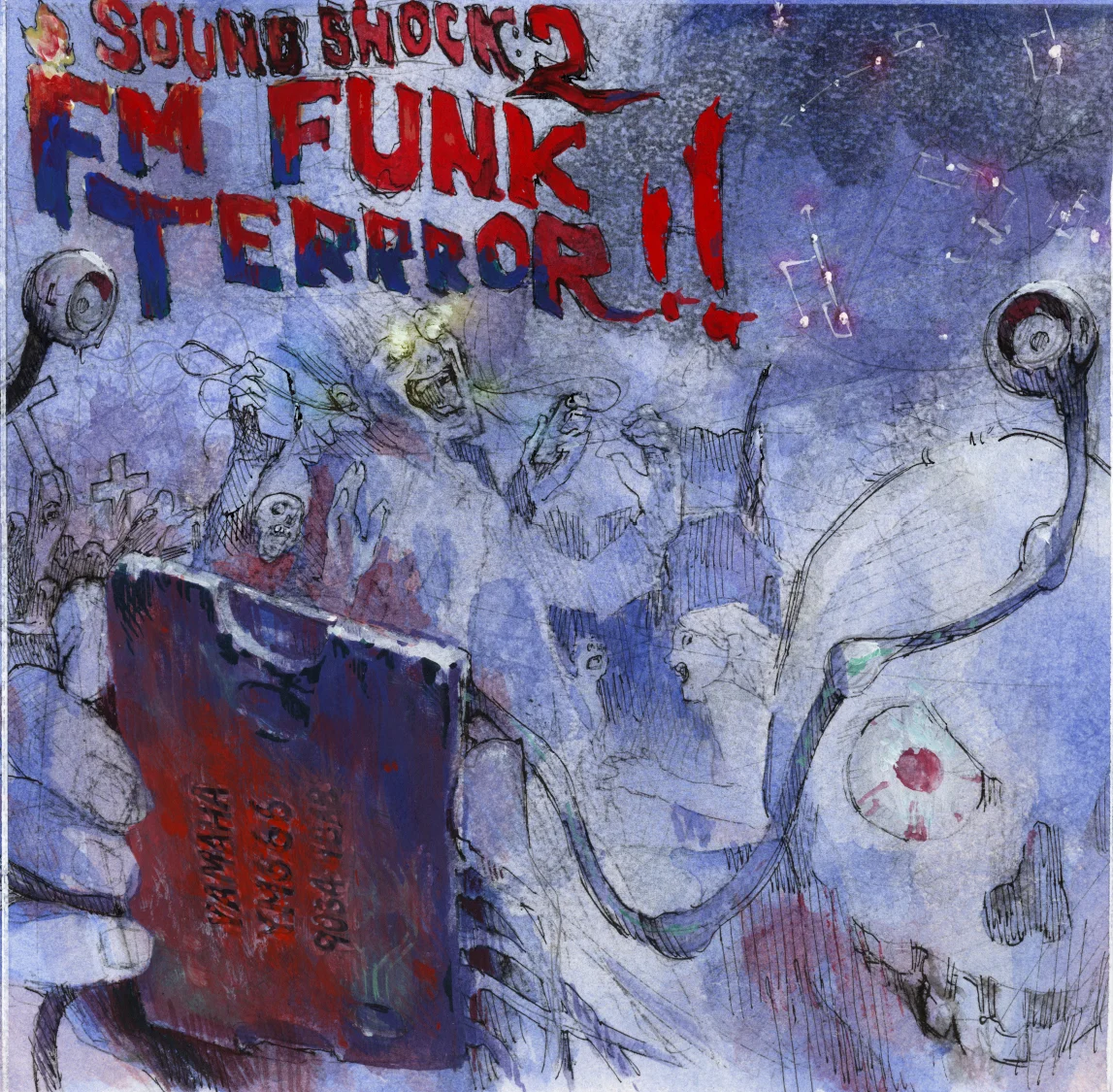
The SOUNDSHOCK series, a seminal collection of music compilations dedicated to the intricate world of Frequency Modulation (FM) synthesis, has officially concluded its three-volume run, leaving behind a legacy that transcends its auditory contributions. While the series gained international acclaim for its curation of high-fidelity FM tracks—utilizing the same sound chip architecture found in 1980s and 1990s arcade hardware and home consoles like the Sega Genesis—its visual identity remains equally significant. Central to this identity is the hand-painted artwork of Tsuyoshi Shimokura, a professional artist and manga creator whose collaboration with the series producer, known as zinger, redefined the aesthetic standards for contemporary chiptune and retrogaming releases.
The final retrospective of the project, published on April 15, 2017, provides a comprehensive look at the creative synergy between zinger and Shimokura. The partnership was born out of a shared passion for the "crunchy," complex textures of FM sound, a technology pioneered by Yamaha. Shimokura, initially invited to contribute musically to the first volume, revealed a portfolio of professional-grade illustrations that aligned perfectly with the series’ high-energy, over-the-top conceptual framework. This discovery led to the commissioning of three distinct, hand-painted covers that serve as a visual narrative for the evolution of the FM synthesis subculture.
Historical Context: The Rise of FM Synthesis and SOUNDSHOCK
To understand the weight of the SOUNDSHOCK series, one must consider the historical importance of FM synthesis. Developed by John Chowning at Stanford University and later commercialized by Yamaha, FM synthesis became the definitive sound of the 1980s. It powered the legendary DX7 synthesizer and eventually the sound chips of the PC-8801, the Sharp X68000, and the Mega Drive (Sega Genesis). Unlike the simpler "pulse-wave" sounds of the Nintendo Entertainment System, FM synthesis allowed for complex, metallic, and percussive timbres that defined the soundtracks of arcade legends like Darius, After Burner, and Streets of Rage.
The SOUNDSHOCK series was conceived as a modern tribute to this era, bringing together veteran composers and new talent to push the limits of old hardware. However, the project aimed to be more than a nostalgic exercise; it sought to present FM sound as a living, breathing art form. This required a visual presentation that moved away from the pixel art tropes common in the chiptune scene, opting instead for the grand, detailed, and often surreal hand-painted style of 1980s Japanese arcade flyers and movie posters.
Chronology of Visual Development
The visual journey of the SOUNDSHOCK series followed a deliberate trajectory of escalating intensity and thematic complexity, moving from science fiction to horror, and finally to spiritual transcendence.
Phase I: FM FUNK MADDNESS!! and the Industrial Aesthetic
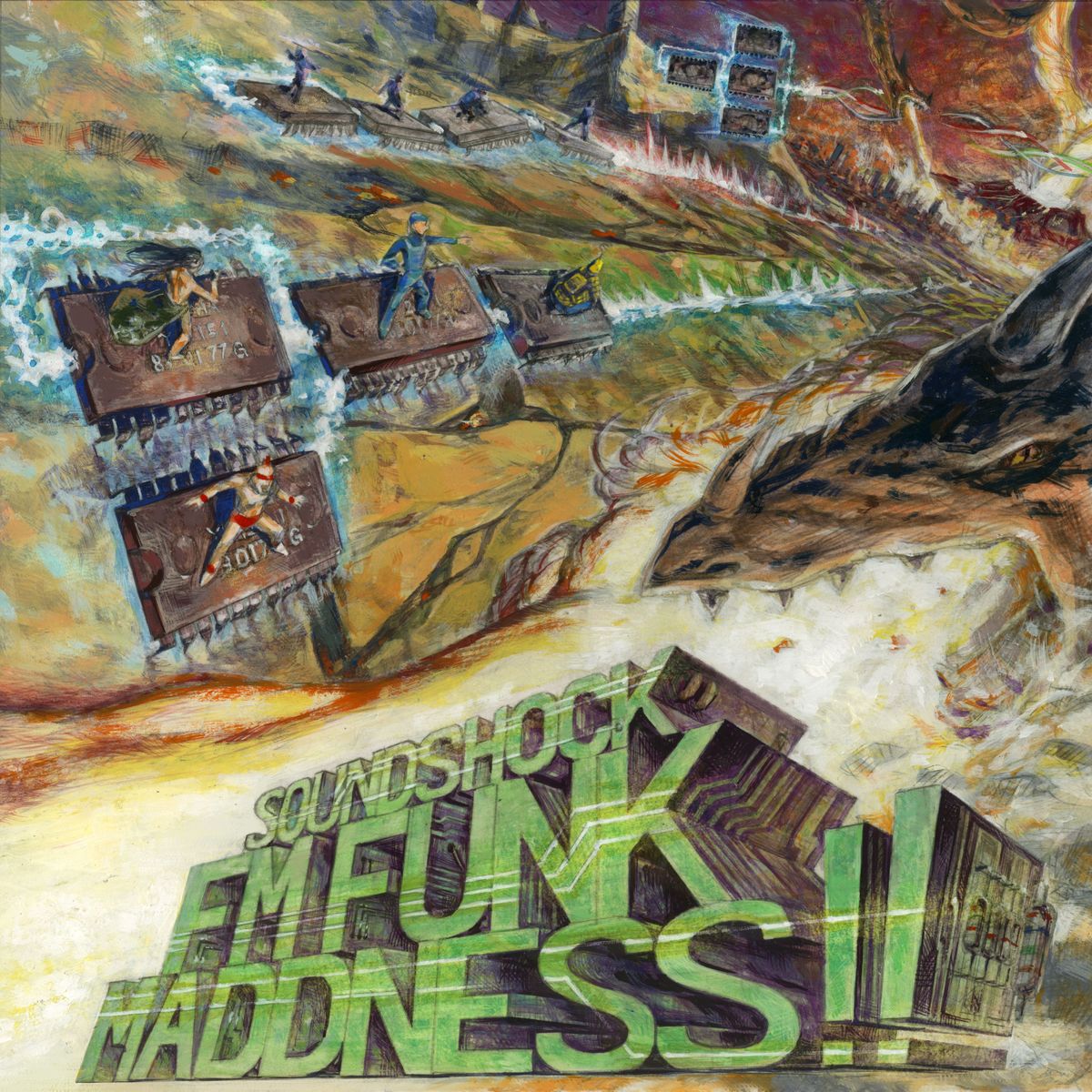
The inaugural release, SOUNDSHOCK: FM FUNK MADDNESS!!, established the series’ penchant for linguistic flair—specifically the intentional misspelling of titles to convey "extra power." For the cover art, zinger and Shimokura looked toward the "heavy" sci-fi aesthetics of Taito Corporation’s arcade flyers, specifically referencing titles like Metal Black and Darius II.
Shimokura’s approach was to personify the hardware itself. The cover features heroic figures and musicians utilizing the power of FM sound to combat monstrous entities. A key detail in this piece is the depiction of FM chips as biological-mechanical hybrids. The chips are arranged in patterns mirroring FM algorithm charts—diagrams that show how operators (oscillators) are connected to produce sound. In a whimsical yet industrial touch, Shimokura depicted the "feet" (pins) of the integrated circuits moving like caterpillar legs, suggesting that the hardware itself was a living participant in the music creation process.
Phase II: FM FUNK TERRROR!! and the Horror Influence
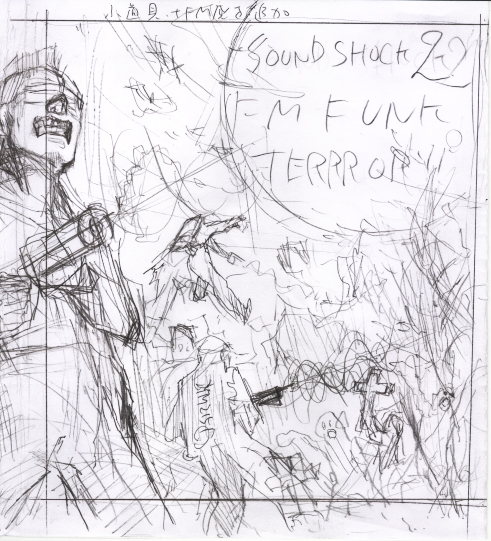
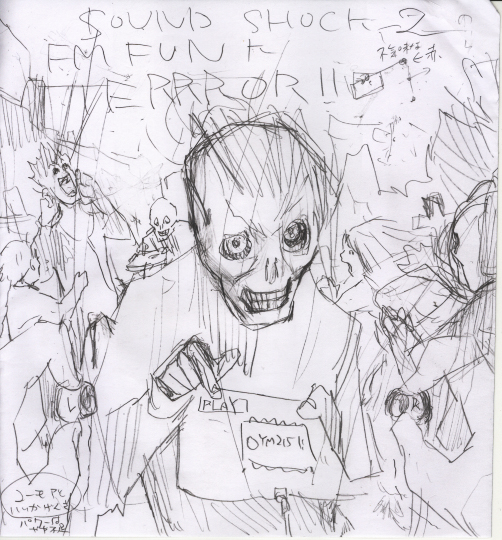
For the second installment, SOUNDSHOCK 2: FM FUNK TERRROR!!, the creative direction shifted toward the macabre. The producer provided Shimokura with a collection of 1980s horror movie posters and game flyers, including the Splatterhouse series and A Nightmare on Elm Street. The goal was to capture the "terror" of the aggressive, distorted FM basslines that characterized the more intense tracks on the album.
The resulting artwork is a dense, detail-oriented tribute to retro horror. It features a central ghoul wielding a gravestone-styled device labeled "YM666"—a play on the Yamaha YM chip series numbers (such as the YM2151 or YM2612) and the "Number of the Beast." This character was intended to represent the "conversion" of the listener, with the FM sound acting as a supernatural force. Shimokura further integrated technical easter eggs into the sky, where stars are positioned to form FM algorithm charts, bridging the gap between celestial phenomena and digital synthesis.
Phase III: FM FUNK NIRVANA!! and Spiritual Culmination
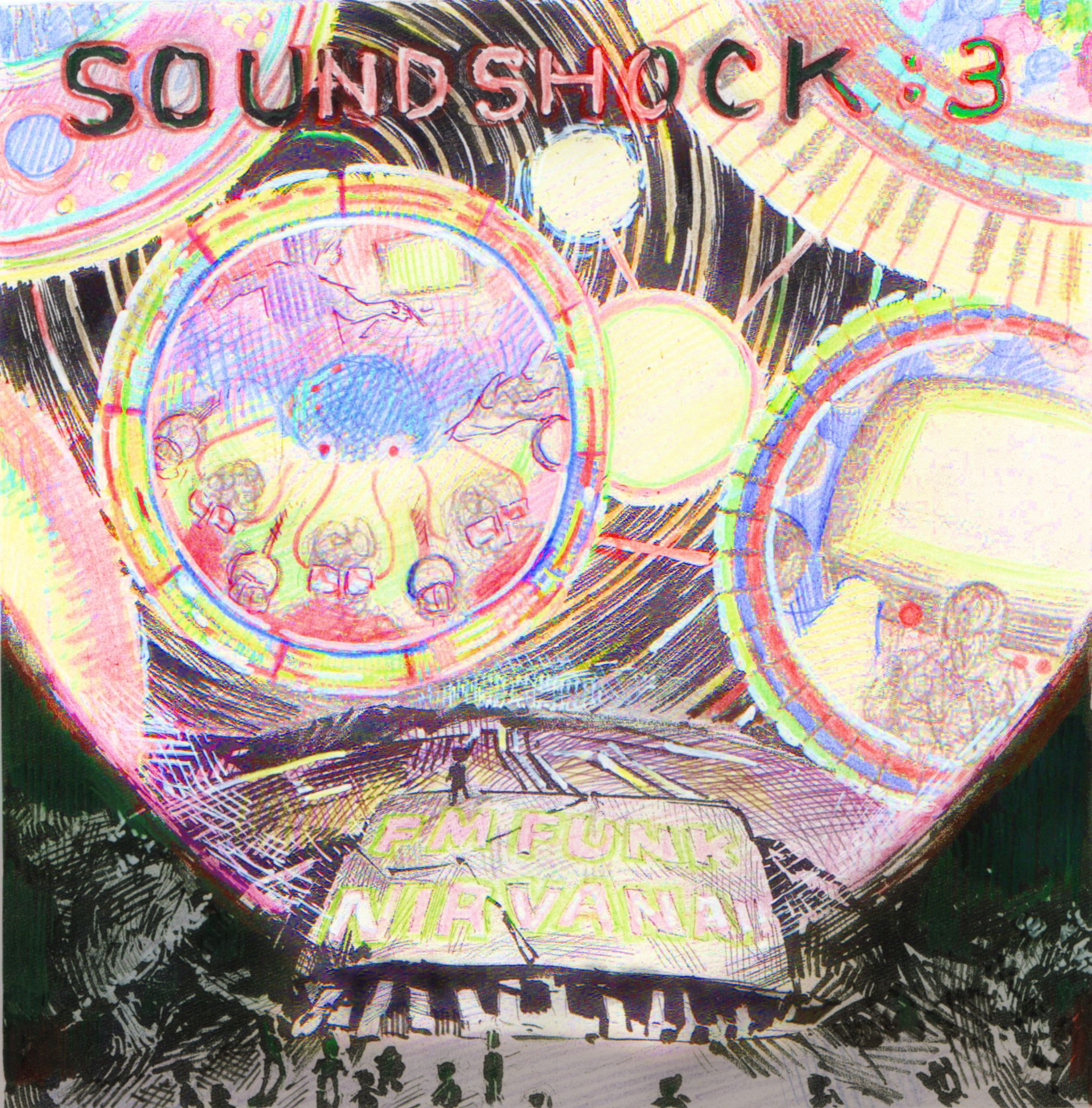
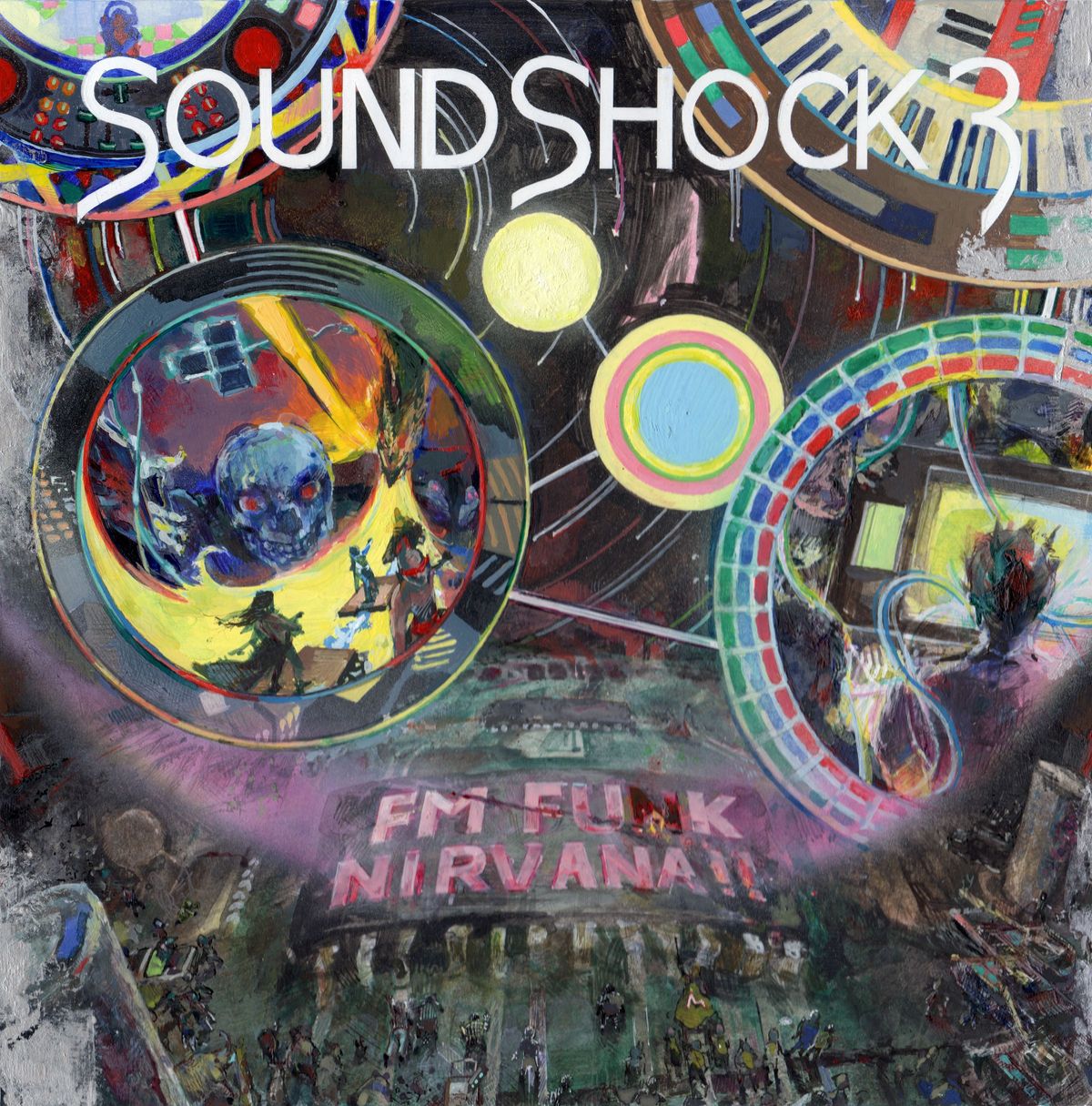
The final volume, SOUNDSHOCK 3: FM FUNK NIRVANA!!, represented the "perfect and ultimate" conclusion of the series. The title was inspired by a fan comment on social media, which zinger felt captured the peak of the project’s ambition. Unlike the previous entries, the word "Nirvana" was not embellished with extra letters, as the team felt the word already represented a state of maximum intensity.
The artwork for NIRVANA!! moved away from the literal and into the symbolic. Shimokura drew inspiration from Buddhist mandalas and the soundtrack cover of Darius Gaiden. The composition features a vast hierarchy of spheres containing elemental symbols, forming a cosmic map of the FM universe. At the base of the image, a mass of worshippers gathers before a giant FM chip mounted on a circuit board, treating the hardware as a religious relic. This "mandala of synthesis" served as a metaphor for the devotees of the FM sound—those who find spiritual resonance in the frequency-modulated waves of the past.
Technical Analysis of Shimokura’s Artistic Process
Shimokura’s work is notable for its refusal to rely on modern digital shortcuts. His background in professional manga and traditional painting allowed him to create textures that felt organic and "warm," providing a necessary counterpoint to the sometimes cold, mathematical nature of FM synthesis.
The process for each cover involved:
- Conceptual Mapping: Collaborative brainstorming sessions where zinger provided thematic anchors (sci-fi, horror, religion).
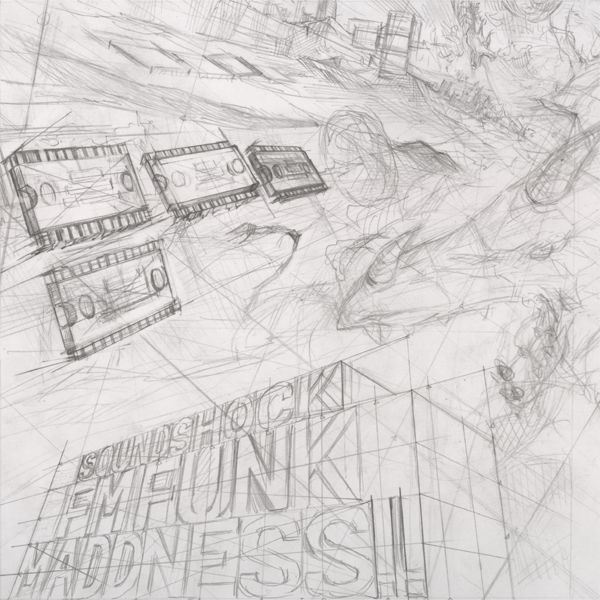
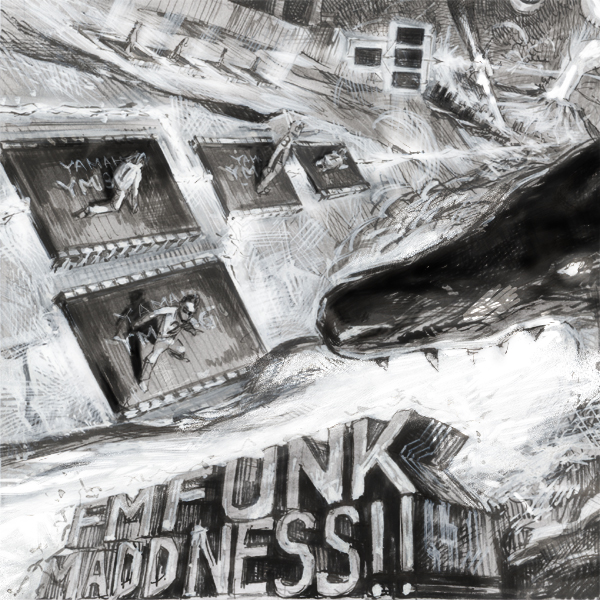
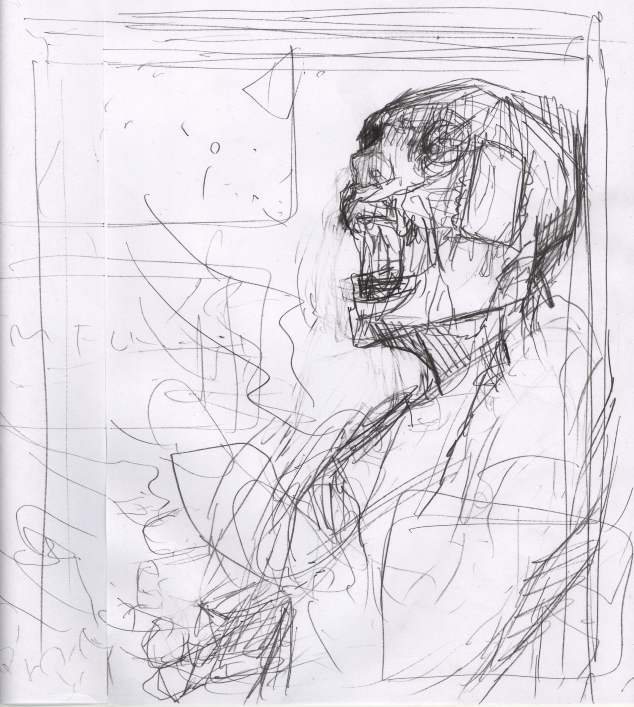
- Rough Sketching: Multiple iterations of pencil sketches to determine the "flow" of the algorithm patterns within the art.
- Detailed Rendering: The use of traditional media to achieve the saturated colors and high-contrast lighting reminiscent of 1980s airbrushed art.
- Narrative Integration: Shimokura often wrote short stories or "lore" to accompany his sketches, ensuring that every character and mechanical detail had a functional place in the SOUNDSHOCK world.
Official Statements and Artist Reflections
In his concluding message to the community, Tsuyoshi Shimokura reflected on the end of the series not as a loss, but as a transition. His statement, translated from Japanese, emphasized the cyclical nature of artistic influence:
"SOUNDSHOCK has come to an end. That, however, is not a sad thing. Supposing SOUNDSHOCK really has struck a chord in its listeners’ hearts, then our work could be thought of as a seed for future stars that have yet to be born. These new stars, we regard as our spiritual offshoots—just as we are the progeny of our forerunners. For us, believers in FM sound, we are all one and the same."
This sentiment was echoed by zinger, who expressed deep gratitude for Shimokura’s ability to translate abstract audio concepts into tangible, evocative imagery. The producer noted that the artist’s "bursting creativity" was essential in making the series feel like a cohesive world rather than a mere collection of songs.
Broader Impact and Implications for the Chiptune Scene
The conclusion of the SOUNDSHOCK series marks a significant moment in the independent music scene. It demonstrated that niche, hardware-specific music could be presented with the same level of artistic rigor as mainstream commercial releases. By investing in high-quality, hand-painted artwork, the project challenged the "disposable" nature of digital-only releases, encouraging fans to engage with the physical and visual history of the medium.
Furthermore, the series has served as an educational bridge. For younger listeners, the inclusion of algorithm charts and chip model numbers in the artwork provided a gateway into the technical side of sound design. For veterans of the arcade era, it offered a sophisticated reimagining of the imagery that defined their youth.
The legacy of SOUNDSHOCK, as Shimokura suggested, lies in the "seeds" it has planted. The series has inspired a new generation of "FM believers" to explore the creative possibilities of 1980s hardware, ensuring that the unique, metallic chime of the Yamaha sound chip will continue to resonate in both the visual and auditory landscapes of the future. As the project enters the annals of retrogaming history, it stands as a testament to the power of collaborative art—where sound and vision converge to create something truly "over the top."