Jia Lissa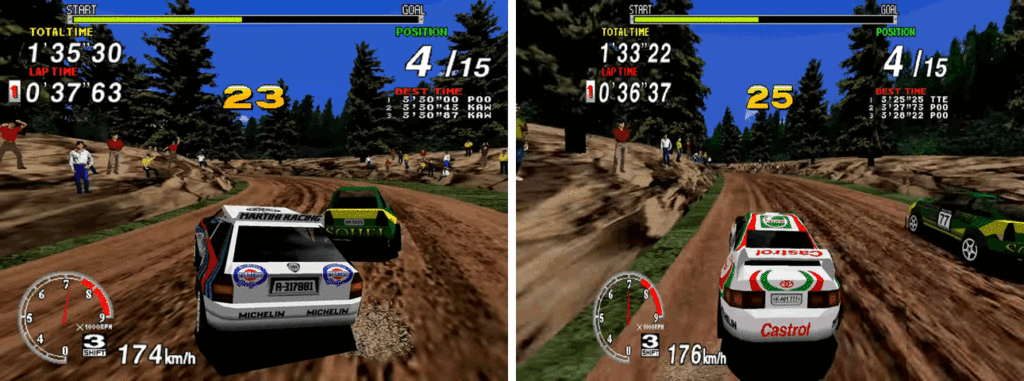
The landscape of the video game industry in the 1990s is often defined by the fierce console war between Sega and Nintendo, yet a parallel and equally intense conflict was unfolding in the world’s amusement centers. On the arcade front, Sega was locked in a relentless technological arms race with Namco to define the future of the 3D racing genre. This competition served as the primary catalyst for a decade of unprecedented innovation, moving the industry from flat, sprite-based 2D visuals into the era of high-fidelity polygon rendering. At the heart of this transition was the 1995 release of Sega Rally Championship, a title that not only revolutionized the racing sub-genre but also established a new blueprint for immersive entertainment through a combination of military-grade hardware and avant-garde creative direction.
The Genesis of 3D and the "Emotion Design" Philosophy
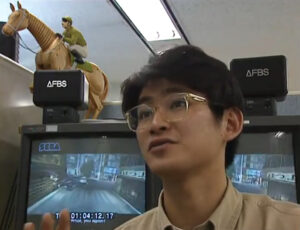
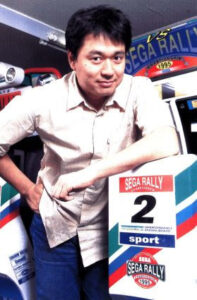
The transition to 3D technology in the early 1990s was a prohibitively expensive venture that required companies to build internal expertise from the ground up. In 1989, Sega sought fresh talent to spearhead this movement, leading to the recruitment of Tetsuya Mizuguchi. Mizuguchi, who would later gain fame for avant-garde titles like Rez and Space Channel 5, did not enter the company with a traditional gaming background. Instead, he presented Sega’s R&D head, Hisashi Suzuki, with a 40-page manifesto outlining the future of "virtual environment display systems" and the integration of 3D computer graphics (CG) into entertainment.
Mizuguchi’s vision was rooted in the concept of "body sensation" or taikan games, exemplified by Sega’s R-360 cabinet. Upon joining, he was tasked with developing high-end 3D simulations, leading to the creation of the AS-1 Simulator. To achieve the necessary visual fidelity, Mizuguchi convinced Sega management to invest approximately 100 million yen (roughly $1 million USD at the time) into high-end Silicon Graphics workstations and Softimage software. This investment birthed the "Emotion Design Lab," a specialized unit within Sega’s AM3 division focused on researching how 3D technology could evoke specific emotional responses from players.
The Technological Leap: Model 2 Architecture
While Sega’s Model 1 board had paved the way with Virtua Racing (1992), it was the introduction of the Model 2 architecture that truly enabled the 3D revolution. Developed through a partnership between Sega and GE Aerospace, the Model 2 was a monster of its era. While the Model 1 could push 180,000 polygons per second, the Model 2 increased this capacity to 500,000 polygons per second. More importantly, it introduced advanced graphical features such as texture filtering, anti-aliasing, and trilinear filtering, which allowed for the smoothing of textures and the reduction of "jaggies" that plagued early 3D efforts.
The Model 2’s debut with Daytona USA in 1994 set a high bar for arcade performance. However, Mizuguchi and his team realized that Daytona USA utilized only about 50 percent of the hardware’s potential. The mandate for Sega Rally Championship was clear: use the remaining overhead to create a more immersive, environmentally diverse experience that would stand in stark contrast to the urban, asphalt-centric racers like Namco’s Ridge Racer.
Chronology of Development and the American Scouting Trip
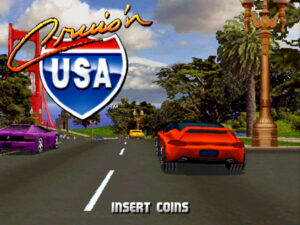
The development of Sega Rally Championship was marked by a pivot in conceptual direction. Initially, the project was titled "Rally California," intended to be a cross-country race inspired by the film Cannonball Run. However, the 1994 announcement of Midway’s Cruis’n USA—a title with a nearly identical premise—forced the AM3 team to reconsider their strategy.
To find a unique identity, the team looked toward the World Rally Championship (WRC), a sport with immense popularity in Europe but a relatively small footprint in Japan. Mizuguchi argued that the off-road nature of rally racing allowed for greater environmental creativity, moving away from "cold" cityscapes to "warm" natural landscapes like forests and mountains.
A critical turning point occurred when Mizuguchi realized his team’s conceptual sketches of the American West looked like the Japanese coastline. In a bold move for the time, Mizuguchi secured a travel budget from Hisashi Suzuki and led a five-man team—including director Kenji Sasaki and programmer Sohei Yamamoto—on a 1,200-mile research trip across North America. Traveling from Mexico City to Yosemite National Park, the team captured over 4,000 photographs and hours of video. This data provided the authentic textures for the game’s terrain, from the dry, dusty air of the desert to the towering scale of the Redwood forests.
Innovation in Gameplay and Licensing
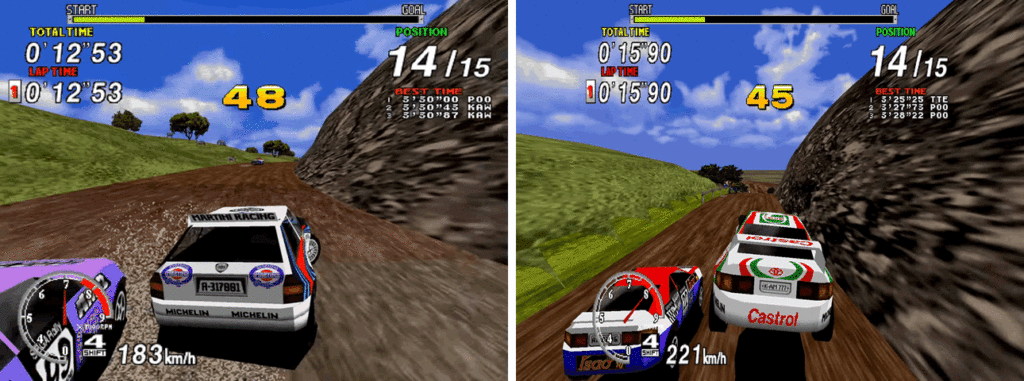
Sega Rally Championship introduced several mechanics that would become industry standards. Foremost among these was the differentiation of surface handling. For the first time in a major arcade title, players had to account for how their vehicle reacted to gravel, mud, and asphalt. This was made possible by the programming expertise of Sohei Yamamoto, who translated the team’s real-world observations into a physics engine that balanced realism with arcade accessibility.
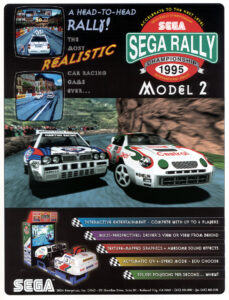
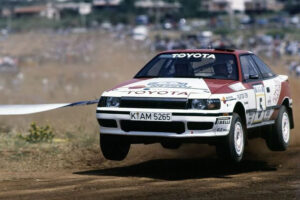
The game also pioneered the use of licensed vehicles in a high-profile 3D environment. Mizuguchi was adamant about including the Toyota Celica ST205 and the Lancia Delta HF Integrale. Initially, Toyota was skeptical, dismissing video games as a non-viable marketing tool. However, after seeing the 3D rendering capabilities of the Model 2, Toyota management relented. Mizuguchi then traveled to Italy and successfully leveraged Toyota’s participation to secure the Lancia license. Notably, these licenses were granted without fees, as both manufacturers recognized the game’s potential as a "virtual showroom."
Audio Fidelity and the Active Shock Generator
The sensory experience of Sega Rally was further enhanced by its audio and haptic feedback. Takenobu Mitsuyoshi, the composer behind Daytona USA, returned to provide the soundtrack. Leveraging the improved sound drivers of the Model 2, Mitsuyoshi was able to use longer vocal samples, leading to the creation of the iconic "Game Over, YEAH!" jingle.
Beyond the music, the team sought absolute authenticity for the mechanical sounds. AM3 recorded engine noises, gear shifts, and gravel splashes from actual rally-spec Celicas at the Maruwa Autoland Nasu dirt track. These sounds were integrated into the cabinet using the "Active Shock Generator" (ASG). Unlike previous systems that used a single motor for vibration, the Sega Rally Deluxe cabinet utilized two ASG motors to move the seat in six directions, providing a sophisticated level of immersion that mimicked the physical jolts of off-road driving.
Market Impact and the Saturn Port
Upon its release in February 1995, Sega Rally Championship became an immediate sensation. In Japan, the game sold approximately 12,000 arcade units, a significant figure for a high-end dedicated cabinet. It was offered in three formats: a standard upright, a "Twin" cabinet for head-to-head play, and a premium "Deluxe" cabinet featuring a mini-Celica replica.
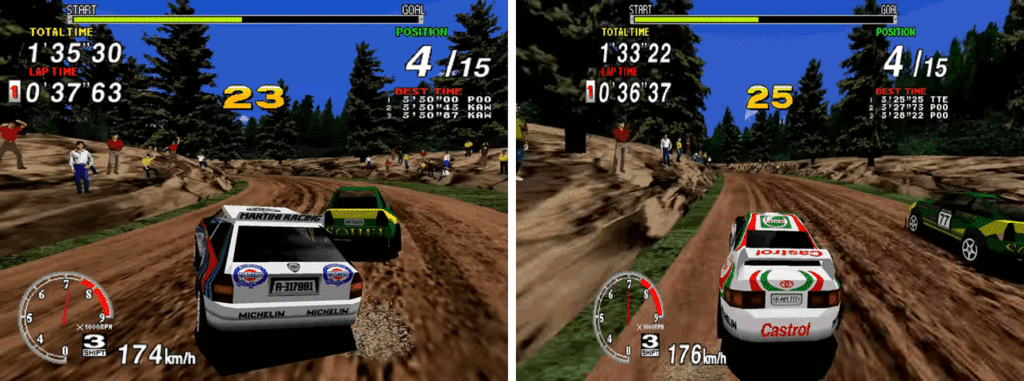
The success of the arcade version was essential for the struggling Sega Saturn. In 1996, AM3 delivered a home port that is still regarded as one of the finest arcade-to-console conversions of the 32-bit era. While the Saturn version ran at a lower resolution and frame rate than the Model 2 original, it maintained the precise handling and "feel" of the arcade experience. It also introduced a "Time Attack" mode and a hidden Lancia Stratos, adding significant replay value. The Saturn version’s success was bolstered by its support for the Netlink modem in North America and Xband in Japan, allowing for early iterations of online competitive racing.
Legacy and Professional Analysis
The impact of Sega Rally Championship on the racing genre cannot be overstated. Guy Wilday, the producer of the original Colin McRae Rally series at Codemasters, cited Sega Rally’s handling of loose surfaces as the primary inspiration for his own team’s work. The game proved that 3D racing could be more than just a test of speed; it could be a nuanced simulation of environmental interaction.
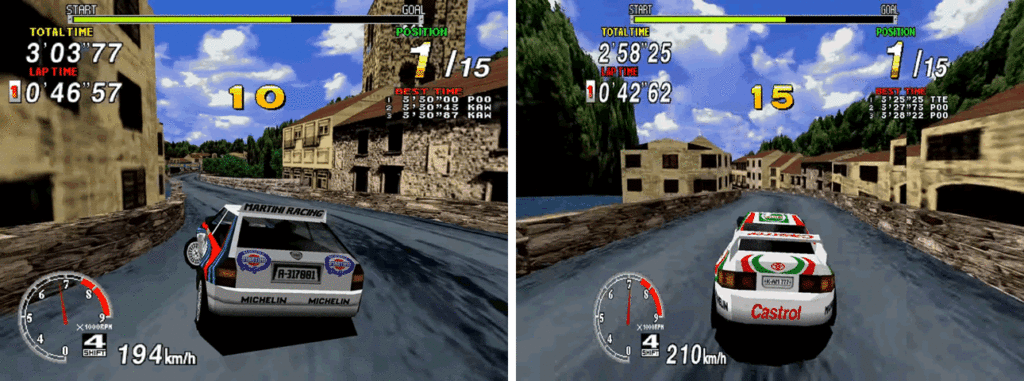
From a business perspective, the game validated the "Producer" role within Sega. Mizuguchi’s ability to manage high-level licensing, international research, and technological R&D signaled a shift in how games were developed—moving from small, insular programming teams to large-scale, multi-disciplinary productions.
Today, Sega Rally Championship remains a benchmark of the 1990s arcade golden age. It represents a rare moment where technological prowess, creative risk-taking, and logistical ambition converged to create a product that was both a commercial success and a foundational piece of gaming history. The game’s focus on "emotion design"—the idea that the physical and visual sensation of a drift or a jump could create a lasting memory—remains the core philosophy of modern immersive entertainment. While the arcades of the 1990s have largely faded, the DNA of Sega Rally continues to influence every off-road racing title produced in the decades since its debut.