Jia Lissa
The early 1990s marked a pivotal era in the history of electronic entertainment, defined by the "Bit Wars" between Nintendo and Sega. While Nintendo dominated the role-playing game (RPG) landscape with juggernauts like The Legend of Zelda and Dragon Quest, Sega sought a definitive title to solidify its 16-bit Mega Drive, known as the Genesis in North America, as a serious contender for RPG enthusiasts. The result was the 1991 release of Shining in the Darkness, a title that not only launched a multi-decade franchise but also introduced a new philosophy of game design centered on immersion, technical innovation, and cross-cultural appeal. Developed by the newly formed Climax Entertainment, the game represented a radical departure from the industry’s reliance on imitation, setting a benchmark for 3D dungeon crawlers and establishing a legacy that persists today.
The Genesis of Climax Entertainment: A Break from Tradition
The origins of Shining in the Darkness are rooted in the professional dissatisfaction of two industry veterans, Hiroyuki Takahashi and Hiroshi "Kan" Naito. Both men had built their reputations at Chunsoft, the studio responsible for the early Dragon Quest titles published by Enix. Despite the commercial success of Dragon Quest III and IV, Takahashi and Naito felt constrained by the rigid development structures of the time. Takahashi, who transitioned from a background in television production and theater to game development, was particularly critical of the industry’s tendency to produce "copycat" titles that merely imitated existing hits.
In April 1990, Takahashi and Naito departed Chunsoft to establish Climax Entertainment. Their goal was to create software that earned international respect for its originality rather than its adherence to Japanese market trends. Takahashi was particularly motivated by his experiences during focus testing for Dragon Quest III in Seattle, where he observed American gamers dismissing Japanese titles as mere clones of Western concepts. This fueled a desire to create a "universal" aesthetic and gameplay experience that would resonate globally. Along with colleagues like Shinya Nishigaki, the duo embarked on a mission to redefine the RPG genre through the lens of a "real-time haunted house fantasy."

Technical Ambition: Leveraging the 16-Bit Architecture
Choosing the right hardware was a critical strategic decision for the fledgling studio. While the 8-bit Famicom (NES) was the dominant platform in Japan, its technological limitations made it incapable of rendering the smooth, immersive 3D environments Naito envisioned. The team bypassed the aging 8-bit hardware in favor of the Sega Mega Drive. Although the Super Famicom (SNES) was nearing its launch, the Mega Drive offered a stable and powerful 68000 CPU architecture that was well-documented and capable of high-performance calculations.
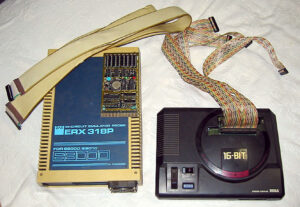
The development process was not without its hurdles. Climax found Sega’s internal development tools, particularly the in-circuit emulator (ICE), to be insufficient for high-level graphics work. In an act of bold engineering, the team spent the initial phase of development building their own proprietary graphics tools and a custom development environment. Naito, a self-taught programmer with an obsession for 3D imagery dating back to the wireframe era of the late 1970s, insisted on a level of visual fluidity that the Mega Drive was not natively designed to handle. To achieve this, Sega’s R&D head, Hisashi Suzuki, provided the team with high-performance Hewlett-Packard workstations, allowing Climax to push the boundaries of the 16-bit hardware.
Visual Innovation and the Disney Influence
One of the most striking aspects of Shining in the Darkness was its visual departure from the traditional manga-inspired art of its contemporaries. Takahashi and Naito sought a "timeless" quality, drawing inspiration from early Disney animated features like Sleeping Beauty and Alice in Wonderland. To realize this vision, they recruited Yoshitaka Tamaki, a young freelance artist who shared their affinity for Western-style caricatures and cinematic perspective.
Tamaki’s character designs for the trio of heroes—Max, Milo, and Pyra—focused on expressive, stylized features that felt more like an action-adventure film than a comic book. This aesthetic extended to the game’s "Panorama 3D" presentation. By manually placing pixels and calculating perspective angles for every building and NPC, the team created a sense of depth that was rare for the era. The tavern and shops in the Kingdom of Thornwood were designed to feel like theatrical stages, where the environment remained static but the "acting" of the characters and the dynamic resizing of sprites created a lived-in, three-dimensional atmosphere.
Gameplay Evolution: The Icon Menu and the Absence of Maps
Climax aimed to reduce the "burden" on the player by streamlining the often-cumbersome menu systems of early RPGs. They developed an intuitive, icon-based command system where each action—such as magic, items, or combat—was represented by an animated icon corresponding to the directional pad. This system, which would become a staple of the Shining series and influence future titles like Square’s Secret of Mana, allowed for rapid navigation and kept the focus on the game’s visual immersion.
Conversely, the team made the controversial decision to exclude an auto-mapping system. In an era where Sega was packing 100-page hint books with titles like Phantasy Star II, Climax’s refusal to provide a map was a deliberate design choice intended to foster realism. Naito believed that players should learn the environment through trial and error, relying on visual landmarks like torches, puddles, and specific wall textures to find their way. While some players found the difficulty of the labyrinth daunting, the developers argued that this approach made the eventual mastery of the dungeon more rewarding.
Achieving Pseudo-3D: Programming the Labyrinth
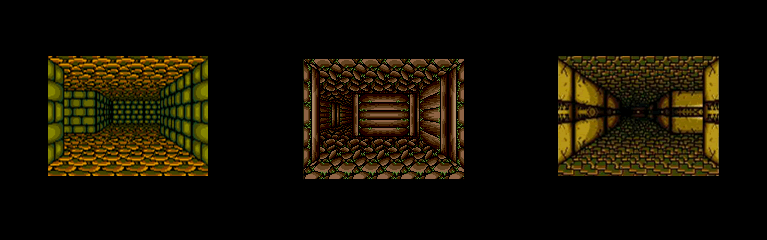
The centerpiece of Shining in the Darkness was its first-person dungeon exploration. At a time when Nintendo’s SNES was showcasing "Mode 7" hardware scaling and rotation, the Mega Drive had no such built-in capabilities. To compete, Climax utilized the talents of special effects programmer Yasuhiro Taguchi.
The team developed a software-based engine that used tile-based tricks to simulate smooth scrolling. By using a strict single-point perspective and discrete wall segments that changed based on distance, they created a convincing illusion of motion. To maintain a high frame rate and allow for detailed monster animations, the team made strategic trade-offs, such as shrinking the playable window to conserve VRAM. This disciplined approach to hardware constraints allowed them to include large, expressive enemy sprites and complex magical effects that rivaled the visual fidelity of much more expensive arcade hardware.

Orchestrating the Atmosphere: The Role of Audio
The game’s immersive quality was further bolstered by the musical score of Masahiko Yoshimura. A graduate of the Shobi-Gakuen Junior College School of Music Business, Yoshimura brought a sophisticated, orchestral sensibility to the project. He worked closely with Tamaki to ensure the music reflected the tone of each location, contrasting the regal, stable themes of the castle with the mysterious and claustrophobic sounds of the labyrinth.
Yoshimura utilized the Mega Drive’s YM2612 sound chip to its fullest extent, though he remained publicly critical of the hardware’s limitations compared to his original compositions. Despite his personal reservations, the soundtrack became a hallmark of the series, establishing a melodic identity that would be carried forward into sequels. The popularity of the score led to the release of the "Sound Story of Shining & the Darkness" CD in Japan, which featured rearranged versions of the game’s 18 themes.

Commercial Impact and the Birth of a Franchise
Shining in the Darkness launched in Japan on March 29, 1991, to immediate critical and commercial acclaim. It sold approximately 300,000 units, a significant figure given the Mega Drive’s installed base of 1.9 million units at the time. In North America, the game was released during a period of intense marketing for Sonic the Hedgehog. While Sega of America (SOA) did not provide the game with a television advertising budget, marketing head Al Nilsen noted that the title found a "loyal, dedicated audience" through print media and word-of-mouth.
The success of the game proved that there was a global market for high-quality, 16-bit RPGs that prioritized presentation and user-friendly interfaces. It also established Climax Entertainment as a premier developer for Sega, leading to the creation of Shining Force, which would further evolve the franchise into the realm of tactical RPGs.
Timeline of Key Events
- April 1990: Hiroyuki Takahashi and Hiroshi Naito leave Chunsoft to found Climax Entertainment.
- September 20, 1990: Sega holds a press conference at the ANA Tokyo Hotel to officially announce Shining in the Darkness.
- January 1991: Final software-based scaling and rotation effects are implemented into the game’s transitions.
- March 29, 1991: The game is released in Japan, selling 300,000 copies.
- June 1991: Sound Story of Shining & the Darkness CD is released in Japan.
- August 1991: The game debuts in North America, becoming a sleeper hit among Western RPG fans.
- 1992: Shining Force is released, expanding the "Shining" brand into the strategy-RPG genre.
Broader Implications and Legacy
The development of Shining in the Darkness serves as a masterclass in how creative independence and technical ingenuity can overcome hardware limitations. By refusing to follow the established "Dragon Quest" formula, Climax Entertainment created a template for the modern "immersive" RPG. The game’s icon-based menu system is now a standard feature in many modern titles, and its emphasis on cinematic presentation paved the way for the high-production-value RPGs of the 32-bit era.
Furthermore, the game’s success helped Sega establish a foothold in the RPG market, providing a necessary counterweight to Nintendo’s dominance. While the relationship between Climax and Sega would eventually sour due to budgetary disputes and management changes, the foundation laid in 1991 remains a high-water mark for the 16-bit era. Today, the Shining series consists of nearly two dozen entries across various platforms, all of which owe their existence to the "real-time haunted house" envisioned by a small team of rebels in 1990. Shining in the Darkness remains not just a nostalgic relic, but a testament to the power of original thinking in an industry often defined by imitation.