Chalid Lutfie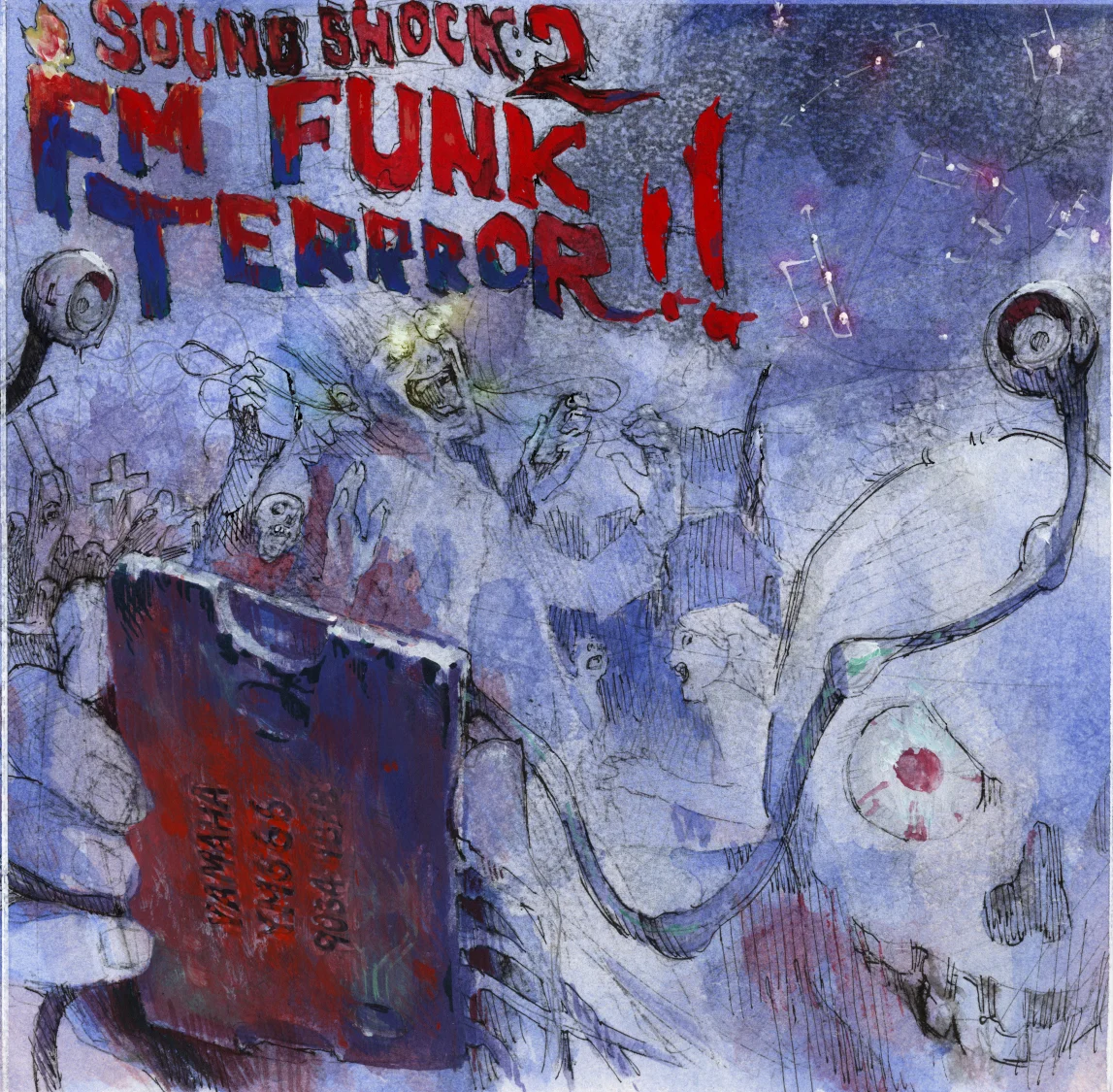
The conclusion of the SOUNDSHOCK music series marks a significant milestone in the contemporary preservation and celebration of Frequency Modulation (FM) synthesis, a sound synthesis technology that defined the auditory landscape of the 1980s and early 1990s. While the series is primarily recognized for its high-energy musical contributions, the visual identity of the project, spearheaded by professional manga artist and musician Tsuyoshi Shimokura, has played an equally vital role in establishing its cultural resonance. Through a collaborative effort with the project’s organizer, known as zinger, Shimokura produced a trilogy of handpainted album covers that serve as a narrative and thematic retrospective of the FM sound era. This collaboration, which began following an introduction by the artist hex125, evolved from a single track contribution to a comprehensive visual overhaul of the series, culminating in the release of the final volume, SOUNDSHOCK 3: FM FUNK NIRVANA!!.
The SOUNDSHOCK series was conceived as a tribute to the Yamaha-developed FM synthesis chips, such as the YM2151 and YM2612, which powered iconic arcade hardware and home consoles like the Sega Genesis. To match the intensity of the music, the visual direction required a similar level of technical complexity and nostalgic reverence. Shimokura, leveraging his professional background in the Japanese manga industry and his personal passion for retro computing and arcade culture, utilized a handpainted style that stood in stark contrast to the digital minimalism often found in modern electronic music packaging.
The Chronological Evolution of the SOUNDSHOCK Visual Identity
The visual narrative of the trilogy followed a deliberate trajectory of escalation, moving from heroic action to psychological horror and, finally, to spiritual transcendence. This progression was mirrored in the naming conventions of the albums, which utilized intentional misspellings to emphasize the "over-the-top" nature of the project.
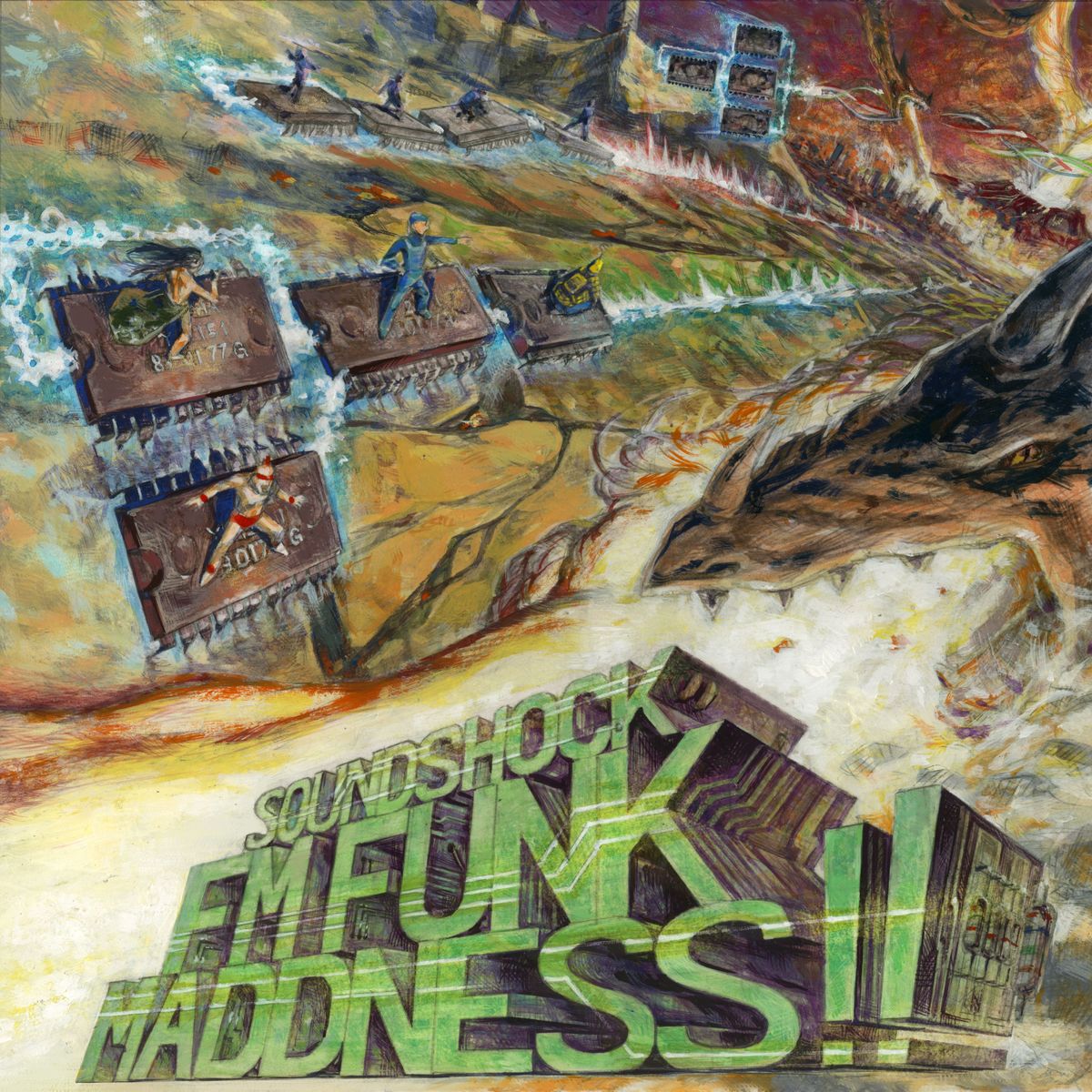
Volume 1: FM FUNK MADDNESS!!
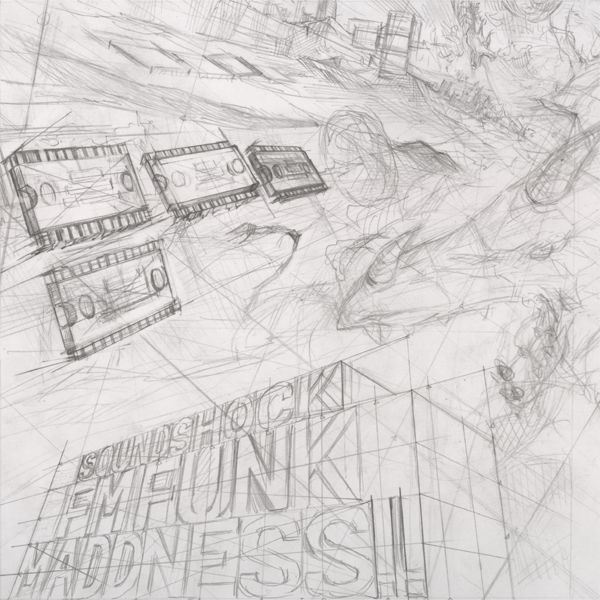
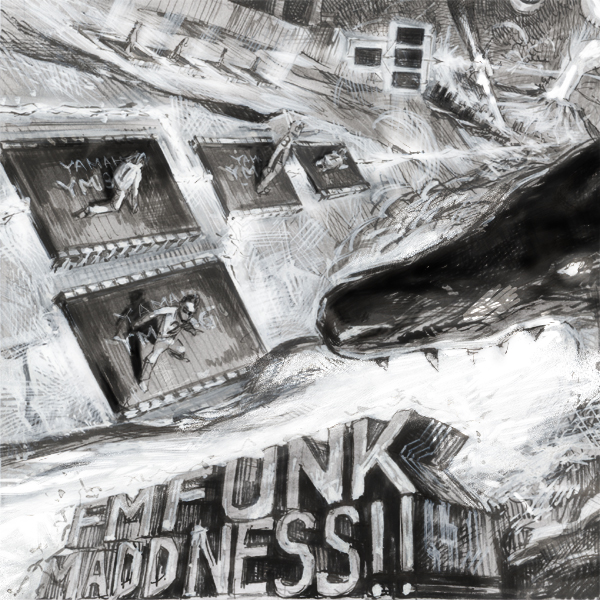
The inaugural release, FM FUNK MADDNESS!!, established the groundwork for the series’ aesthetic. The creative process involved deep dives into the marketing materials of the 1990s Japanese arcade scene, specifically referencing the flyer artwork for Taito titles such as Metal Black and Darius II. These games were noted for their surrealistic and highly detailed hand-drawn art, which Shimokura sought to emulate.
The concept for the first cover centered on a heroic struggle where musicians utilized the "power of FM sound" to defend the world against monstrous invaders. Technical details of FM synthesis were integrated directly into the character designs; for instance, the legs of the mechanical entities were modeled after the pin configurations of FM chips, moving in a manner reminiscent of caterpillars. Furthermore, the alignment of the chips on the battlefield was designed to mimic FM algorithm charts—the mathematical structures that determine how operators interact to create sound.
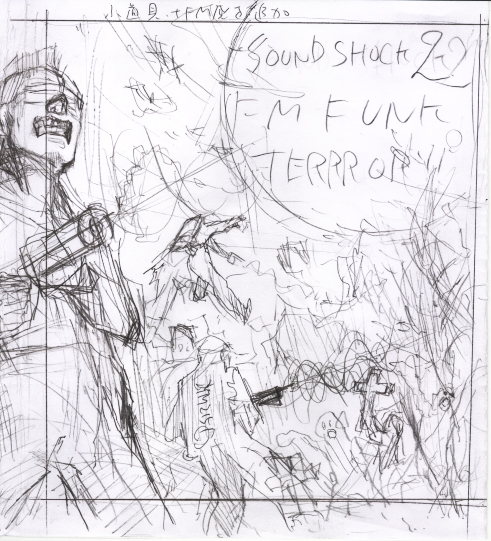
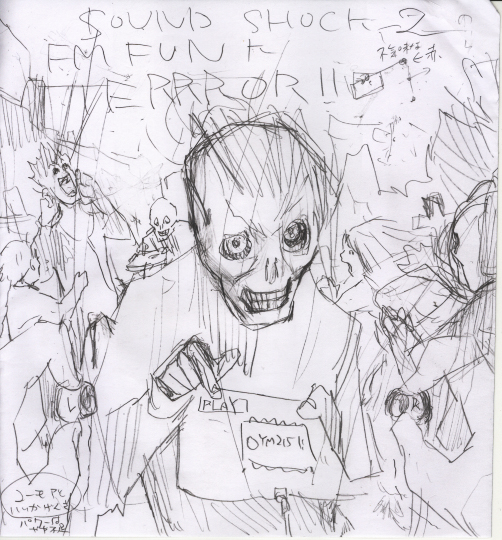
Volume 2: FM FUNK TERRROR!!
For the second installment, the thematic focus shifted toward the horror genre, drawing inspiration from 1980s cinema and dark fantasy video games. Reference materials provided by the production team included posters for the A Nightmare on Elm Street and The Evil Dead franchises, alongside the aesthetic of Namco’s Splatterhouse series.
The artwork for TERRROR!! introduced a darker narrative element. Shimokura envisioned a scenario where "Algorithm constellations" aligned to trigger a global event where ghouls, obsessed with the seductive power of FM sound, sought to "convert" humanity through auditory terror. A notable detail in this piece is a ghoul wielding a gravestone-styled device labeled "YM666," a play on the Yamaha chip naming convention and the "Number of the Beast." The sky in this composition featured stars arranged in the patterns of FM algorithms, reinforcing the connection between the cosmic and the synthetic.
Volume 3: FM FUNK NIRVANA!!
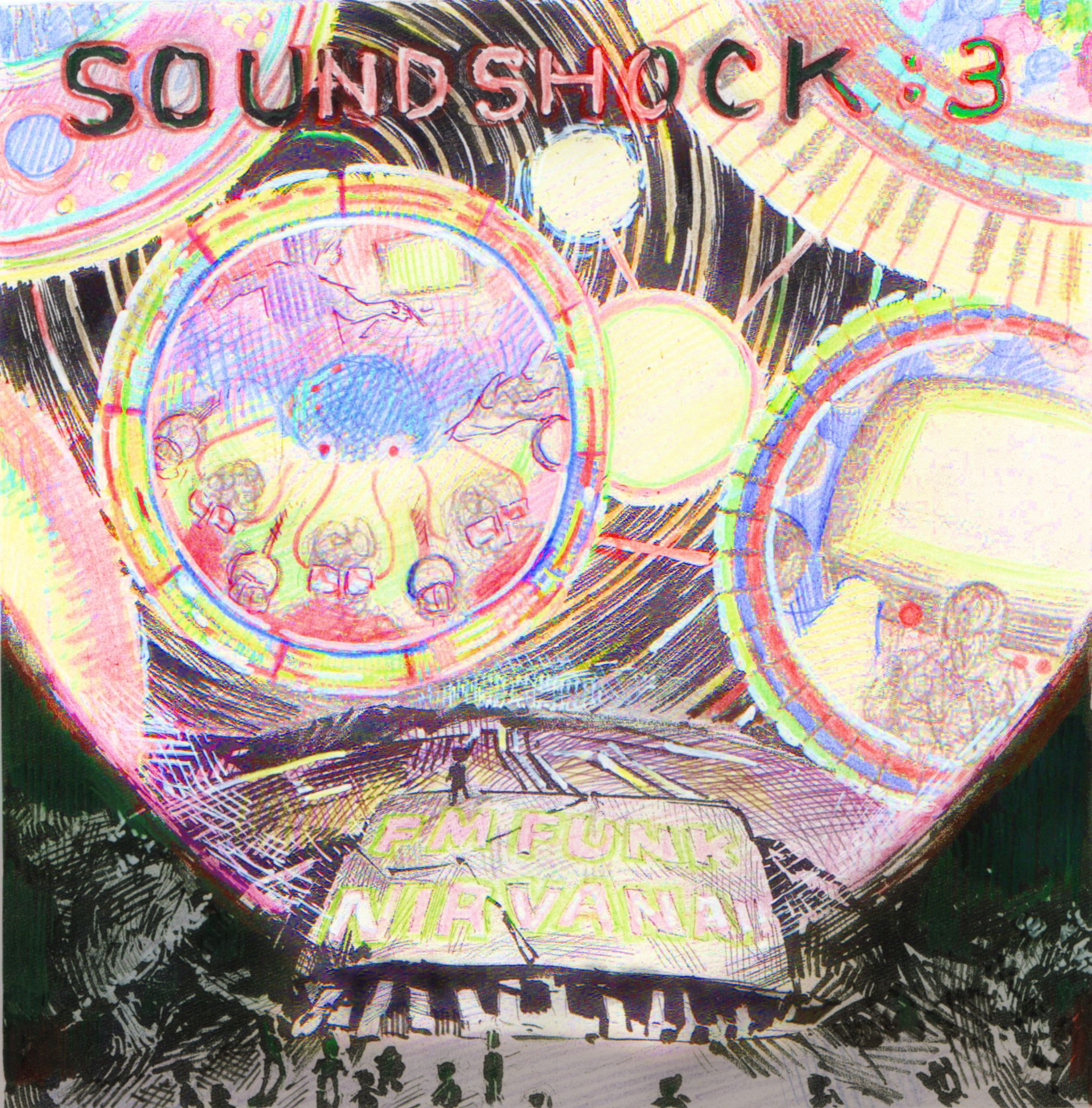
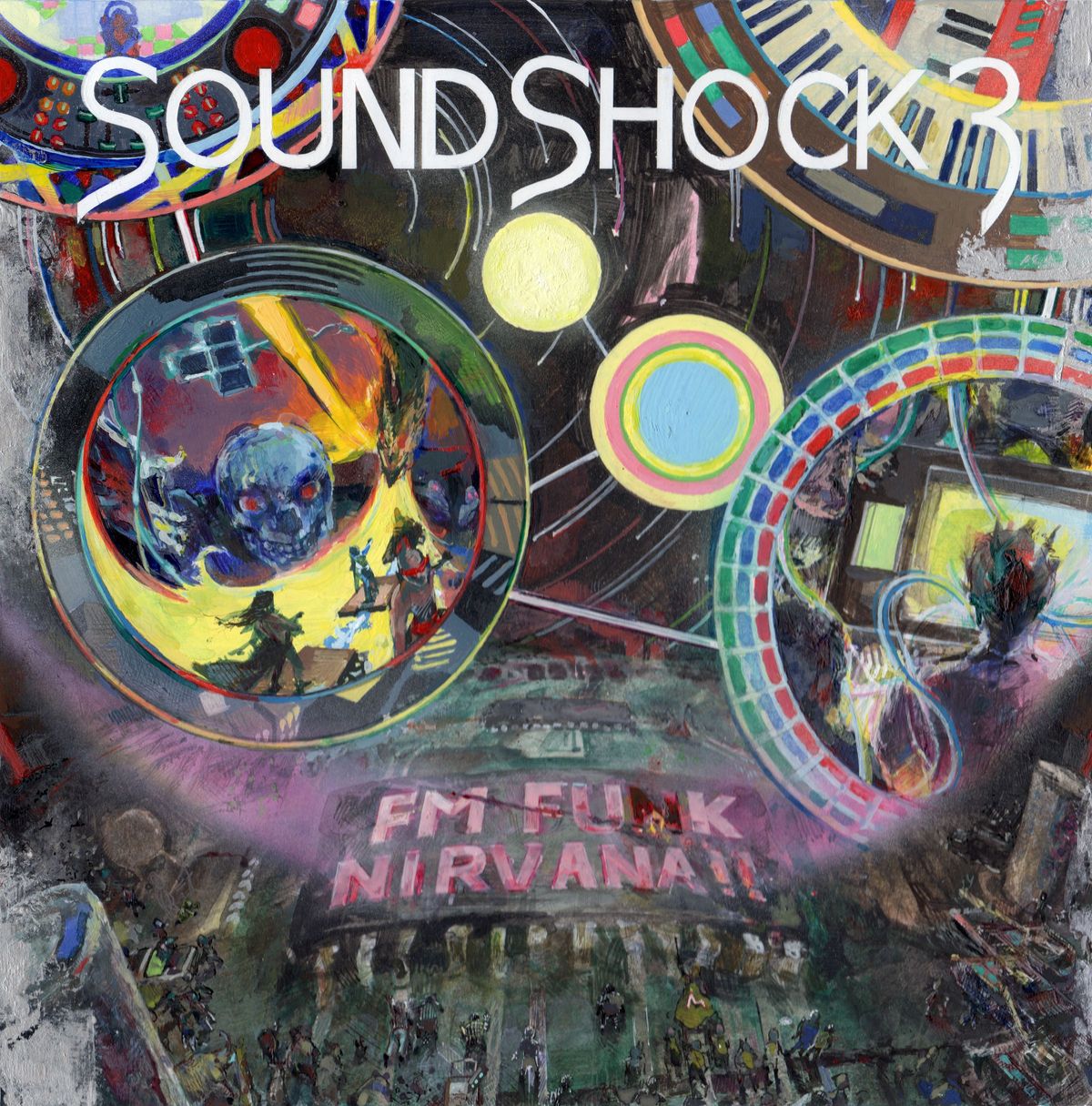
The final chapter, FM FUNK NIRVANA!!, moved away from the literal depictions of conflict and horror toward a conceptualization of the "ultimate" state of the FM sound. The title itself was chosen to represent a "maxed out" concept that required no further linguistic exaggeration. Unlike the previous volumes, the creative process for NIRVANA!! was driven almost entirely by Shimokura’s intuition regarding Buddhist philosophy and the concept of enlightenment.
The cover art depicts a vast mandala-like structure composed of spheres containing various elemental visions of the universe. At the base of the image, a mass of worshippers gathers before a monumental FM chip mounted on a circuit board. This imagery positions the FM chip not merely as a piece of hardware, but as an object of spiritual veneration. The influence of the Darius Gaiden soundtrack cover is evident in the scale and ethereal atmosphere of the piece, signaling the end of the series not as a death, but as a transition into a higher state of existence.
Technical Symbolism and Artistic Methodology
The enrichment of the SOUNDSHOCK series through Shimokura’s art is rooted in its technical accuracy. In FM synthesis, an "algorithm" refers to the specific arrangement of operators (oscillators) that produce a final sound. By incorporating these charts into the artwork—as stars in the sky or formations on a battlefield—Shimokura bridged the gap between abstract music theory and representational art.
This methodology reflects a broader trend in the "chiptune" and "synthwave" subcultures, where the limitations of legacy hardware are celebrated as artistic virtues. The handpainted nature of the covers also serves as a tribute to the era before the ubiquity of Computer-Generated Imagery (CGI), echoing the labor-intensive process of 1980s game development and marketing.
Official Artist Statement and Philosophical Implications
In a concluding message to the SOUNDSHOCK community, Tsuyoshi Shimokura addressed the cessation of the series, framing it as a necessary step in a larger cycle of creative output. He stated:
"SOUNDSHOCK has come to an end. That, however, is not a sad thing. Supposing SOUNDSHOCK really has struck a chord in its listeners’ hearts, then our work could be thought of as a seed for future stars that have yet to be born. These new stars, we regard as our spiritual offshoots—just as we are the progeny of our forerunners. For us, believers in FM sound, we are all one and the same."
This statement highlights the project’s underlying philosophy: the belief that digital sounds produced by vintage silicon are part of a continuous lineage. The "forerunners" mentioned by Shimokura refer to the legendary Japanese composers of the 1980s—such as Yuzo Koshiro and the members of Taito’s Zuntata—whose work on FM-based arcade systems provided the foundation for the SOUNDSHOCK series.
Broader Impact and Industry Context
The completion of the SOUNDSHOCK trilogy in 2017 occurred during a period of renewed interest in FM synthesis. While the mid-1990s saw FM sound largely replaced by sample-based synthesis and high-fidelity redbook audio, the 2010s saw a resurgence through software emulations and the release of new FM-capable hardware, such as the Korg Volca FM and the Yamaha Reface DX.
The SOUNDSHOCK series served as a bridge during this revival, providing a platform for both veteran composers and new artists to explore the nuances of the Yamaha YM chips. By providing a high-quality visual counterpart to the music, the project elevated the status of FM synthesis from a nostalgic curiosity to a respected medium of contemporary art.
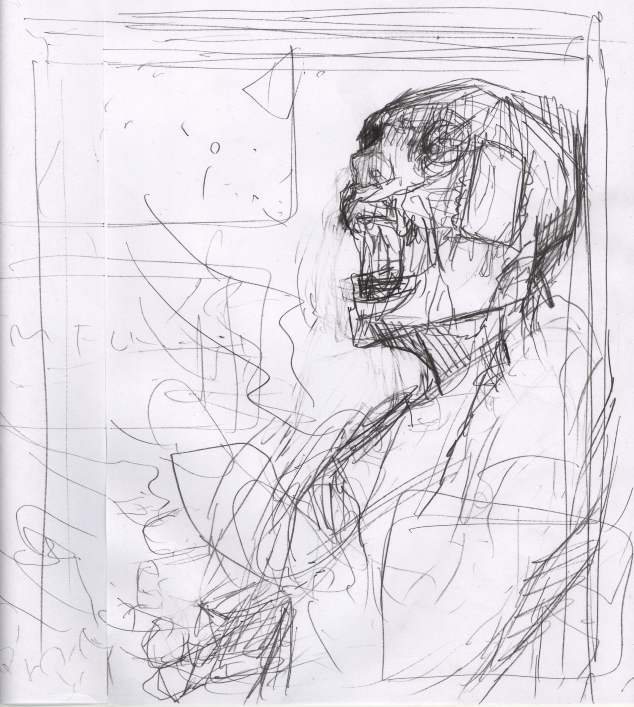
The collaboration between zinger and Shimokura also underscores the importance of cross-disciplinary synergy in independent music publishing. The use of prototype sketches and developmental artwork in the project’s documentation has provided fans with a rare glimpse into the "world-building" aspects of music production. This transparency has helped foster a dedicated community of "FM believers" who view the hardware not just as a tool, but as a cultural icon.
Conclusion
The SOUNDSHOCK series concludes its run leaving behind a robust legacy of both auditory and visual innovation. Tsuyoshi Shimokura’s handpainted covers have done more than decorate the albums; they have codified the mythology of the FM sound. From the "Maddness" of its beginnings to the "Nirvana" of its end, the series has demonstrated that the resonance of a 30-year-old sound chip is as much about the human imagination and spiritual connection as it is about mathematical algorithms and electrical signals. As the series moves into history, its influence remains as a "seed" for the next generation of artists who will continue to find inspiration in the complex, metallic, and endlessly versatile world of FM funk.