
 Jia Lissa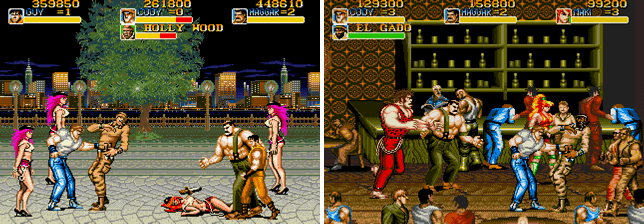
The Sega Genesis, known as the Mega Drive outside of North America, is currently witnessing a technical renaissance driven by a dedicated homebrew community. Among the most ambitious projects in development is Final Fight MD, a comprehensive reimagining of Capcom’s seminal 1989 arcade beat-’em-up. Developed by the Brazilian studio MXRetroDev, led by Mauro Xavier, this project seeks to rectify decades of hardware-based compromises found in previous home console ports. While the Sega CD version of Final Fight was long considered the definitive 16-bit iteration, Final Fight MD aims to surpass it by offering three-player cooperative gameplay, expanded rosters, and technical optimizations previously thought impossible on the base Genesis hardware.
The Historical Context of Final Fight Ports
To understand the significance of Final Fight MD, one must look back at the landscape of the early 1990s. When Capcom released Final Fight in arcades on the CP System (CPS-1) hardware, it set a new standard for the genre with large, detailed sprites and fluid animation. However, translating this experience to home consoles proved difficult. The 1990 Super Nintendo (SNES) port was notoriously compromised, lacking a two-player mode, missing the character Guy, and omitting the entire Industrial Area stage.
Sega eventually answered with Final Fight CD in 1993. While this version restored the two-player mode, included all characters, and featured a celebrated arranged CD-quality soundtrack, it still faced limitations. The Sega CD’s color palette was restricted, and some arcade nuances were lost in the transition. Subsequent versions, such as Final Fight One on the Game Boy Advance, added features like hidden characters and dialogue but suffered from the handheld’s smaller screen resolution. For decades, Genesis owners without the Sega CD peripheral were left without a native version of the game, a gap that MXRetroDev is now closing with unprecedented technical fidelity.
Technical Innovations and Performance Modes
Final Fight MD is not a simple ROM hack or a modification of the Sega CD code; it is a ground-up reconstruction designed to exploit the specific strengths of the Motorola 68000 processor found in the Genesis. The developer has implemented a variety of performance-enhancing features to ensure the game remains fluid even during intense combat sequences.
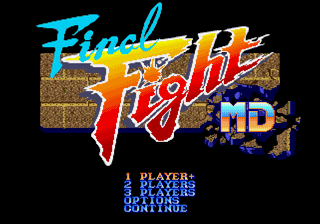
One of the most notable technical additions is the "1 Player+" mode. By accessing a hidden toggle on the main menu, players can enable a high-performance state that utilizes additional system memory to reduce sprite flickering and slowdown. In this mode, the engine can support up to seven enemies on screen simultaneously—a feat that matches the intensity of the arcade original and exceeds the capabilities of the 1990s console ports.
Furthermore, the game offers a choice between 30 and 60 frames-per-second (FPS) output. While the 60 FPS mode provides the smoothest visual experience, it is primarily recommended for users playing on overclocked hardware or high-end emulators. This level of customization allows the game to be tailored to the specific hardware configuration of the user, whether they are using an original 1989 Model 1 Genesis or a modern FPGA-based system like the Analogue Mega Sg.
Expanded Gameplay and Roster Enhancements
While the arcade original featured three playable characters—Guy, Cody, and Mike Haggar—Final Fight MD expands the roster to include Maki Genryusai. Originally introduced in the SNES-exclusive Final Fight 2, Maki’s inclusion in this Genesis project represents a crossover of the franchise’s history. Her moveset has been adapted to fit the mechanics of the first game, providing a fresh tactical option for veteran players.
The gameplay experience is further modernized through a robust achievement and unlockable system. The game features 60 distinct achievements tied to "Mega Mode," a dedicated meta-game layer that rewards players for skillful play. These achievements are not merely cosmetic; they unlock gameplay modifiers that significantly alter the experience.
Milestone Unlockables and Modifiers
The progression system is divided into tiers, providing a steady stream of new content as players master the mechanics:
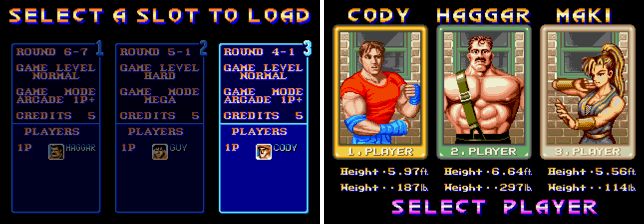
- Initial Rewards: Early achievements unlock cosmetic options, such as the ability to change character palettes using simple directional inputs. Players can also unlock alternate music tracks, including boss themes from Final Fight 2 and Final Fight 3.
- Gameplay Enhancements: Intermediate unlocks include functional upgrades such as air combos, instant knockout punches, and a "Boss Rush" mode. These features allow for a more aggressive playstyle that aligns with modern brawler standards.
- Advanced Challenges: Upon reaching the 30-achievement milestone, the game introduces "Nightmare" difficulty and specialized play styles. These include "Vampire Mode," where players regain health by dealing damage; "Lunar Gravity," which alters jump physics; and "One Punch Man" mode, which focuses on high-stakes, high-damage encounters.
To maintain the integrity of the achievement system, the developer has implemented a restriction: once a gameplay-altering cheat or special mode (such as God Mode) is activated, the game halts progress toward new achievements for that session.
Multi-Player Support and Peripheral Compatibility
Perhaps the most ambitious feature of Final Fight MD is the inclusion of three-player simultaneous cooperative play. The original arcade cabinet supported two players, and almost every subsequent home port maintained that limit. By utilizing the Sega Team Player or EA 4-Way Play multitap adapters, MXRetroDev has turned the title into a three-player experience, placing it in the company of other Genesis classics like Streets of Rage 3 (via hacks) and Gauntlet IV.
This expansion required a significant overhaul of the game’s hit detection and enemy AI. The developer has reportedly spent considerable time refining hitboxes and enemy behavior algorithms to ensure that the increased player count does not trivialize the difficulty or lead to unmanageable screen clutter. The result is a chaotic yet balanced experience that breathes new life into the 35-year-old level designs.
Licensing Hurdles and the Path to Release
Despite the high quality of the project, the path to a physical release remains fraught with legal and logistical challenges. Mauro Xavier has expressed transparency regarding his attempts to secure an official license or a partnership with a publisher. In a statement on his Patreon page, Xavier noted the frustration of dealing with prospective distributors who ultimately failed to secure the necessary rights from Capcom.
"I have held back the development of the game countless times at the request of supposed publishers and distributors," Xavier stated. "I can no longer stand being stuck and unable to move forward with other projects definitively because of this pending promise."

Without the official blessing of Capcom, a legitimate physical cartridge release—similar to the 2021 re-release of Mega Man: The Wily Wars by Retro-Bit—remains unlikely. Consequently, Xavier has shifted his focus toward completing the project at his own pace and releasing it digitally. Currently, a demo version of Final Fight MD is available for free on itch.io, while supporters on Patreon receive more frequent updates and access to the latest builds.
Comparative Analysis: Genesis vs. Sega CD
A recurring question within the retro gaming community is how this cartridge-based version compares to the existing Sega CD port. From a technical standpoint, Final Fight MD offers several advantages:
- Stage Completeness: Unlike some versions that cut sections of levels to save memory, Final Fight MD includes every stage from the arcade, including the full Industrial Area and the transit segments.
- Sprite Density: The "1 Player+" mode allows for more on-screen enemies than the Sega CD version, which often struggled with sprite limits during two-player sessions.
- Color and Contrast: While the Genesis is limited to a 512-color master palette with 64 colors on screen, MXRetroDev has utilized advanced dithering and color-swapping techniques to create a visual presentation that rivals the Sega CD’s output.
- Audio Flexibility: While the cartridge format cannot natively reproduce the Redbook CD audio of the Sega CD, the developer is working on making the game compatible with the Sega CD soundtrack for those using hardware like the Mega EverDrive Pro or the MiSTer FPGA, which can stream high-quality audio while running Genesis ROMs.
Broader Impact on the Homebrew Scene
The development of Final Fight MD is part of a larger trend of "impossible" ports appearing on 16-bit hardware. Recent years have seen the release of titles like Paprium and the port of Street Fighter Alpha 2 to the SNES, both of which pushed their respective consoles far beyond their original commercial lifespans.
Projects like Final Fight MD serve as a proof-of-concept for what can be achieved when modern programming techniques are applied to vintage silicon. By optimizing assembly code and utilizing modern development tools, homebrew creators are essentially "unlocking" latent power in the Sega Genesis that original developers in the 1990s could not access due to strict deadlines and high memory costs.
For the retro gaming community, Final Fight MD represents more than just a new way to play an old game; it is a tribute to the enduring legacy of the Sega Genesis. As the project nears completion, it stands as a testament to the passion of independent developers who refuse to let the limitations of the past dictate the possibilities of the present. Whether played on an emulator or an original console via a flash cartridge, Final Fight MD is poised to become a staple of the Genesis library, finally delivering the "arcade-perfect" experience that fans have requested for over three decades.








