Jia Lissa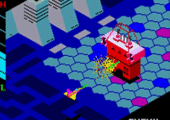
Zaxxon, developed and published by Sega Enterprises in 1982, represents a pivotal moment in the evolution of the shoot ‘em up (shmup) genre and the broader landscape of arcade gaming. Upon its release, the title introduced a visual and mechanical complexity that diverged sharply from the established norms of the era. While contemporary hits such as Defender and Galaxian relied on strictly two-dimensional planes—either horizontal or vertical—Zaxxon utilized an axonometric projection to simulate a three-dimensional environment. This isometric viewpoint allowed for gameplay that incorporated altitude as a core mechanic, a feat that had not been achieved with such fidelity in previous arcade iterations. The game’s primary objective involves navigating a fighter spacecraft through a series of heavily defended space fortresses and open-space environments, ultimately culminating in a confrontation with the titular robot antagonist, Zaxxon.
The Technological Innovation of Isometric Projection
The defining characteristic of Zaxxon is its use of isometric perspective, often referred to in the context of 1980s gaming as "2.5D." Unlike the flat backgrounds of its predecessors, Zaxxon’s playfield is tilted at a 45-degree angle, creating an illusion of depth and volume. This was not merely an aesthetic choice; it fundamentally altered the spatial relationship between the player’s craft and the environment. To assist players in navigating this new dimension, Sega implemented a shadow system. By observing the position of the ship’s shadow on the ground or the walls of the fortress, players could gauge their current altitude relative to obstacles and enemy fire.
The hardware powering Zaxxon was sophisticated for its time. Built on the Sega Zaxxon hardware platform, the cabinet utilized a Zilog Z80 primary microprocessor running at 3.072 MHz. This was supported by a secondary Z80 and a robust sound system featuring two SN76489 programmable sound generators. This configuration allowed for the smooth scrolling of complex, layered sprites and the simultaneous management of the game’s unique altitude-tracking logic. The resolution of 256×224 pixels provided enough clarity for players to distinguish between various heights, though the inherent ambiguity of isometric visuals remained a significant hurdle for novice players.
Chronology of Development and Global Distribution
The development of Zaxxon occurred during the peak of the "Golden Age" of arcade video games. Following its initial Japanese release in early 1982, Sega partnered with Gremlin Industries for distribution in North America. This partnership was crucial for Sega’s expansion into the Western market, as Gremlin provided the manufacturing infrastructure necessary to meet the high demand for the title.
- January 1982: Zaxxon is released in Japanese arcades, garnering immediate attention for its graphics.
- April 1982: Gremlin-Sega releases the game in North America. It quickly becomes one of the top-earning arcade cabinets of the year.
- Late 1982: Due to the game’s immense success, Sega releases Super Zaxxon, an iterative sequel that increased the game’s speed and introduced new enemy types, though it was often criticized for being overly difficult.
- 1983–1984: Coleco acquires the home console rights, producing versions for the ColecoVision, Atari 2600, and Intellivision. Parallel versions are developed for home computers, including the Apple II, TRS-80, and Commodore 64.
- 1987: Zaxxon 3-D is released for the Sega Master System, utilizing the SegaScope 3-D glasses to enhance the original isometric concept.
- 1995: Zaxxon Motherbase 2000 is released for the Sega 32X, attempting to modernize the franchise with polygonal graphics.
- 2010: The original arcade version is re-released on the Nintendo Wii Virtual Console, introducing the title to a new generation of players.
Analysis of Gameplay Mechanics and Difficulty
Zaxxon is characterized by a steep learning curve, primarily due to its unconventional control scheme and resource management requirements. Unlike standard shooters where movement is restricted to a 2D plane, Zaxxon utilizes an airplane-style flight stick. Pulling back on the stick causes the ship to climb, while pushing forward causes it to descend. An altimeter displayed on the left side of the screen is the only objective indicator of the ship’s vertical position.
The game is divided into three distinct phases:
- The First Fortress: Players must fly over or through gaps in electrified walls, avoid surface-to-air missiles, and destroy fuel tanks.
- Deep Space: A transitional phase focusing on dogfighting against waves of enemy fighters.
- The Second Fortress: A more complex version of the first base, leading to the final encounter with the Zaxxon robot.
Fuel management serves as a critical secondary challenge. The player’s fuel supply constantly depletes, and the only way to replenish it is by destroying fuel tanks labeled "FUEL" scattered throughout the fortresses. This mechanic forces a high-risk, high-reward playstyle; players must often dive toward dangerous ground-level targets to sustain their flight, leaving them vulnerable to radar-guided missiles and stationary turrets. Industry analysts have noted that this "forced aggression" was a deliberate design choice intended to limit session times and maximize arcade revenue.
Commercial Success and Market Impact
Zaxxon was a commercial powerhouse for Sega and Gremlin. Upon its release in the United States, it was frequently cited in trade publications like RePlay and Play Meter as one of the top-performing arcade machines. By the end of 1982, it was estimated that tens of thousands of units had been sold worldwide.
The game’s success sparked a trend in isometric game design. Titles such as Crystal Castles (1983) and Knight Lore (1984) would later refine the use of axonometric projection, but Zaxxon remains the progenitor of the style in the action genre. Furthermore, Zaxxon was one of the first video games to be promoted through television advertising, a rarity in the early 1980s. The commercial emphasized the game’s "3-D" visuals, a marketing term that, while technically inaccurate by modern standards, successfully differentiated the product from its competition.
Home Port Adaptations and Hardware Limitations
The transition of Zaxxon from the arcade to home consoles was a significant technical challenge. Most 1982-era home hardware lacked the processing power to render the arcade’s detailed isometric sprites. The ColecoVision version is widely regarded as the most faithful port, as the console’s hardware was specifically designed to handle arcade-style graphics. In contrast, the Atari 2600 version had to be completely redesigned, resulting in a game that lacked the visual depth of the original but attempted to preserve the altitude-based gameplay.
The reliance on a flight stick in the arcade version also created a disconnect for home players. Standard console controllers, such as the Atari joystick or the D-pad found on later systems, lacked the tactile feedback and precision required for fine altitude adjustments. This led to a perception of the game being "unfairly" difficult on home systems, a sentiment that persists among retro gaming enthusiasts today.
Legacy and Contemporary Perspective
In the decades following its release, Zaxxon has been recognized as a landmark achievement in game design. While the franchise itself struggled to maintain relevance in the 1990s and beyond, its influence is visible in many modern 3D flight simulators and shooters. The game’s insistence on spatial awareness—requiring the player to think in three dimensions despite being displayed on a two-dimensional screen—laid the groundwork for the 3D revolution of the mid-1990s.
The 2010 release on the Wii Virtual Console and subsequent inclusions in Sega Genesis/Mega Drive collections have allowed for a formal reassessment of the title. Modern critics often point to the game’s lack of "depth" in terms of level variety—there are only three stages that repeat with increasing difficulty—but acknowledge that for 1982, the presentation was unparalleled.
Broader Implications for the Gaming Industry
Zaxxon’s legacy is tied to the industry’s transition from abstract representations to more literal, simulated environments. It proved that players were willing to engage with more complex control schemes if the visual payoff was significant enough. It also highlighted the importance of unique cabinet hardware; the flight stick was as much a part of the "Zaxxon experience" as the graphics themselves.
Today, Zaxxon is maintained in various arcade museums and private collections as a testament to Sega’s early innovation. Its difficulty remains legendary, and it continues to be a staple of high-score competitions. As a product of the early 1980s, it reflects a time of rapid experimentation where developers were constantly pushing the boundaries of what was possible with limited silicon. While modern players may find its mechanics unforgiving, the historical significance of Zaxxon as the first isometric shooter ensures its place in the pantheon of classic electronic entertainment.