Jia Lissa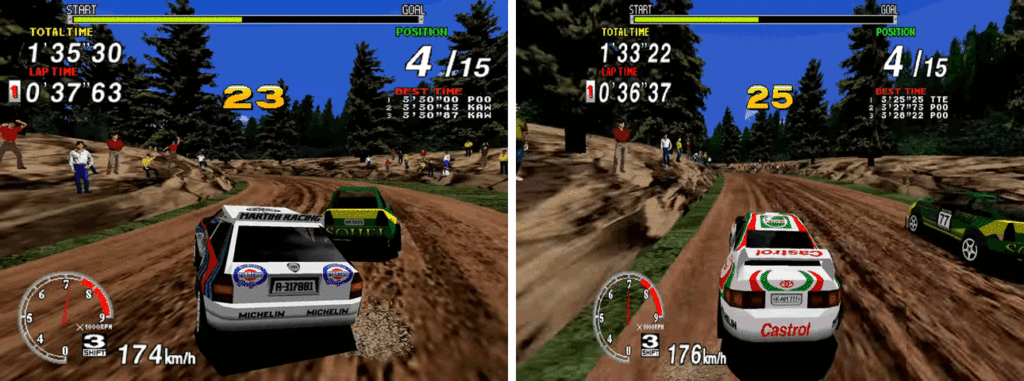
During the mid-1990s, the video game industry was defined by a series of high-stakes corporate rivalries that fundamentally reshaped digital entertainment. While the "console wars" between Sega and Nintendo dominated headlines, a parallel and equally fierce battle was unfolding in the arcade sector. Sega and Namco were locked in a technological arms race to produce the definitive 3D racing experience. This competition yielded several genre-defining classics, but few proved as influential or enduring as the 1995 release of Sega Rally Championship. Developed by Sega’s AM3 division and produced by the then-emerging visionary Tetsuya Mizuguchi, the title represented a paradigm shift in how racing games handled physics, environmental surfaces, and licensed content.
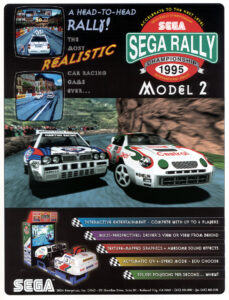
The development of Sega Rally Championship occurred during a pivotal transition from 2D sprite-based graphics to fully realized 3D environments. By leveraging the advanced capabilities of the Sega Model 2 arcade hardware, the development team moved beyond the sterile, flat tracks of previous racers to create a visceral experience that emphasized the unpredictability of off-road driving. The game’s legacy is not merely found in its commercial success, which included approximately 12,000 arcade units sold, but in its foundational influence on the rally racing subgenre and the career of its lead creator.
The Technological Foundation: The Model 2 Revolution
To understand the impact of Sega Rally Championship, one must examine the hardware that made it possible. In the early 1990s, Sega inaugurated the 3D era with the Model 1 board, which powered Virtua Racing (1992). However, it was the Model 2 architecture—a collaborative venture between Sega and GE Aerospace—that provided the necessary horsepower for true environmental realism.
The Model 2 board was a significant leap forward, capable of pushing up to 500,000 polygons per second, a nearly threefold increase over the Model 1’s 180,000 polygons. More importantly, it introduced advanced graphical features such as texture mapping, texture anti-aliasing, and trilinear filtering. These tools allowed developers to move away from flat-shaded polygons toward realistic surfaces. For a rally game, this meant that gravel, mud, and asphalt could not only look different but could be programmed to affect the vehicle’s traction and handling in distinct ways.
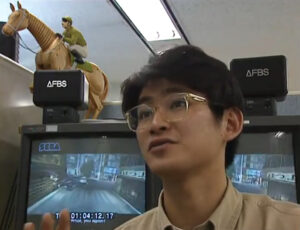
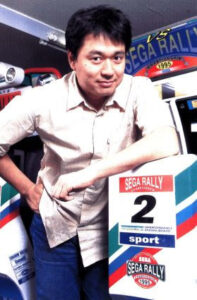
Tetsuya Mizuguchi, who had joined Sega in 1989 with a background in media aesthetics rather than traditional programming, saw this technology as a way to create "emotional design." Working within the "Emotion Design Lab," Mizuguchi sought to bridge the gap between the mechanical nature of video games and the immersive quality of cinema.
The Formation of AM3 and the Recruitment of Talent
The development of Sega Rally Championship was marked by an unusual confluence of talent. Mizuguchi was appointed as the producer, a role that was still relatively ill-defined in the Japanese development culture of the time. To lead the project’s creative direction, Sega recruited Kenji Sasaki, who had recently departed rival Namco. Sasaki brought invaluable experience, having served as a lead designer on Ridge Racer, the title that had set the previous benchmark for 3D arcade racing.
Sasaki’s transition from Namco to Sega was a significant event in the industry, signaling a shift in the creative balance of power. He was joined by Sohei Yamamoto, an AM3 veteran with a background in mechanical design and programming for large-scale motion cabinets. Together, this trio—Mizuguchi, Sasaki, and Yamamoto—formed the core leadership of a team consisting of roughly 12 developers, most of whom were in their twenties and eager to exploit the untapped potential of the Model 2 hardware.
Chronology of Development: From California to Kenya
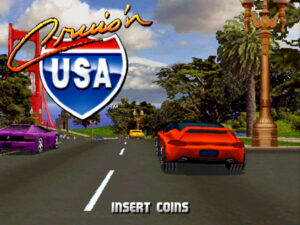
The project began under the working title "Rally California," with an initial concept focused on a cross-country race across the United States. However, the development timeline was disrupted by external competition. In 1994, Midway Games announced Cruis’n USA, a title that utilized a nearly identical premise. Fearing a lack of differentiation, Mizuguchi and Sasaki pivoted the project toward the World Rally Championship (WRC) format.
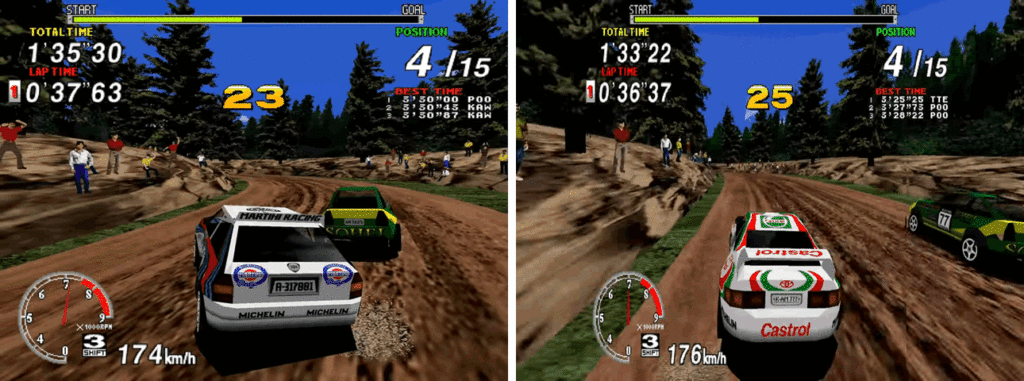
This shift required a massive research undertaking. The team embarked on a two-week, 1,200-mile road trip from Mexico City to Yosemite National Park to gather reference materials. During this journey, the team captured over 4,000 photographs and hours of video footage to serve as the basis for the game’s textures and track layouts. This commitment to on-site research was rare for the era and contributed to the game’s distinctive atmosphere, which traded the neon-lit urbanism of Ridge Racer for the dusty savannas of Africa and the dense forests of North America.
The final game structure featured three primary tracks:
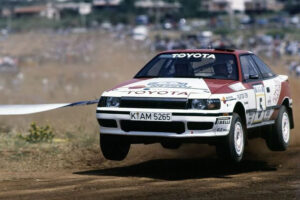
- Desert (Beginner): Inspired by the Safari Rally in Kenya, blending African savanna imagery with North American landscapes.
- Forest (Intermediate): Originally based on Redwood National Park but altered to Yosemite National Park to avoid similarities with competing titles.
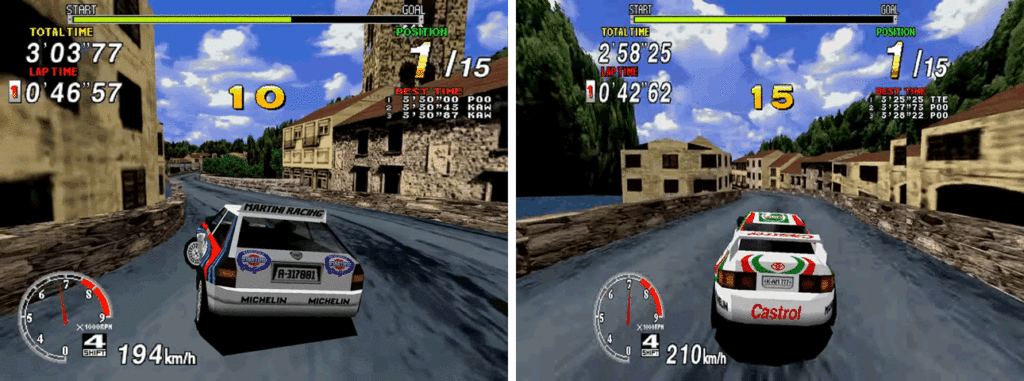
- Mountain (Advanced): Based on the Tour de Corse in France, emphasizing tight turns and technical driving.
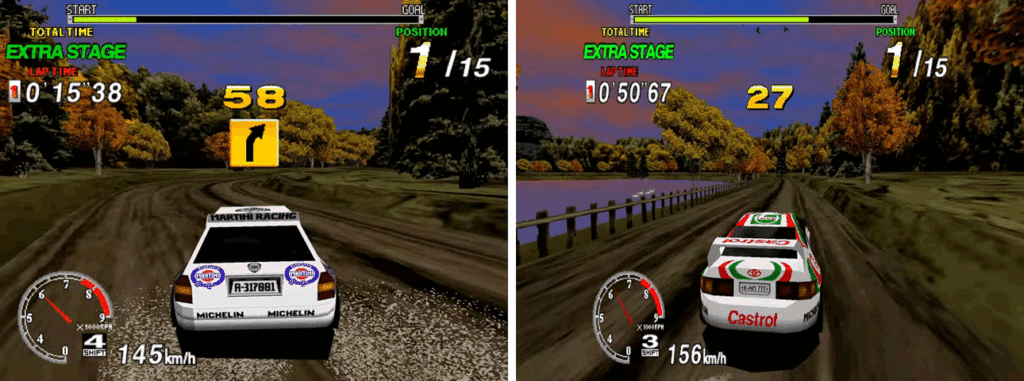
- Lakeside (Secret): A bonus track modeled after Northern European scenery, accessible only to players who finished the Championship mode in first place.
Innovation in Physics and Audio Design
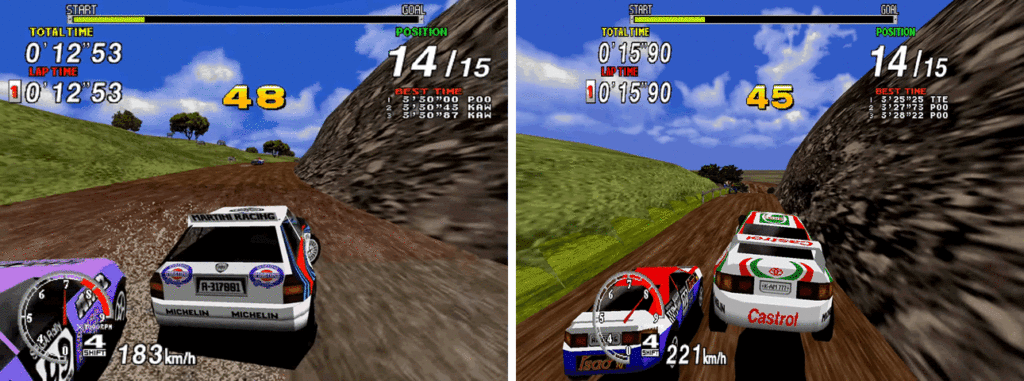
Sega Rally Championship is widely credited with being the first racing game to successfully implement surface-dependent handling. In previous titles, the "road" was a uniform surface. In Sega Rally, the car’s behavior changed dynamically as it transitioned from asphalt to loose gravel or mud. This required a sophisticated physics engine that could calculate friction and slip in real-time, encouraging players to master the "power slide" or drift.
The auditory experience was equally groundbreaking. Takenobu Mitsuyoshi, the composer behind Daytona USA, created a high-energy soundtrack that complemented the intensity of the racing. However, the most famous audio element was the "Game Over, YEAH!" jingle. Mitsuyoshi utilized the improved sampling capabilities of the Model 2 to record full-phrase vocals, creating a cultural touchstone that remains iconic among enthusiasts decades later.
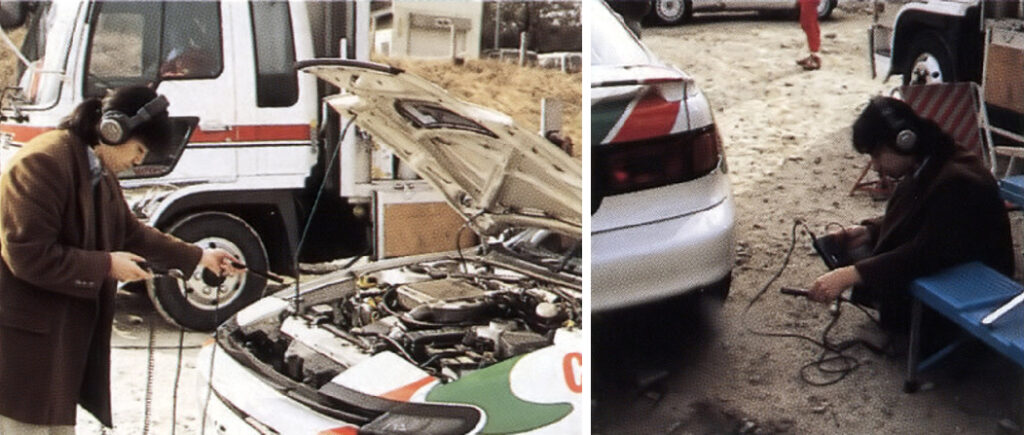
To ensure mechanical accuracy, the team recorded actual engine sounds from rally-spec Toyota Celicas at the Maruwa Autoland Nasu dirt track. This attention to detail extended to the "navigator" system. Much like real-world rally racing, players were guided by audio cues such as "Easy right!" or "Over jump!", recorded by programmer Kenneth Ibrahim. This system allowed players to anticipate upcoming hazards without relying solely on a mini-map.
Licensing and Industry Impact
In a landmark move for the industry, Sega Rally Championship featured officially licensed vehicles. Mizuguchi successfully negotiated with Toyota and Fiat to include the Toyota Celica ST205 and the Lancia Delta HF Integrale. At the time, car manufacturers were skeptical of the marketing value of video games. Mizuguchi reportedly secured the licenses by demonstrating the high-fidelity 3D models to executives, who were stunned by the realism.
The inclusion of these vehicles added a layer of authenticity that resonated with the European market, where rally racing enjoyed immense popularity. This global appeal helped Sega Rally Championship achieve a level of international success that surpassed many of its contemporaries.
Variants and the Joypolis "Special Stage"
Sega released the game in three primary cabinet formats: the standard upright, the "Twin" unit for head-to-head play, and the "Deluxe" cabinet. The Deluxe version featured a moving seat and a high-fidelity sound system, providing a more immersive "body sensation" (taikan) experience.
The most ambitious version, however, was "Sega Rally Special Stage," an attraction built exclusively for the Shinjuku Joypolis indoor theme park. This version utilized full-sized, rally-spec Toyota Celicas mounted on a six-axis motion base. This setup allowed for six degrees of freedom, recreating the pitches, rolls, and yaws of a real rally car with unprecedented accuracy. While the Joypolis unit did not survive the center’s closure in 2000, its technology paved the way for modern high-end racing simulators.
The Saturn Port and Long-Term Legacy
In 1996, Sega released a home port for the Saturn console. While technical compromises were necessary—including a reduced framerate and lower resolution—the port was hailed as a masterpiece of optimization. It expanded the game’s longevity by adding a "Time Attack" mode and more robust car settings, helping the Saturn compete against the Sony PlayStation during the height of the 32-bit era.
The influence of Sega Rally Championship extended far beyond Sega’s own ecosystem. Guy Wilday, the producer of the original Colin McRae Rally (1998), cited Sega Rally’s car handling and surface physics as the primary inspiration for his series. The game essentially defined the "feel" of digital rally racing, establishing a balance between arcade accessibility and simulation-style depth.

Conclusion and Analytical Implications
Sega Rally Championship remains a benchmark for the arcade industry because it successfully synthesized technological prowess with artistic vision. By prioritizing "emotion" and environmental realism, Mizuguchi and his team moved the racing genre forward from simple speed-based gameplay to a complex interaction between vehicle and environment.
The game also served as the launchpad for Tetsuya Mizuguchi’s career as an auteur in the gaming space. The lessons he learned during the development of Sega Rally—the importance of sensory immersion, the value of cross-industry collaboration (licensing), and the pursuit of "emotional design"—would later inform his work on Rez, Space Channel 5, and Lumines.
Decades after its debut, Sega Rally Championship is remembered not just for its "Game Over, YEAH!" jingle, but as a project that proved video games could capture the visceral, unpredictable essence of motorsport. It remains a testament to a time when arcade hardware led the way in innovation, pushing the boundaries of what was possible in digital entertainment.