Jia Lissa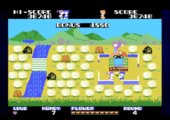
Released in 1985 for the Sega SG-1000, Girl’s Garden stands as a seminal moment in the history of Sega Corporation, marking the professional debut of Yuji Naka, who would later achieve global fame as the creator of Sonic the Hedgehog. While the SG-1000 is often overshadowed by the meteoric success of the Nintendo Famicom, Girl’s Garden serves as a testament to the technical ingenuity and creative ambition that Sega’s internal teams brought to limited hardware. The title was developed at a time when the home console market was in its infancy, and the industry was beginning to explore diverse demographics, specifically targeting female players—a rarity in the mid-1980s.
Core Gameplay Mechanics and Narrative Structure
The narrative of Girl’s Garden centers on Papri, a young girl with pink hair who is navigating a romantic rivalry. Her objective is to win the affection of a boy named Minto, who is currently being courted by another girl named Cocco. To secure Minto’s heart, Papri must navigate a series of hazardous environments to collect exactly ten flowers and deliver them to Minto’s house before Cocco arrives.
The game utilizes a sophisticated "timer" system that is integrated directly into the game’s visual narrative. Rather than a standard numerical countdown, the passage of time is represented by Cocco’s progress toward Minto. If the player is too slow in gathering flowers, Cocco reaches Minto first, resulting in a loss. This mechanic creates a sense of urgency that is thematic rather than purely mechanical, a design choice that was ahead of its time for 1985.
Gameplay involves traversing a grid-like environment filled with various flora. The flowers cycle through six distinct stages of growth; players must harvest them during the fourth stage, when they are in full bloom. Harvesting wilted or underdeveloped flowers results in a penalty, specifically the loss of half of the player’s current bouquet. Hazards include bears that patrol the garden and bees that drop various items. While some items are beneficial, such as extra lives or immediate bouquet completion, others, like the skull item, are lethal. To mitigate the threat of bears, Papri can deploy honey pots, a strategic layer that requires the player to manage limited resources while navigating environmental obstacles like water hazards and rocks.
Technical Innovation on the SG-1000 Hardware
From a technical standpoint, Girl’s Garden is a tour de force on the SG-1000. The system was powered by the Texas Instruments TMS9918A Video Display Processor (VDP), a chip also found in the ColecoVision and MSX computers. This hardware was notorious for its limitations, particularly its inability to handle smooth hardware-based scrolling and its restriction of one color per sprite line.
Despite these constraints, the development team implemented a form of parallax scrolling, a feature almost unheard of on the platform. By manipulating background tiles and shifting them at different rates, the game creates an illusion of depth, with clouds moving in the background and grass tufts in the foreground. Although the scrolling is somewhat "choppy" due to the CPU overhead required to update tile patterns manually, it represented a significant leap over the static screen-flipping common in other SG-1000 titles.
Furthermore, the game utilizes a specialized mode of the VDP during its "Challenging Stages." After every two rounds, the game transitions to a bonus level featuring enlarged versions of Papri and the bears. To achieve this, the developers utilized a hardware feature that allowed sprites to be displayed at four times their standard size. This stage requires the player to jump over waves of bears, testing reflexes and hitbox management.
The Genesis of Development: Yuji Naka and the Team
The development of Girl’s Garden was born out of a specific corporate directive at Sega. During the early 1980s, Sega’s management sought to expand its market share by appealing to female gamers. Yuji Naka, then a new recruit at the company, was tasked with designing a game that would fit this demographic. Naka, who worked alongside Hiroshi Kawaguchi (later famous for the soundtracks of Space Harrier and Out Run), spent approximately five months on the project.
In retrospective interviews, Naka has noted that the project served as his "graduation" piece. Sega was so impressed with the polish and technical execution of the prototype that they decided to move forward with a full commercial release. This was a pivotal moment for Naka, as it established his reputation within the company as a programmer capable of extracting maximum performance from underpowered hardware—a skill he would later use to create the high-speed scrolling of the original Sonic the Hedgehog on the Sega Genesis.
The audio for the game was managed by Tohru Nakabayashi and Katsuhiro Hayashi, with Hiroshi Kawaguchi serving primarily as a programmer. The soundtrack is notable for its use of classical arrangements, including Felix Mendelssohn’s "Wedding March," which plays upon a successful round completion. The music utilizes the SG-1000’s SN76489 Programmable Sound Generator (PSG) to its fullest, providing a cheery, multi-layered accompaniment that reinforces the game’s "kawaii" (cute) aesthetic.
Historical Timeline and Release Context
To understand the impact of Girl’s Garden, it must be viewed within the context of the 1983–1985 console war in Japan:
- July 15, 1983: Sega releases the SG-1000 in Japan on the same day Nintendo launches the Famicom.
- 1984: Sega begins internal development on titles meant to diversify the SG-1000 library, which was heavily dominated by arcade ports like Star Jacker and Congo Bongo.
- February 1985: Girl’s Garden is released. It stands out for being an original home console IP rather than an arcade port.
- October 1985: Sega releases the Mark III (later the Master System), which featured significantly improved hardware.
- Late 1980s: Girl’s Garden becomes a cult classic among Sega enthusiasts, recognized as the starting point for several key Sega figures.
The game was priced at 4,300 yen upon release, a standard price for the era. While it did not outsell Nintendo’s Super Mario Bros. (released later that year), it secured a loyal following and proved that Sega’s internal R&D was capable of creating high-quality, original content.
Broader Impact and Modern Legacy
The legacy of Girl’s Garden is two-fold: it is a milestone in gender-targeted marketing in gaming and a landmark in technical programming. By creating a game centered on a female protagonist and themes of romance and gardening, Sega acknowledged a demographic that many other developers were ignoring. While the "damsel in distress" trope was the industry standard, Girl’s Garden flipped the script by making the female lead the active agent of the story.
In modern times, the game has been preserved through various collections. It is compatible with the Sega Mark III and the Master System, though the color palette appears slightly darker due to differences in video output. In 2016, the game was included as a hidden unlockable in "Sega 3D Reprint Archives 3: Final Stage" for the Nintendo 3DS. Its inclusion in such a prestigious collection highlights its enduring status as a "hidden gem" of the 8-bit era.
Analysts often point to Girl’s Garden as the beginning of Sega’s "Blue Sky" philosophy—a design ethos characterized by vibrant colors, upbeat music, and high technical polish. This philosophy would eventually define the company’s output during the 16-bit era. The game also serves as an early example of "environmental storytelling," where the layout of the garden and the behavior of the animals tell a story of a dangerous but beautiful world.
Conclusion and Assessment
Girl’s Garden remains a high-water mark for the SG-1000 library. With a score of 8 out of 10 from contemporary retro-gaming critics, it is praised for its charm, difficulty curve, and technical sophistication. It is a rare example of a game that successfully balances a niche thematic appeal with robust, challenging gameplay mechanics. For historians of the medium, it provides an essential look at the formative years of one of gaming’s most influential developers and the early competitive landscape of the Japanese console market. Whether viewed as a technical marvel or a charming relic of 1980s pop culture, Girl’s Garden is a vital piece of Sega’s corporate DNA.