Jia Lissa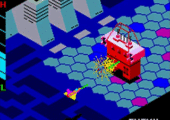
The release of Zaxxon in 1982 by Sega Enterprises marked a definitive pivot point in the evolution of the shoot-’em-up (shmup) genre, introducing a sophisticated isometric perspective that challenged the established conventions of two-dimensional arcade gaming. Developed during the height of the "Golden Age" of arcade games, Zaxxon was the first cabinet to utilize axonometric projection, a form of orthographic projection that simulated a three-dimensional environment. This technical achievement allowed Sega to move beyond the flat, scrolling backgrounds of contemporaries like Defender or Galaxian, offering instead a "2.5D" experience that emphasized depth, altitude, and spatial awareness.
Technical Innovation and the Isometric Shift
The primary innovation of Zaxxon lay in its visual presentation. By tilting the playfield at an angle, Sega’s developers created a sense of three-dimensional space that was previously unavailable on standard arcade hardware. This was achieved using the Sega G80 hardware—specifically the "Axon" board set—which utilized a Zilog Z80 primary processor and a specialized video system capable of rendering complex, layered sprites.
Unlike the vertical or horizontal scrollers of the era, Zaxxon required players to account for three axes of movement. The inclusion of an altitude meter on the left side of the screen was not merely decorative; it was a functional necessity. Players had to navigate their "ZAXXON" craft over electrified walls, through narrow gaps, and under radar dishes. This necessitated a constant adjustment of height, a mechanic that added a layer of simulation-style complexity to the traditional twitch-based shooting gameplay.
Gameplay Mechanics and Strategic Depth
The gameplay of Zaxxon is structured around a high-stakes infiltration mission. The player assumes the role of a pilot tasked with penetrating a heavily fortified space fortress. The experience is divided into distinct phases: the approach through deep space, the navigation of the fortress interior, and the final confrontation with the titular robot, Zaxxon.
One of the most significant hurdles for players in 1982 was the disconnect between visual cues and hitbox detection. Because the game used an isometric view, determining whether a shot would connect with an enemy required a mastery of "shadow-reading" and altitude monitoring. The game provided a crosshair that appeared when the ship was at the same level as an obstacle, but the rapid pace of the scrolling often forced players to rely on instinct.
Furthermore, Zaxxon introduced a resource management element through its fuel system. Unlike many shmups where the only threat is enemy fire, Zaxxon pilots are under constant pressure from a depleting fuel gauge. To replenish fuel, players must destroy fuel tanks labeled "E" (for energy) scattered throughout the fortress. This created a "risk-versus-reward" dynamic; players often had to dive into dangerous, low-altitude zones to secure fuel, risking a collision with ground-based turrets or walls to ensure they didn’t flame out in the vacuum of space.
Chronology of Development and Release
The development of Zaxxon occurred during a period of rapid expansion for Sega. In the early 1980s, Sega was aggressively pursuing the North American market, often collaborating with Gremlin Industries. Zaxxon was released in Japanese arcades in December 1981 and reached North American shores in early 1982.
- 1981 (December): Initial release in Japan. The game’s unique look immediately garnered attention for its "3D" graphics.
- 1982 (April): Sega/Gremlin releases the game in North America. It becomes an instant commercial success, leading to high-volume cabinet production.
- 1982 (Late): Coleco acquires the home console rights. In a landmark marketing move, Coleco spent over $2 million on television advertising for the ColecoVision port, a staggering sum for the time.
- 1983: Ports arrive on the Atari 2600, Atari 5200, Intellivision, and various home computers including the Apple II and Commodore 64.
- 1984: Sega releases Super Zaxxon, a sequel that increased the game’s speed and difficulty, though it failed to achieve the same cultural impact as the original.
- 1995: Zaxxon Motherbase 2000 is released for the Sega 32X, attempting to bring the franchise into the polygonal era.
Commercial Success and Market Impact
Zaxxon was a financial powerhouse for Sega. By the end of 1982, the game had become one of the top-earning arcade titles in the United States. Its success was not limited to the arcade floor; the ColecoVision version was a "killer app" for the console, praised for its near-arcade-perfect graphics.
Industry analysts at the time noted that Zaxxon represented a shift in consumer expectations. Players were no longer satisfied with simple black backgrounds and single-colored sprites. The "Star Wars" aesthetic—evoking the imagery of the Death Star trench run—resonated with a public enamored with science fiction. The game’s difficulty also ensured a high "coin drop" rate for arcade operators. The learning curve was steep; the average play session for a novice lasted less than two minutes, necessitating frequent re-investment from the player to master the altitude controls.
Critical Reception and Legacy
Contemporary reviews from the early 1980s were overwhelmingly positive regarding the game’s visuals. Electronic Games magazine described Zaxxon as "the most visually impressive game of the year," highlighting the way the ship’s shadow moved across the terrain to indicate height. However, some critics pointed out that the isometric view could be "deceptive," leading to "unfair deaths" when a player believed they were clear of an obstacle only to clip its edge.
In historical retrospect, Zaxxon is credited with laying the groundwork for several sub-genres. The "isometric shooter" would later evolve into titles like Viewpoint (SNK) and the Desert Strike series (Electronic Arts). The concept of using a flight stick in an arcade setting also helped bridge the gap between arcade action and flight simulation.
The game’s legacy is also tied to its sound design. The deep, rumbling engine noise and the distinct "thwip" of the laser fire were iconic components of the 1980s arcade soundscape. Even the game’s boss, a giant homing-missile-launching robot, became a recognizable mascot for Sega’s early era of hardware dominance.
Broader Implications for the Gaming Industry
The success of Zaxxon signaled to the industry that specialized hardware could create "experiences" that home computers of the time could not easily replicate. This hardware gap fueled the arcade boom of the early 80s. When home versions eventually arrived, they were often used as benchmarks to measure the power of home consoles. For instance, the Atari 2600 version of Zaxxon, while impressive for the hardware, lacked the depth and color of the arcade original, highlighting the superiority of dedicated arcade circuits.
Furthermore, Zaxxon’s difficulty curve influenced the "Nintendo Hard" era of game design. It taught players that mastery required more than just reflexes; it required an understanding of the game’s internal physics and spatial logic. The requirement to monitor a fuel gauge while dodging projectiles added a multitasking element that is now a staple of modern gaming.
Modern Accessibility and Preservation
For contemporary audiences, Zaxxon remains accessible through various retro collections and digital storefronts. It was released on the Nintendo Wii Virtual Console in 2010 and has appeared in various Sega Genesis Classics collections, despite being an arcade original rather than a Genesis title.
However, purists argue that the true Zaxxon experience is inextricably linked to its original hardware. The arcade cabinet featured a heavy-duty flight stick that provided tactile feedback, allowing for precise altitude adjustments that are difficult to replicate on a modern D-pad or analog thumbstick. This mechanical connection between the player and the craft was a hallmark of 1980s arcade engineering, where the interface was as much a part of the game as the software itself.
Conclusion
Zaxxon stands as a testament to Sega’s early 1980s ingenuity. By daring to break the two-dimensional plane, Sega developers provided a glimpse into the future of 3D gaming. While its steep difficulty and specific control requirements may pose a challenge to modern players accustomed to more forgiving mechanics, its place in the pantheon of video game history is secure. It was a game that not only pushed the limits of what 8-bit hardware could display but also redefined the player’s relationship with the digital environment through the introduction of the Z-axis. As a product of its time, it remains a quintessential example of the innovation and uncompromising challenge that defined the first great era of the arcade.