 Arya Paningal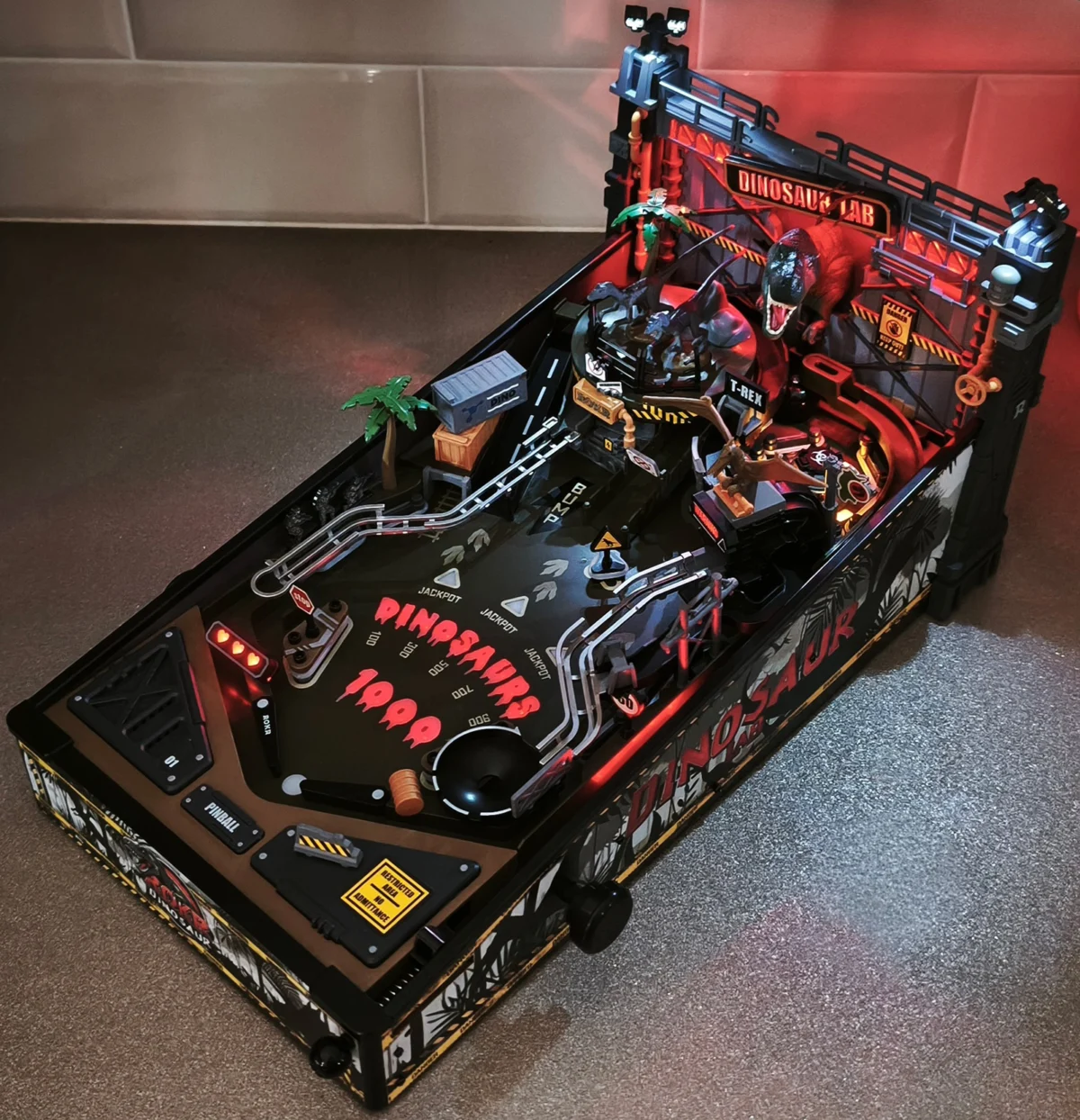
Since its inception in 2017, Robotime—the parent company of the ROKR brand—has established a niche market for high-fidelity, self-assembly mechanical models. These kits have transitioned from static display pieces to complex, functional engineering marvels. Following the successful reception of the 3D Pinball Puzzle three years ago, the manufacturer has officially released its second pinball-themed construction set, titled Dinosaur Lab. This latest offering represents a significant evolution in the company’s product design philosophy, shifting from the rustic, exposed-wood aesthetic of its predecessor to a more robust, industrial, and theme-heavy construction.

Development and Product Evolution
The development cycle for Dinosaur Lab underscores ROKR’s strategy to iterate on its existing mechanical platforms. While the original 3D Pinball Puzzle was praised for its ingenuity, it served primarily as a proof-of-concept for the company’s capability to integrate electronics, sensors, and gameplay mechanics into a consumer-grade wooden puzzle. The 3D Pinball Puzzle consisted of 482 individual parts and required an estimated twelve-hour assembly time.

Dinosaur Lab builds upon this foundation by refining the manufacturing tolerances and expanding the scope of the theme. Unlike the earlier circus-themed machine, which focused on a "raw" wooden finish, Dinosaur Lab utilizes a darker, more detailed material palette. This change in design language allows for the inclusion of molded plastic components and complex thematic elements, such as the T-Rex figure and containment-themed dioramas, which suggest a more sophisticated approach to the "build-at-home" hobbyist market.

Kickstarter Campaign and Market Performance
The commercial journey of Dinosaur Lab began on June 1, 2026, when it was launched on the crowdfunding platform Kickstarter. This project marked the fourth time the company utilized the platform to gauge consumer interest and secure capital for large-scale production runs. The campaign demonstrated significant market demand, with the fundraising target achieved 1,800% over the base goal. By the conclusion of the campaign on July 9, 2026, over 4,000 backers had committed to the project.

Early-bird pricing started at approximately $65, a price point that positions the kit as an accessible entry point into the hobbyist model market. The rapid funding and the high volume of backers indicate a sustained interest in "functional nostalgia," where consumers seek out tabletop versions of classic arcade experiences that are attainable without the significant space and financial requirements of full-sized, professional pinball machines.

Technical Specifications and Assembly Overview
Dinosaur Lab is engineered as a tabletop unit, eliminating the need for traditional cabinet legs and floor space. The kit arrives with a comprehensive, albeit complex, set of parts, including the playfield assembly, mechanical flippers, and various thematic decorations such as palm trees and dinosaur models.

One of the notable technical shifts in this model is the movement away from purely mechanical interaction. The game features an integrated USB-C power system that manages computer-controlled lighting, sound effects, and a rudimentary ruleset. The game is designed to operate on a 5V@2A power supply, a common standard for modern consumer electronics.

The playfield layout is designed for a specific objective-based gameplay loop. The machine features seven distinct shots:

- The Left Lane: A dead-end shot with a concealed bell.
- The Left Ramp: A primary scoring ramp equipped with an opto sensor.
- The Bump Target Bank: A three-target assembly with progressive LED indicators.
- The Centre Ramp: Features a passive spinner to enhance kinetic feedback.
- The Pop Bumper: A single, high-action solenoid-driven bumper.
- The Right Ramp: A vertical turnaround shot.
- The Right Lane: A secondary ball-return path.
The scoring system relies on a "D-I-N-O-S-A-U-R-S" illuminated display, where each letter corresponds to 100 points. The inclusion of a wizard mode in the "difficult" setting, which requires the player to hit all five scoring features to conclude the game, adds a layer of depth absent in many entry-level mechanical models.

User Experience and Mechanical Nuances
The feedback from the initial evaluation units suggests that ROKR has prioritized durability and playability over the aesthetic simplicity of their previous models. The use of silicone-banded slingshots and the inclusion of fifteen 8mm metal balls (with a storage tray for six) indicate a product designed for frequent, albeit casual, use.

The manual nature of the flipper operation—directly linked to the cabinet buttons—provides a tactile experience that mimics the tension of traditional pinball. However, the absence of playfield glass or a protective cover represents a departure from standard pinball design, necessitating a controlled environment to prevent the loss of the small 8mm balls.

Industry Impact and Future Implications
The success of the Dinosaur Lab campaign highlights a growing segment within the global toy and hobby industry: the rise of "complex mechanical construction." By bridging the gap between a jigsaw puzzle and a functional game machine, ROKR has managed to cultivate a dedicated community of builders who value the process of construction as much as the final product.

From a manufacturing standpoint, the transition toward higher-tolerance plastic and wood-composite materials suggests that ROKR is moving toward a more standardized, scalable production model. This trend has broader implications for the DIY market, as it demonstrates that sophisticated arcade-style mechanics can be effectively miniaturized and distributed at a consumer-friendly price point.

The delay in shipping—which extended by two months beyond the initial estimate—serves as a reminder of the challenges inherent in scaling high-precision manufacturing. However, the subsequent release of the units to backers suggests that the company has successfully resolved the logistical bottlenecks associated with mass-producing intricate, multi-part kits.

Conclusion
Dinosaur Lab represents a balanced evolution in ROKR’s product lineup. While it moves away from the purely wooden, artisan aesthetic of the 3D Pinball Puzzle, it compensates with enhanced mechanical reliability, a more cohesive theme, and improved gameplay mechanics. As the company continues to refine its ability to deliver complex, light-and-sound-enabled models to a global audience, it remains a primary driver of innovation in the tabletop hobby space. Whether the market will continue to demand this level of complexity remains to be seen, but the 4,000-strong backer count for Dinosaur Lab provides a strong signal that the appetite for miniature, buildable arcade experiences is robust. For hobbyists, the machine offers an engaging challenge, proving that even at a small scale, the principles of pinball physics and game design remain compelling.