 Jia Lissa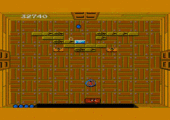
The 1987 release of Woody Pop: Shinjinrui no Block Kuzugi for the Sega Mark III marked a distinct, if ultimately niche, chapter in the history of peripheral-driven home console gaming. As the final title released under the Sega My Card format for the platform, the game functioned primarily as a vessel for a specialized input device: the Sega Paddle Controller. While the title attempted to iterate upon the established mechanics of the arcade-dominant "block breaker" genre, its technical execution and design choices offer a revealing look at the challenges console manufacturers faced when attempting to translate arcade-style precision to domestic hardware during the late 1980s.
The Evolution of the Paddle Input
The technological lineage of the paddle controller dates back to the early 1970s, reaching its zenith in the home market with the Atari 2600. Unlike standard digital directional pads or joysticks—which operate on binary on/off inputs—paddle controllers utilize potentiometers to regulate voltage. This allows for a granular, variable range of motion, providing a level of responsiveness that remains the gold standard for games requiring high-speed lateral tracking.
For many consumers, the inclusion of paddle controllers with the Atari 2600 facilitated a robust library of titles, including classics like Super Breakout, Kaboom!, and Warlords. However, as the industry shifted toward the Nintendo Entertainment System (NES) and the Sega Master System (the international successor to the Mark III), the prevalence of these controllers declined. Nintendo, opting for a standard D-pad configuration for its Famicom, forced developers like Taito to bundle their own proprietary paddle controllers with specific software, such as the home port of Arkanoid. This fragmentation of hardware standards ultimately limited the longevity and cross-compatibility of paddle-dependent software.
Chronology of the Sega Paddle Initiative
Sega’s decision to enter the paddle peripheral market in 1987 was a strategic, albeit curious, endeavor. At the time, Sega was heavily invested in porting its successful arcade catalog to the Mark III. However, the company’s arcade portfolio at the time did not heavily feature paddle-controlled titles.
The launch of the paddle controller in 1987 saw it bundled with two distinct software packages: the card-based Woody Pop and the 1Mb Gold Cartridge release of Alex Kidd BMX Trial. Throughout the lifespan of the Mark III, Sega released seven titles compatible with this peripheral. Of these, four were exclusive to the device. Among these, Megumi Rescue stands out as the most critically recognized title, whereas games like Woody Pop were relegated to a secondary status, often perceived as mere technical demonstrations of the hardware’s capability rather than software highlights in their own right.
Technical Analysis: Woody Pop and the Arkanoid Paradigm
Woody Pop arrived in a market already dominated by Taito’s Arkanoid. While Arkanoid was praised for its sleek, 3D-modeled aesthetic and precision, Woody Pop opted for a more whimsical, character-driven narrative. The protagonist, a wood spirit named Woody, is tasked with navigating the "Bizarre Mansion" to rescue his companion, Gumball.
Structurally, Woody Pop introduced several innovations intended to differentiate it from the Arkanoid formula:
- Damage Indicators: Bricks requiring multiple hits to destroy display visible cracks, providing immediate feedback to the player.
- Branching Paths: Players are offered choices after clearing levels, adding a degree of non-linearity to the progression system.
- Item Synergy: The game allows for the combination of certain power-ups, such as the "glue" effect (which holds the ball) and the "flame" effect (which increases destructive power).
Despite these additions, the implementation of these mechanics often fell short of the industry standard. The screen real estate of the Mark III, formatted for a 4:3 display, presented a wider playfield than the vertical monitors for which Arkanoid was designed. This forced the paddle to cover more ground, a difficulty exacerbated by an aggressive speed-scaling curve. Furthermore, the inclusion of "toy box" blocks—which continuously spawn enemies until destroyed—often created situations of unavoidable frustration, as the player is forced to manage hazards while simultaneously tracking the ball’s trajectory.
Visual and Auditory Challenges
A significant point of criticism regarding Woody Pop concerns its aesthetic presentation. The title’s color palette is dominated by dark browns and oranges, intended to represent the wood-paneled interior of the mansion. While thematic, these choices resulted in a visual landscape that lacked contrast, making it difficult for players to discern objects against the background.
The audio design presents an even more unconventional case. The game lacks a traditional melodic soundtrack, relying instead on a series of randomized sound effects and percussive pings. Contemporary analysis suggests that this may have been a deliberate design choice to avoid sound-channel competition, as the game’s frequent, high-pitched mechanical noises would likely have overwhelmed any melodic composition attempted by the hardware’s sound chip.
Market Implications and Legacy
The reception of Woody Pop by the gaming public was lukewarm, characterized by a perception that the software was secondary to the hardware it contained. The Japanese subtitle—often translated as "New Generation Block Breaker"—suggested a level of ambition that the final product failed to sustain. While it attempted to bridge the gap between simple arcade clones and the more complex "dungeon crawler" variants of the genre (such as the later Wizorb), it lacked the polish required to become a defining title.
From a historical perspective, Woody Pop serves as a case study in the limitations of 8-bit era hardware expansions. The game was never released in Western markets, and the paddle controller remained a Japanese exclusive. For Sega, the endeavor was not a commercial failure in the strictest sense, as it provided a necessary entry point for players to access the peripheral, but it did not leave a lasting impact on the company’s software legacy.
Conclusion
With a critical score of 4 out of 10, Woody Pop remains a footnote in the history of the Sega Mark III. It is remembered not for its innovative gameplay or its narrative charm, but for its role as a bundled utility for the paddle controller. The game serves as a stark reminder of the era when hardware manufacturers frequently experimented with proprietary input methods, often at the expense of software quality. While the title is technically functional and offers a glimpse into the design philosophy of 1987, it remains an artifact of a bygone period in console gaming, overshadowed by the more successful and refined iterations of the block-breaking genre that followed.