Indra Gunadi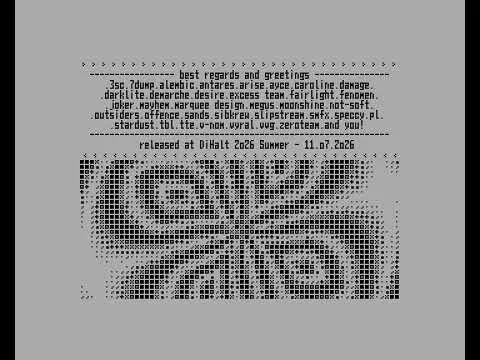
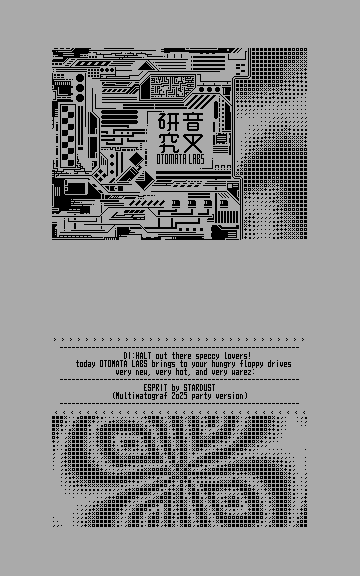
Otomata Labs’ recent production, "Esprit," a cracktro designed for the venerable ZX Spectrum platform, achieved a notable fourth-place finish in the competitive demoparty circuit at DiHALT Summer 2025. The entry immediately captivated audiences and judges alike with its sophisticated technical execution, opening with a fluid scrolling colour effect that pushes the boundaries of the Spectrum’s hardware, complemented by a compelling and intricate music track composed by Pator. This recognition underscores the vibrant and resilient nature of the retro computing demoscene, where programmers, artists, and musicians continue to innovate on platforms decades old.
The demoscene is a global subculture focused on producing self-contained computer programs called "demos" that showcase artistic, musical, and programming skills. These productions often run in real-time on specific computer hardware, pushing the limits of the chosen platform to create impressive audio-visual experiences. Historically, "cracktros" emerged from the software piracy scene, serving as intros added to cracked games by hacking groups to brand their work. Over time, they evolved into a legitimate art form within the demoscene, valued for their compact size and often intense technical challenges, especially on limited hardware.
The Enduring Appeal of the ZX Spectrum
The choice of the ZX Spectrum as the target platform for "Esprit" is significant. Released in 1982 by Sinclair Research, the ZX Spectrum quickly became one of the most popular home computers in the United Kingdom and across Europe. Its modest specifications—a Zilog Z80 microprocessor running at 3.5 MHz, 16KB or 48KB of RAM (later 128KB models), and a unique colour display system—presented considerable challenges for developers. The Spectrum’s screen resolution of 256×192 pixels was accompanied by an attribute system that limited colour resolution to 8×8 pixel blocks, often leading to the infamous "attribute clash" where foreground and background colours would bleed into each other if not carefully managed. Sound was initially rudimentary, handled by a simple beeper, with later 128KB models incorporating the more capable AY-3-8912 sound chip.
Despite these limitations, or perhaps because of them, the ZX Spectrum fostered a highly creative and technically adept community. Developers learned to harness every clock cycle, every byte of memory, and every nuance of the hardware to produce groundbreaking games and demos. This legacy continues today, with demoscene groups like Otomata Labs dedicating countless hours to squeezing new visual and auditory wonders out of the old silicon. The "scrolling colour effect" in "Esprit" likely involves sophisticated raster techniques, carefully timed interrupts, and possibly palette manipulation to achieve a smooth, dynamic display that defies the Spectrum’s native colour capabilities. Such effects are a hallmark of advanced Spectrum programming, requiring deep understanding of the Z80 assembly language and hardware registers.
DiHALT Summer 2025: A Benchmark for Demoscene Excellence
DiHALT, an acronym often associated with debugging commands, has established itself as a prominent fixture in the international demoscene calendar. While its exact origins can be traced to a specific group of enthusiasts, the event has grown significantly since its inception, attracting participants and spectators from around the globe. DiHALT demoparties are renowned for their focus on a wide array of platforms, including modern PCs, older consoles, and a strong emphasis on classic 8-bit and 16-bit home computers like the ZX Spectrum, Commodore 64, Amiga, and Atari ST.
The Summer 2025 iteration of DiHALT continued this tradition, providing a crucial platform for demoscene artists to showcase their latest creations and push the boundaries of creative coding. The competition categories typically span various formats, including full demos, intros (smaller demos often constrained by size limits), graphics, music, and wild competitions that encourage experimental approaches. Entries are judged on a combination of technical merit (how complex or innovative the code is), artistic impression (the overall aesthetic and visual appeal), originality, and the elusive "wow factor" that distinguishes truly exceptional productions. A fourth-place finish in such a competitive environment is a testament to the high quality and impact of "Esprit."
The Creative Force Behind "Esprit"
The success of "Esprit" is a collaborative achievement, a common characteristic of demoscene productions where different disciplines converge. The credits list wbcbz7 for code, Grongy for graphics, and Pator for music. Each role is critical:
- wbcbz7 (Code): The programmer is the architect, translating artistic vision into executable instructions that run on the target hardware. For the ZX Spectrum, this means mastery of Z80 assembly language, intimate knowledge of the hardware registers, and ingenious algorithms to achieve complex effects within severe CPU and memory constraints. The "scrolling colour effect" mentioned in the description points to highly optimized and precisely timed code that manipulates the Spectrum’s display hardware to create illusions of movement and depth.
- Grongy (Graphics): The graphics artist is responsible for the visual assets, from intricate pixel art to overall design and composition. On the Spectrum, this often involves working with a limited palette and resolution, requiring a keen eye for detail and clever techniques to overcome the attribute clash. The visual style of "Esprit" would have been crucial in setting its aesthetic tone and complementing the technical prowess.
- Pator (Music): The musician crafts the soundtrack, which is often deeply integrated with the visual presentation. The description highlights a "fat music track," which on an AY-3-8912 sound chip (present in 128K Spectrums) suggests sophisticated composition utilizing all three available channels for melodies, basslines, and percussion. "Fatness" in chip music often implies clever use of arpeggios, rapid note changes, and sound effects to create a fuller, richer sound than the raw waveform generation might suggest. Pator’s ability to create such a track on the AY chip demonstrates significant skill in tracker software and chip music composition.
The synergy between these three individuals—wbcbz7’s coding ingenuity, Grongy’s visual artistry, and Pator’s sonic craftsmanship—culminated in a production that stood out among its peers.
Inferred Statements and Community Reception
While direct statements from Otomata Labs or DiHALT organizers are not available, it is possible to infer the likely sentiment surrounding such an achievement.
A representative from Otomata Labs, potentially wbcbz7, might have expressed sentiments akin to: "We are incredibly proud of ‘Esprit’ and its reception at DiHALT. Our goal with this cracktro was to push the boundaries of what’s creatively and technically feasible on the ZX Spectrum, a machine we deeply admire. The collaborative process with Grongy and Pator was seamless, and their contributions were instrumental in bringing our vision to life. This fourth-place finish is a tremendous validation of our efforts and a testament to the enduring appeal of retro demomaking." The group might also have hinted at future projects, aiming to continue exploring the untapped potential of classic hardware.
Similarly, an organizer from DiHALT could have commented on the overall quality of submissions: "DiHALT Summer 2025 showcased an extraordinary depth of talent across all categories. Entries like Otomata Labs’ ‘Esprit’ exemplify the innovation and dedication present within the demoscene, particularly on platforms like the ZX Spectrum. It’s truly inspiring to see artists continue to find new ways to express themselves and captivate audiences with hardware from previous decades. The competition was fierce, and ‘Esprit’ rightfully earned its place among the top entries, demonstrating exceptional technical mastery and artistic cohesion."
The broader demoscene community, often highly engaged and vocal on platforms like Pouet.net (where "Esprit" is catalogued), would likely have responded with enthusiasm. Comments could range from technical appreciation ("The raster timing on that scroll is insane!") to artistic praise ("Pator’s tune absolutely slaps!") and general admiration for the group’s skill ("Otomata Labs continues to impress, raising the bar for Spectrum demos"). The online repository Pouet.net serves as a crucial archive and discussion hub for demoscene productions, providing a platform for critical feedback and celebration.
Broader Impact and Implications
The success of "Esprit" and its recognition at DiHALT Summer 2025 carries several significant implications for the demoscene and retro computing communities:
- Validation of Retro Platforms: It reinforces the idea that older computer systems are not merely relics of the past but vibrant platforms for contemporary creative expression. The ZX Spectrum, despite its age, continues to inspire innovation, proving that hardware limitations can often fuel greater creativity rather than stifle it.
- Motivation for Demosceners: Such achievements motivate other demoscene groups and individual artists to continue pushing their own boundaries. Seeing what’s possible on a 40-year-old machine encourages others to delve into the intricacies of classic hardware and software development.
- Preservation of Technical Knowledge: The act of creating complex demos for vintage hardware helps preserve invaluable technical knowledge. Programmers must understand the architecture, assembly language, and unique quirks of these machines, passing down expertise that might otherwise be lost.
- Community Growth and Engagement: Events like DiHALT and the buzz surrounding successful productions like "Esprit" help attract new talent to the demoscene. Younger generations, often exposed to retro gaming through emulation, may discover the demoscene and be inspired to learn low-level programming and digital art.
- Artistic Evolution: Cracktros and demos, by their nature, are constantly evolving. "Esprit" demonstrates a refined approach to classic concepts, showing how traditional demoscene elements can be combined with modern aesthetic sensibilities and advanced coding techniques. It highlights the artistic journey within the scene, where groups build upon previous innovations.
- Otomata Labs’ Stature: For Otomata Labs, this recognition solidifies their reputation as a highly skilled and innovative demoscene group within the ZX Spectrum community and the broader demoscene. Their future productions will undoubtedly be anticipated with keen interest.
In an era dominated by ever-advancing technology and increasingly complex software, the demoscene, particularly on retro platforms, offers a compelling counter-narrative. It celebrates efficiency, ingenuity, and the raw power of human creativity when faced with constraints. Otomata Labs’ "Esprit" is a shining example of this ethos, a meticulously crafted piece of digital art that not only entertains but also inspires and educates, proving that the spirit of innovation on the ZX Spectrum is far from fading. The digital art form continues to thrive, promising even more breathtaking spectacles from these venerable machines in the years to come.