Jia Lissa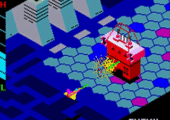
Zaxxon, developed and published by Sega Enterprises in 1982, represents a pivotal moment in the evolution of the shoot ‘em up (shmup) genre and the broader history of interactive entertainment. At a time when the arcade industry was dominated by two-dimensional side-scrollers and vertical shooters such as Defender, Galaxian, and Stargate, Zaxxon introduced a revolutionary isometric perspective that simulated a three-dimensional environment. This "axonometric" projection allowed players to perceive depth and altitude, a feat of graphical engineering that had not been previously achieved in the commercial arcade space. By utilizing a flight stick controller and incorporating a dedicated altitude meter, Sega provided a sophisticated simulation of flight that challenged the cognitive and mechanical skills of players during the Golden Age of Arcades.
The Technical Innovation of Axonometric Projection
The primary distinction of Zaxxon was its use of isometric projection, a method of visually representing three-dimensional objects in two dimensions. While modern gaming relies on true 3D polygons and real-time rendering engines, Zaxxon achieved its depth through clever sprite manipulation and a fixed diagonal camera angle. This perspective provided a "birds-eye" view that allowed the player’s craft to move along three axes: the X-axis (left and right), the Y-axis (forward movement), and the Z-axis (altitude).
To facilitate this gameplay, the arcade cabinet featured a heavy-duty flight stick, diverging from the standard four-way or eight-way joysticks common in 1982. This hardware choice was essential for managing the game’s unique altitude mechanics. Players had to monitor an on-screen altimeter to navigate through narrow openings in walls and avoid electrified barriers. To assist with depth perception—a common challenge in isometric games—Sega implemented a shadow system. The player’s ship cast a shadow directly below its position on the ground, serving as a vital visual cue for determining the craft’s height relative to obstacles and enemies.
Core Gameplay Mechanics and Difficulty Scaling
Zaxxon’s gameplay is divided into distinct phases that test different aspects of pilot proficiency. The initial stage requires the player to penetrate a heavily fortified space fortress. In this environment, the player must navigate a series of walls with varying heights and gaps. Success in this stage is predicated on the player’s ability to synchronize their altitude with the physical openings in the structures.
A critical secondary mechanic is fuel management. Unlike many contemporary shooters that focused solely on survival and score, Zaxxon introduced a resource-scarcity element. The player’s fuel reserves constantly deplete during flight. To replenish these reserves, players must destroy fuel tanks labeled "FUEL" situated throughout the enemy base. This created a high-risk, high-reward dynamic; fuel tanks were often positioned in hazardous areas or near defensive turrets, forcing players to choose between a safe flight path and the necessity of refueling.
Following the fortress breach, the game transitions into a deep-space dogfight. In this phase, the isometric perspective remains, but the focus shifts to ship-to-ship combat against waves of enemy fighters. The difficulty increases as enemy ships utilize vertical movement, requiring the player to constantly adjust their altitude to align their shots. The final confrontation involves a massive enemy robot—the titular Zaxxon—which serves as one of the earliest examples of a "boss battle" in the shmup genre.
Chronology of Development and Global Release
The development of Zaxxon occurred during a period of rapid expansion for Sega Enterprises. Released in January 1982, the game was a technical showcase for Sega’s G80 hardware, a modular arcade system board that allowed for advanced color vector and raster graphics.
- January 1982: Zaxxon debuts in Japanese arcades, immediately garnering attention for its unique visual style.
- April 1982: Sega partners with Gremlin Industries for the North American distribution of Zaxxon. The game becomes a staple in arcade chains such as Aladdin’s Castle and Circus Playhouse.
- Late 1982: Due to the game’s immense popularity, Coleco acquires the home console rights. Zaxxon becomes a flagship title for the ColecoVision, showcasing the console’s superior graphical capabilities compared to the Atari 2600.
- 1983: Sega releases Super Zaxxon, an iterative sequel that increased the game’s speed and introduced new enemy types, though it failed to replicate the cultural impact of the original.
- 1984-1985: Ports are released for virtually every major home computer system, including the Apple II, Commodore 64, and IBM PC.
Market Impact and Commercial Performance
Zaxxon was a significant commercial success for Sega. By the end of 1982, it was consistently ranked among the top-earning arcade games in both Japan and the United States. According to historical arcade earnings charts from the era, Zaxxon frequently competed with Namco’s Pole Position and Atari’s Centipede for the top spot in weekly collections.
The game’s success was not limited to the arcade. The ColecoVision port is often cited by historians as a "killer app" that helped the console gain a foothold in a market dominated by Atari. While the Atari 2600 and Mattel Intellivision versions had to significantly downgrade the graphics—often losing the iconic isometric perspective in favor of a standard 2D view—the ColecoVision version retained the 3D feel, moving millions of units.
The licensing of Zaxxon also extended into various merchandising ventures, including a board game by Milton Bradley and a dedicated tabletop electronic game by Coleco. This cross-media presence solidified Zaxxon’s status as a foundational pillar of early 1980s pop culture.
Official Responses and Industry Legacy
Industry veterans and former Sega engineers have often reflected on Zaxxon as a "trial by fire" for the company’s hardware divisions. In various retrospective interviews, designers have noted that the difficulty of the game was intentional, designed to maximize "coin drop" in arcades. The learning curve associated with the isometric perspective meant that new players would often lose their initial lives within seconds, necessitating multiple credits to master the basics of altitude control.
The legacy of Zaxxon is evident in the subsequent evolution of the "3D" shooter. It paved the way for titles like Viewpoint (1992) and the Strike series (e.g., Desert Strike), which utilized similar isometric viewpoints to provide a more tactical gaming experience. Furthermore, the game’s influence can be seen in the design of the "Trench Run" sequences in various Star Wars licensed titles, as Zaxxon was one of the first games to capture the cinematic feel of navigating a high-tech fortress.
Broader Implications and Modern Analysis
From a modern perspective, Zaxxon serves as a case study in how hardware limitations can drive creative software solutions. The developers could not render true 3D, so they invented a new visual language to simulate it. However, this innovation came with inherent flaws. Modern analysts point out that the isometric perspective creates "input ambiguity," where it is not always clear if a player’s shot is on the same plane as the target.
The game’s reappearance on digital storefronts, such as the Nintendo Wii eShop in 2010 and the PlayStation Network, has allowed a new generation to experience the title. However, contemporary reception is often tempered by the game’s extreme difficulty and the lack of specialized hardware. The original arcade experience relied heavily on the physical feedback of the flight stick; playing Zaxxon with a modern D-pad or analog thumbstick often results in a less precise and more frustrating experience.
Despite these challenges, Zaxxon remains a landmark achievement. It was a bold experiment that pushed the boundaries of what was possible in the early 80s. It transformed the "shmup" from a test of simple reflexes into a complex exercise in spatial awareness and resource management. As Sega continues to iterate on its classic IPs, Zaxxon stands as a testament to the company’s historical role as a pioneer in arcade technology. For enthusiasts of gaming history, the title represents the moment when the industry first looked beyond the flat screen and began its long, complex journey toward three-dimensional immersion.