Farhan hamdan
The Atari Jaguar, famously marketed during its 1993 launch as the world’s first 64-bit interactive multimedia system, occupies a unique and complicated space in the history of the video game industry. Long after its commercial failure and Atari’s eventual departure from the hardware manufacturing sector, the console continues to command a passionate following among retro gaming enthusiasts, hardware modders, and preservationists. Recently, prominent retro hardware content creator Tito of Macho Nacho Productions published a comprehensive video documenting the complete restoration, modernization, and maintenance of his personal Atari Jaguar console. This undertaking has once again thrust the notoriously misunderstood platform into the spotlight, offering the retro gaming community a masterclass in breathing new life into vintage hardware through modern engineering solutions.
Main Facts of the Atari Jaguar Restoration Project
Tito’s restoration project serves as a practical blueprint for preserving aging hardware that is now entering its fourth decade. The video details a multi-step overhaul of the console, addressing structural degradation, power supply vulnerabilities, audio-visual limitations, and modern storage accessibility. Rather than treating the Jaguar as a fragile museum piece, the restoration transforms the console into a robust, high-performance machine capable of operating reliably on modern television displays and vintage cathode-ray tube (CRT) monitors alike.
The restoration process highlights several critical aftermarket components developed by independent hardware engineers over recent years. These include modern power protection circuits, RGB video bypass modifications, specialized multi-out adapters, and flash-based game loading solutions. By combining these modifications, retro gaming hobbyists can circumvent many of the factory limitations that plagued the Jaguar during its original commercial lifecycle, such as poor composite video output, fragile power input jacks, and a notoriously scarce physical software library.
Chronology and Historical Context of the Atari Jaguar
To understand the significance of modern hardware modifications for the Atari Jaguar, one must examine the turbulent timeline of the console’s release and subsequent market collapse.
In November 1993, Atari Corporation, led by CEO Sam Tramiel, launched the Jaguar in test markets in New York and San Francisco, followed by a nationwide rollout in early 1994. The console was heralded as a technological marvel, featuring a unique multi-chip architecture containing custom processors named "Tom" and "Jerry." Atari aggressively marketed the system as the only true 64-bit console on the market, frequently taking direct aim at competitors Nintendo and Sega in print and television advertising campaigns.
However, the hardware suffered from significant design flaws, difficult programming documentation, and an inadequate software library. Developers frequently complained that the custom architecture was overly complex to program for, leading to third-party software support drying up rapidly. Furthermore, the decision to rely on ROM cartridges rather than the emerging CD-ROM format at launch severely limited game sizes and multimedia capabilities, though Atari later attempted to rectify this with the release of the Atari Jaguar CD add-on in 1995.
By 1996, facing mounting financial losses and a lack of consumer confidence, Atari effectively discontinued the Jaguar, shifting its corporate focus away from hardware entirely. The platform faded into obscurity, leaving behind an estimated total lifetime sales figure of fewer than 250,000 units. For decades, the console was widely dismissed as a commercial and technical failure, relegated to the status of a cautionary tale in corporate video game history.
The Resurgence of Retro Modding and Preservation
Despite its commercial failure, the Atari Jaguar experienced a slow but steady rehabilitation over the subsequent twenty-five years, largely driven by dedicated hobbyists, independent software developers, and hardware modders. As original components began to degrade due to age, engineers stepped in to design modern replacements, effectively creating a thriving aftermarket ecosystem.
The recent video by Macho Nacho Productions synthesizes years of community-driven hardware development into a single, cohesive restoration guide. Key aspects of the restoration process involve targeted interventions at the motherboard and power supply levels.
Power Regulation and Motherboard Upgrades
One of the most critical vulnerabilities of the original Atari Jaguar hardware is its sensitivity to power fluctuations and incorrect power supply units (PSUs). Using an incorrect or failing PSU historically resulted in catastrophic damage to the console’s internal power management circuitry, often rendering the motherboard unrecoverable.

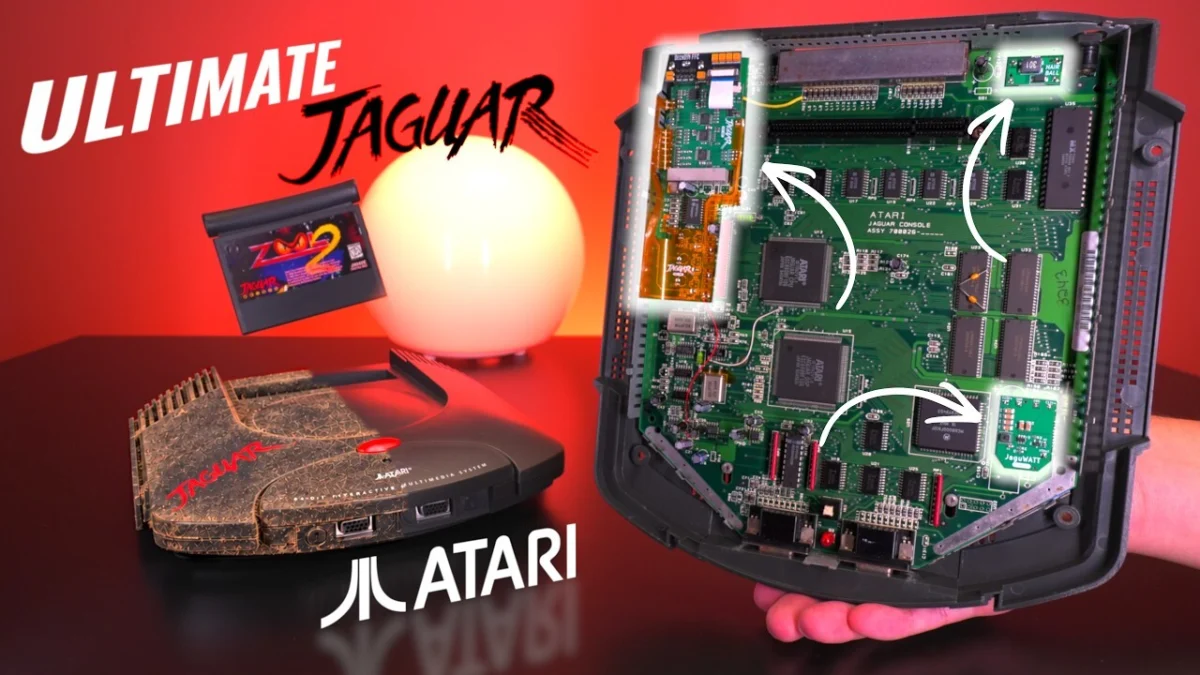
To combat this, hardware developer Zaxour engineered a series of comprehensive motherboard upgrades, which Tito incorporates into his restoration. These include a dedicated power protection mod and a full power circuit replacement. These modern components not only safeguard the console against accidental overvoltage but can actively revive units that were previously shorted out and discarded.
Additionally, the restoration addresses the Jaguar’s notoriously poor native video output. Out of the box, the console was limited to basic radio frequency (RF) and composite video signals, which appear blurry and artifact-laden on modern displays. Zaxour’s RGB video bypass modification brings the Jaguar’s visual fidelity up to modern standards, offering signal quality comparable to a modified Super Nintendo. For audio enthusiasts, an updated audio circuit mod ensures that sound reproduction is crisp and clean, moving well beyond the limitations of basic television speakers.
Modern Connectivity and Display Solutions
Integrating a 1990s console into a modern entertainment setup presents significant logistical challenges. To bridge this gap, Tito highlights the use of the JagAIOA (Atari Input/Output Adapter) Plus. The adapter acts as a fully plug-and-play solution that neatly breaks out all necessary video signals, utilizing a standard Genesis 2 multi-out port for clean RGB output. Designed to look and feel like a factory-integrated add-on, the JagAIOA preserves the physical integrity of the console while vastly expanding its connectivity options.
For users prioritizing modern streaming workflows alongside traditional display methods, alternative adapters exist that combine analog outputs with digital signal converters. While purists often caution against low-cost HDMI cables due to latency and scaling artifacts, certain hybrid adapters offer high-quality analog circuits paired with budget-friendly digital feeds. This allows content creators and streamers to output a clean 720p digital signal for capture cards while simultaneously gaming on a zero-latency cathode-ray tube (CRT) monitor.
Software Accessibility via Flash Cartridges
One of the greatest barriers to enjoying the Atari Jaguar historically has been the scarcity and high cost of physical game cartridges. Many of the system’s most acclaimed titles were produced in limited quantities, making original copies collector’s items that command steep prices on the secondary market.
The landscape of Jaguar software accessibility changed dramatically with the introduction of the RetroHQ Jaguar GameDrive. As demonstrated in the restoration overview, this modern ROM cartridge allows users to load and play the entire official Jaguar software library—along with a significant portion of the Jaguar CD library—from a single SD card. This technological advancement has democratized access to the platform, enabling a new generation of players to experience rare and unreleased software without incurring prohibitive collector costs.
Routine Maintenance: Cleaning and Capacitor Replacement
No retro hardware restoration is complete without addressing baseline physical maintenance. Components that are now over thirty years old inevitably accumulate dust, oxidation, and material fatigue. Tito’s restoration emphasizes thorough disassembly, precision cleaning, and board-level inspection.
Furthermore, while Atari Jaguar consoles are not as notoriously prone to electrolyte leakage as some contemporaneous hardware, aging capacitors remain a ticking clock for electronics of this era. Implementing a complete capacitor replacement kit during a restoration overhaul guarantees long-term stability and prevents unexpected component failure during extended gaming sessions.
Industry Implications and the Future of Retro Preservation
The meticulous restoration showcased by Macho Nacho Productions underscores a broader, ongoing cultural shift in how society views obsolete consumer electronics. Once viewed as disposable consumer goods destined for landfills, vintage video game consoles are increasingly treated as industrial artifacts worthy of active preservation and engineering intervention.
Independent hardware developers, content creators, and archiving organizations play an essential role in this ecosystem. By reverse-engineering proprietary systems and manufacturing modern replacement parts, these communities ensure that historical hardware remains functional long after the original corporate entities have ceased support. For the Atari Jaguar specifically, these technological advancements have successfully rewritten the narrative surrounding the console. What was once dismissed as a dead-end commercial failure is now celebrated as a canvas for engineering ingenuity, proving that even the most troubled hardware can find new life through modern preservation efforts.