
 Jia Lissa
The release of Shining in the Darkness in 1991 marked a pivotal moment in the evolution of the role-playing game (RPG) genre on home consoles, establishing a franchise that would rival industry giants like The Legend of Zelda and Final Fantasy. While Sega fans had long looked to Phantasy Star as their primary source for epic storytelling, the arrival of the Shining series introduced a level of gameplay diversity and technical sophistication that redefined Sega’s presence in the market. Over the course of three decades, the series has expanded into nearly two dozen entries across various hardware generations, but its DNA remains rooted in the innovative design philosophies first established by a small, independent studio known as Climax Entertainment.
The Genesis of Climax Entertainment: A Break from Tradition
The origins of the Shining series are inextricably linked to the professional trajectories of Hiroyuki Takahashi and Hiroshi "Kan" Naitō. Before founding Climax, both men were instrumental in the development of the Dragon Quest series at Chunsoft, a developer closely associated with Enix and Nintendo hardware. Takahashi, whose background was in television production and corporate planning rather than software engineering, brought a narrative-driven perspective to the industry. Naitō, a self-taught programming prodigy who began his career as a high school student, provided the technical expertise necessary to push hardware to its limits.
The decision to leave Chunsoft in April 1990 was driven by a desire for creative autonomy and a dissatisfaction with the "copycat" nature of the Japanese gaming industry at the time. Takahashi often lamented that many developers were content to simply iterate on existing hits rather than innovate. This sentiment was exacerbated during a focus-testing trip to Seattle for Dragon Quest III, where Takahashi perceived a lack of respect from American gamers toward Japanese software. This experience solidified his resolve to create a product that would earn global acclaim through original mechanics and a universal aesthetic.

Selecting the 16-Bit Frontier: The Mega Drive Advantage
When Climax Entertainment was formed, the choice of hardware was a critical strategic decision. While the Famicom (NES) was the dominant platform in Japan, Takahashi and Naitō viewed it as technologically obsolete for the immersive, 3D experiences they envisioned. The Super Famicom (SNES) was a viable alternative, but its nascent architecture presented a steep learning curve. Consequently, the team turned to the Sega Mega Drive (Genesis).
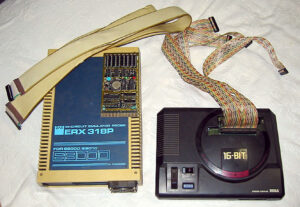
The Mega Drive offered several advantages: it had been on the market since 1988, its Motorola 68000 CPU was well-documented, and Sega was aggressively seeking third-party developers to bolster its RPG library against Nintendo’s dominance. However, the partnership was not without its hurdles. Climax found Sega’s internal development tools insufficient for the high-fidelity graphics they intended to produce. In an act of technical self-sufficiency, Climax spent the initial months of development building their own proprietary graphics tools and workstations, utilizing high-performance Hewlett-Packard hardware to accelerate the production cycle.

Architectural Innovation: The Panorama 3D System
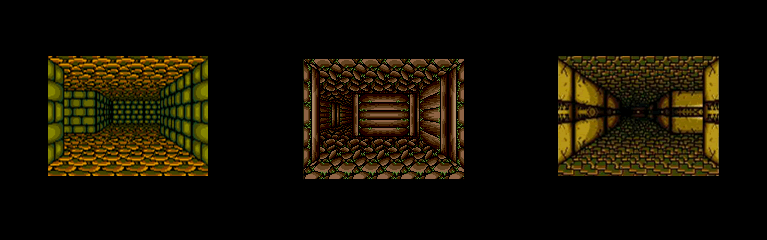
At the heart of Shining in the Darkness was the "Panorama 3D" system, a design philosophy aimed at creating a seamless, first-person immersive experience. Unlike the static, grid-based movement common in earlier dungeon crawlers like Wizardry, Climax sought to achieve fluid motion that would convey a sense of physical space. This was a significant challenge on the Mega Drive, which lacked the hardware-level scaling and rotation capabilities (such as the SNES’s Mode 7).
To circumvent these limitations, special effects programmer Yasuhiro Taguchi utilized sophisticated tile-based tricks and palette manipulation. By meticulously redrawing wall segments and utilizing per-scanline scroll adjustments, the team created a convincing approximation of 3D movement. The decision to use an 8-megabit cartridge—a large and expensive format for 1991—was necessary to store the vast amount of graphical data required for these smooth transitions and the detailed, animated enemy sprites.

Aesthetic Philosophy: The Disney Influence
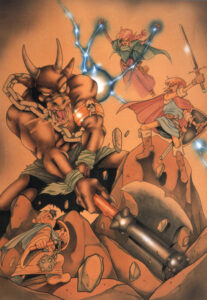
Visually, Shining in the Darkness departed from the traditional manga-inspired art style prevalent in Japanese RPGs. Takahashi and Naitō were deeply influenced by early Western animation, specifically the classic features of Walt Disney such as Sleeping Beauty and Alice in Wonderland. They sought a "caricature" look that would appeal to international audiences while maintaining a high level of artistic quality.
Yoshitaka Tamaki, an 18-year-old freelance artist who had won a design contest judged by Takahashi, was tasked with bringing this vision to life. Tamaki’s character designs for the protagonist Max, the priest Milo, and the mage Pyra emphasized personality and perspective. By placing characters and menus at varying angles, Climax created a cinematic depth within the confines of a 2D screen. This aesthetic choice would become a hallmark of the series, distinguishing it from the more somber or anime-centric visuals of its contemporaries.
Redefining User Interaction: The Icon-Based Menu
One of the most enduring contributions of Shining in the Darkness to the RPG genre was its streamlined command system. Recognizing that wordy, text-heavy menus could alienate players and slow down the pace of gameplay, Climax developed an intuitive, icon-based interface. Each icon corresponded to a direction on the control pad, allowing for rapid navigation and reducing the "cognitive load" on the player.
While some historians have noted similarities to the menu system in Phantasy Star III, the Climax implementation was significantly more refined and visually communicative. This system was designed with the philosophy that a manual should be unnecessary; the visual cues provided by the icons—such as a wizard for magic or a building for entering a town—were intended to be universally understood. This commitment to user-friendly design became a standard for future Climax and Camelot Software Planning titles.

The Philosophy of Navigation: The Absence of Auto-Mapping
A point of historical contention among fans is the game’s lack of an auto-mapping feature. During the early 1990s, many dungeon crawlers began incorporating internal maps to assist players in navigating complex, multi-level environments. Climax, however, deliberately omitted this feature to preserve a sense of realism and challenge.
Naitō argued that relying on a map "spoon-fed" the player and discouraged them from truly learning the environment. He designed the labyrinth with distinct landmarks—such as specific torch placements, puddles, and architectural flourishes—to encourage players to navigate by memory and observation. While a "View" spell and "Wisdom Seeds" were included to provide temporary positional data, the core experience was built around the satisfaction of mastering a hostile environment through trial and error.

Market Performance and Official Reception
Shining in the Darkness debuted in Japan on March 29, 1991, to immediate commercial success. It sold approximately 300,000 units, representing a 16 percent "attach rate" among the Mega Drive’s Japanese install base at the time. This performance was particularly impressive given the niche status of the Mega Drive in the Japanese market compared to the Super Famicom.
In North America, the game faced a different set of challenges. Sega of America’s marketing budget was largely allocated to the launch of Sonic the Hedgehog, which debuted just months later. Despite receiving only a single print advertisement in major gaming magazines, the game became a cult hit. Al Nilsen, former head of marketing at Sega of America, noted that the title achieved a loyal, dedicated audience through word-of-mouth and positive critical reviews, proving that high-quality RPGs could succeed in the West even without extensive television promotion.
Broader Impact and the Evolution of the Franchise
The success of Shining in the Darkness laid the groundwork for a massive expansion of the brand. However, the relationship between Climax and Sega began to strain as Sega’s corporate structure evolved. Takahashi noted that as management shifted toward a more profit-driven, "platform-agnostic" model, second-party developers like Climax felt marginalized. This eventually led to the team branching off to form Sonic! Software Planning (later Camelot Software Planning), where they developed the critically acclaimed Shining Force series.
The chronological legacy of the game is also a subject of intense study among the gaming community. While it was the first game released, it occupies a later position in the series’ internal timeline, following the events of the Shining Force titles. This complex lore, combined with the technical innovations of the 1991 original, has ensured that Shining in the Darkness remains a cornerstone of the 16-bit era.

Technical Legacy and Conclusion
Shining in the Darkness was more than just a dungeon crawler; it was a technical showcase that proved the Mega Drive was a formidable platform for the RPG genre. By prioritizing fluid movement, intuitive UI, and a unique cross-cultural aesthetic, Climax Entertainment set a new benchmark for what a console RPG could achieve. The game’s legacy persists today in the countless titles that utilize its icon-based menu systems and in the continued reverence for the "Golden Age" of Sega RPGs. As a landmark of software engineering and creative risk-taking, it remains a testament to the power of independent vision in a rapidly industrializing medium.








