Hartono Sudibyo
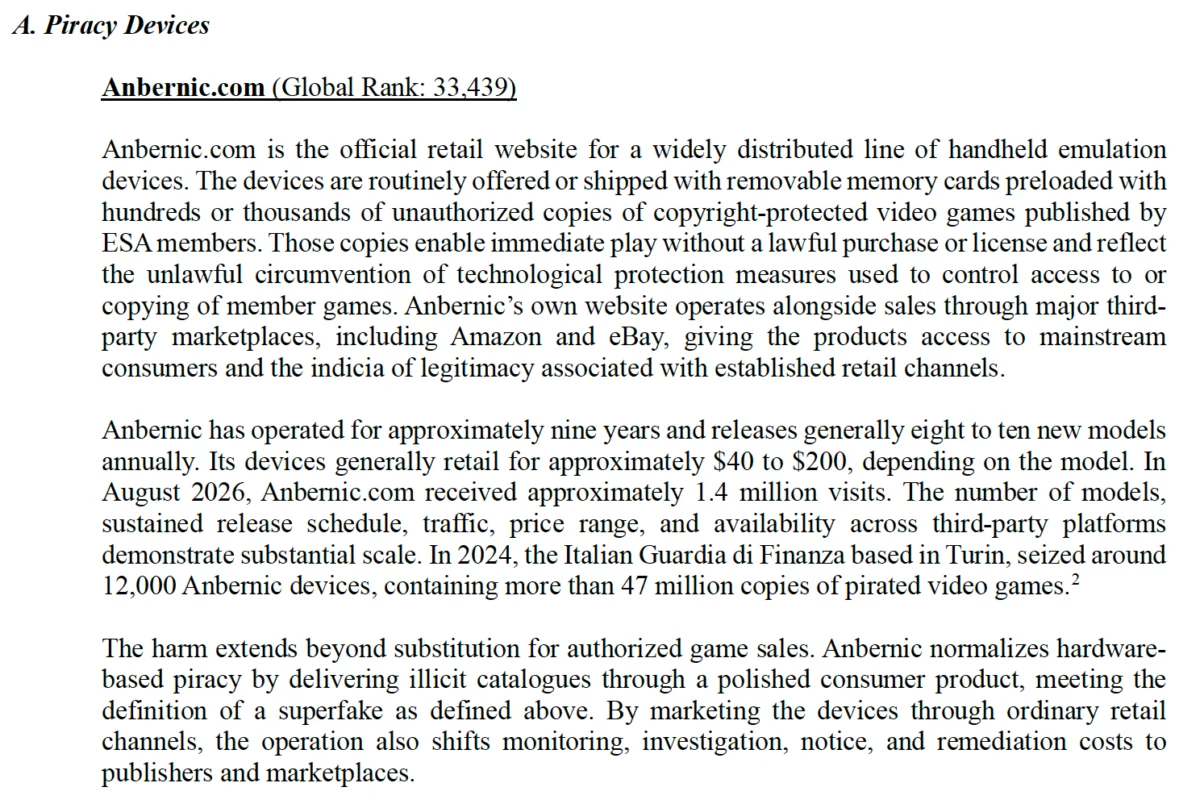
The United States video game industry is intensifying its scrutiny of the burgeoning global market for vintage-inspired portable gaming devices, commonly known as retro handhelds. The Entertainment Software Association (ESA), a prominent trade organization representing major American video game publishers and hardware developers, has formally urged the Office of the United States Trade Representative (USTR) to address what it characterizes as widespread copyright piracy and trademark infringement originating from overseas manufacturers.
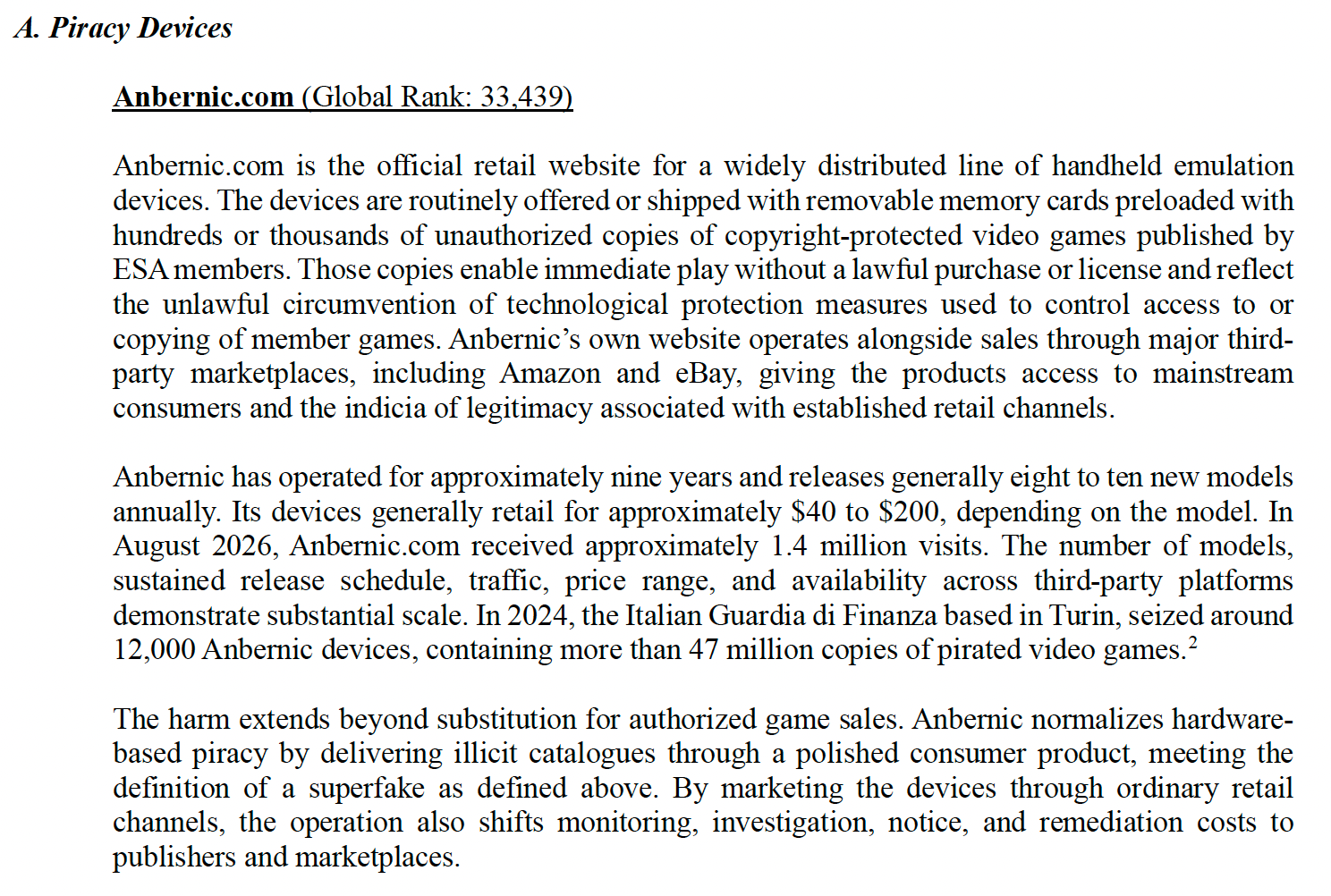
At the center of this regulatory push is ANBERNIC, one of the most prolific and recognizable brands in the Chinese retro handheld sector. In a submission concerning the USTR’s annual Notorious Markets list, the ESA has identified specific imported hardware lines as vehicles for commercial-scale intellectual property theft. This development marks a significant escalation in tensions between mainstream intellectual property holders and the grey-market hardware ecosystem that has flourished over the past decade.
Background and Context of the USTR Notorious Markets List
The Notorious Markets List is an influential, periodic review conducted by the USTR. Its primary purpose is to highlight online and physical marketplaces—as well as specific product categories and distributors—that allegedly engage in or facilitate substantial copyright piracy and trademark counterfeiting. While inclusion on the list does not carry immediate automatic tariffs or criminal penalties, it serves as a powerful diplomatic and economic signal. It encourages foreign governments to crack down on offending entities and prompts domestic agencies, such as U.S. Customs and Border Protection, to increase scrutiny at ports of entry.
For years, the retro handheld market has operated in a legal grey area. Companies based primarily in China design and manufacture ergonomic, modern interpretations of classic consoles produced by industry giants like Nintendo, Sega, and Sony. While the hardware itself frequently runs open-source emulation software, the inclusion of pre-loaded micro-SD cards containing thousands of commercial ROMs—often protected by active international copyright law—has long been a contentious issue.

The ESA’s recent filing specifically targets these pre-loaded configurations, which the organization argues undermine legitimate digital distribution channels and inflict severe financial harm on the creators of the original software. By formally placing companies like ANBERNIC under the microscope, the trade association is signaling a shift from passive observation to active regulatory intervention.
Chronology of Escalating Regulatory Actions
The current confrontation between copyright holders and Chinese emulation hardware manufacturers did not materialize overnight. It represents the culmination of years of expanding production scales and increasingly aggressive marketing by overseas third-party sellers.
Historically, retro handheld devices were niche electronics manufactured by obscure factories and sold through specialized platforms. However, over the past five to six years, brands like ANBERNIC, Retroid, and Powkiddy transformed these niche gadgets into mainstream consumer electronics. They established official storefronts on global platforms, secured reliable supply chains, and built dedicated online communities numbering in the hundreds of thousands of enthusiasts.
As production volumes surged into the hundreds of thousands of units annually, the visibility of these products increased proportionately. While many primary manufacturers gradually phased out the practice of bundling pre-loaded game libraries directly with their flagship hardware—leaving it to individual third-party vendors on platforms like AliExpress to supply ROM-filled media—the perception of complicity remained.
The turning point occurred when industry watchdogs, such as RetroHandhelds.gg, brought public attention to the ESA’s detailed public comments submitted to the federal regulatory docket. The filing explicitly categorized certain imported devices as piracy enablers, providing the USTR with specific corporate entities to investigate.
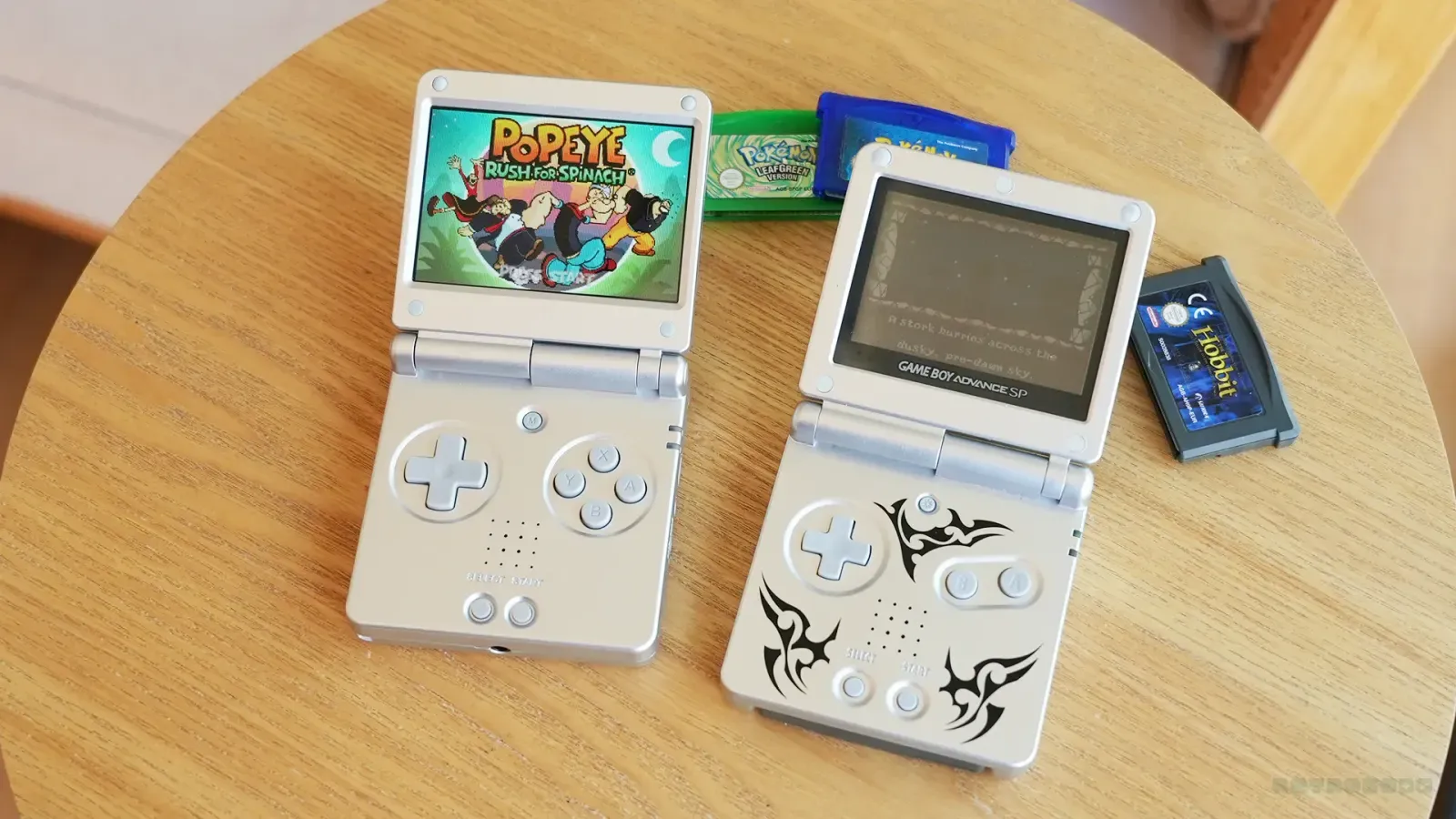
International authorities have previously demonstrated a willingness to intervene independently of U.S. pressure. In prior enforcement actions overseas, such as in Italy, customs authorities seized thousands of units of imported retro hardware over compliance and intellectual property violations. The ESA’s recent maneuver represents an attempt to institutionalize similar enforcement frameworks within the United States market.
Supporting Data and Industry Dynamics
The economic scale of the retro handheld industry makes it a substantial target for federal trade oversight. While exact global sales figures for Chinese emulation hardware are privately held, import manifests and shipping data indicate that hundreds of thousands of units enter the United States annually.
The ecosystem relies on a bifurcated supply chain. Mainstream manufacturers typically market the hardware chassis as blank development platforms capable of running user-supplied software. Yet, the secondary market—comprising thousands of independent vendors—frequently bundles these units with expansive libraries of copyrighted software as a primary selling point.
Industry analysts note that while major manufacturers have largely ceased shipping units with commercial game libraries directly from their primary warehouses, the widespread availability of pre-configured memory cards from associated distributors creates ongoing liability. The ESA’s submission contends that the ease with which consumers can acquire hardware pre-loaded with thousands of commercial titles constitutes a systemic market failure that requires targeted customs enforcement and potential import bans.
Official Responses and Industry Implications
Neither ANBERNIC nor other major hardware manufacturers named in the federal regulatory filings have issued formal legal responses to the ESA’s petition. Representatives for the trade association, however, maintain that robust intellectual property enforcement is vital to maintaining the integrity of the interactive entertainment sector.
The implications of this regulatory pressure extend beyond simple copyright compliance. Legal experts suggest that if the USTR elects to adopt the ESA’s recommendations, the impact on the secondary electronics market could be profound. Inclusion on the Notorious Markets list could prompt U.S. Customs and Border Protection to implement systematic detentions and seizures of incoming shipments from targeted manufacturers, effectively choking off access to the lucrative American consumer base.
Furthermore, intellectual property disputes in this sector are not restricted to software copyrights. Hardware design patents represent another potential vulnerability for manufacturers whose product designs closely mirror legacy hardware. Recent product announcements from major retro handheld brands—such as dual-screen clamshell devices bearing striking structural similarities to historical Nintendo architectures—highlight the potential for secondary patent infringement claims alongside existing copyright challenges.
Broader Economic and Legal Analysis
The friction between open-source emulation hardware developers and legacy intellectual property holders illuminates a broader philosophical and economic debate within the modern video game industry. On one side, advocates for preservation argue that retro handhelds serve an invaluable role in maintaining access to classic digital culture that would otherwise become obsolete or unavailable due to the commercial discontinuation of legacy hardware.
On the other side, publishers and trade representatives emphasize that the distribution of commercial software via unregulated, pre-loaded hardware undermines legal digital storefronts, retro-collection re-releases, and subscription services managed by the original copyright owners. The commercial-scale distribution of copyrighted ROMs, regardless of the hardware medium, remains a clear violation of international copyright treaties and domestic law.
Should the U.S. government pursue formal enforcement actions based on the ESA’s recommendations, the business model of the entire retro handheld industry could face a mandatory structural evolution. Manufacturers may be forced to institute rigorous, verifiable compliance programs to ensure that their distribution channels are entirely decoupled from unauthorized software. For consumers, this could mean the definitive end of the plug-and-play era of imported emulation devices, signaling a transition toward strictly hardware-only distribution models.